Atlantic writer David Brooks, the pundit placing himself on the "rightward edge of the leftward tendency," is half of the PBS News Hour’s traditional Friday evening political discussion. He offered rare criticism of his media colleagues on the September 25 program: “We have got to reestablish some distance from the Democratic Party….They're not people we root for. They're not people we're spin doctors for.”
But with just a month to go before the 2026 midterms, the News Hour in September established they are spin doctors for the Democrats. Their coverage has a clear pattern of aiding the Democratic Party in its quest to win seats and control of the House and Senate on Election Day, mostly by hammering Republicans with negative spin.
Surprisingly little time was spent on individual candidates or issues apart from electoral process controversies, such as President Trump’s call for reform of mail-in voting. Trump himself was the main midterm issue, and every Republican up for election was tied to the president’s perceived failures and unpopularity. A study of the News Hour from September 1 to September 30 underlines the pattern.
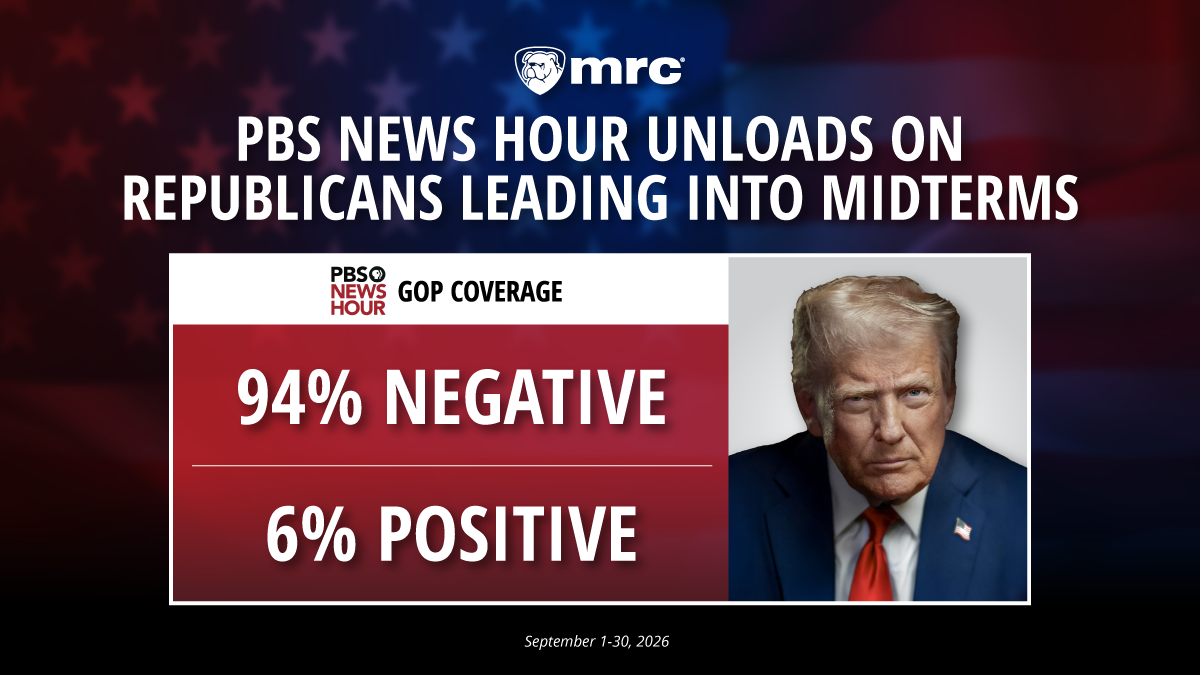
KEY FINDINGS:
■ Ruin for Republicans, Hope for Democrats: From September 1 to September 30, the GOP received 94% negative spin vs. 6% positive spin. The Democrats received far more balanced coverage, 53% negative, 47% positive. The Republicans drew 102 negative evaluations compared to just six positive statements. The Democrats received only 15 percent of the comments -- 10 were negative, nine were positive. With far fewer evaluations, the Democrats still drew more positive statements, nine to six. This doesn't include purely "horse race" or objective polling analysis of Trump or Republican candidates, which was almost completely negative.
■ Cross-Partisan Pattern: PBS reveled in news of Republicans crossing Trump, either through disagreement or through endorsing Democrats. They touted when "lifelong Republican" politicians endorsed Democrats, or when they made ads criticizing Trump policies as going too far.
■ Criticism of Trump on mail-in balloting dominated political coverage, with nearly half an hour of negative coverage. PBS was overtly hostile to the Trump administration's efforts to prevent illegal aliens from voting by mail.
■ Bias by Omission: PBS ignored increasing Democratic ideological radicalism, such as the rise of the Democratic Socialists of America. "Public" broadcasting has proven itself incapable of finding anyone or anything extreme on the Left.
Crossing Party Lines in Only One Direction
The PBS News Hour displayed a one-way cross-party pattern of coverage, with ample space granted to Republicans turning against Trump or endorsing Democrats.
On September 18, co-anchor Geoff Bennett broadcast a campaign ad by Florida Republican Rep. Maria Salazar: “She shot this ad that`s up on the airwaves now in Florida just weeks ahead of the midterms, breaking with the Trump administration over his immigration agenda.” Bennett ran a clip of the ad showing Salazar saying, in part, “Mr. President, some of your immigration enforcement efforts have gone too far.”
On September 21, co-anchor Amna Nawaz named other GOP turncoats. After mentioning the Salazar ad, she recited: “South Dakota’s Republican secretary of state, Monae Johnson, previously refused to acknowledge that former President Joe Biden won in 2020, this weekend endorsed the Democratic candidate, Terrence Davis, to replace her. And all of this, of course, follows Karl Rove we reported on last week, the former adviser to George W. Bush, saying he will vote for a Democrat in a state race in Texas.”
A friendly interview by Bennett with former Republican Kansas Gov. Bill Graves appeared September 23. Graves is a retired GOP politician who now endorses Democrats, a detail PBS didn’t mention when Graves endorsed the Democrat running against the sitting Republican senator in Kansas. Bennett also recited a list of anti-Trump elected officials during the interview.
The only occasion in which that polarity was reversed came in a September 10 clip from Democratic Sen. John Fetterman of Pennsylvania’s surprise appearance by video at the Republican Party’s midterm convention in Dallas. Fetterman said, in part, “We will work with President Trump to fight and defend the steel way of life right here in the Steel Valley.” White House correspondent Liz Landers also pointed out that same night that “the upper decks definitely had empty seats” when Trump spoke.
Mail-in Ballots
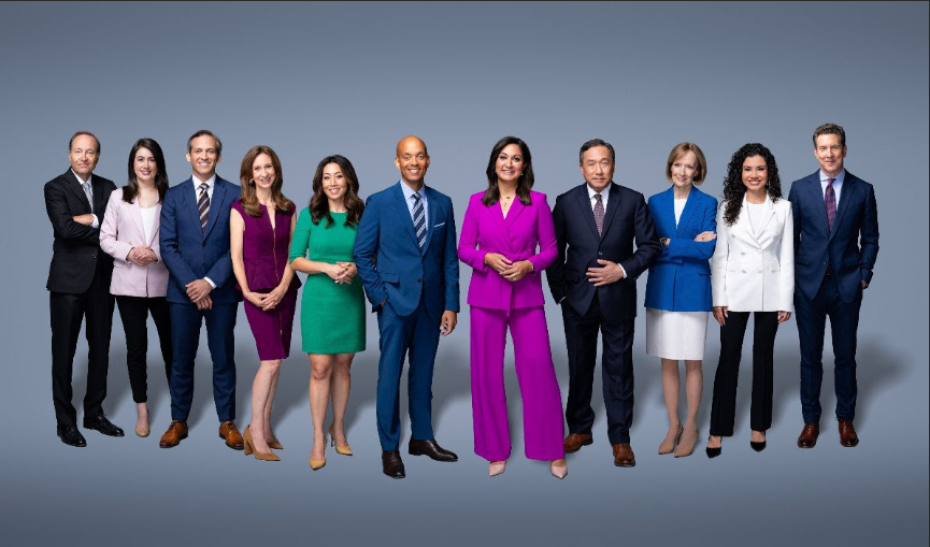
By far the most-covered midterm-related issue on the News Hour was the controversy over Trump’s executive order to overhaul the use of mail-in ballots in the name of stopping potential voter fraud. The News Hour devoted a wholly negative 29 minutes and 37 seconds of intense coverage in total, complete with interviewing a lawyer representing an anonymous whistleblower, and two full stories on consecutive nights.
Trump’s war on illegal immigration (as it related to the midterms) clocked in next at 8 minutes, 47 seconds of coverage, followed by pushback to the building of data centers to facilitate Artificial Intelligence (A.I.) at 5 minutes, 14 seconds. 100% of the evaluative comments on those three issues were negative against Republicans.
The News Hour was aggressively negative on Trump pushing measures to ensure only eligible citizens could vote by mail. The story led the September 1 show, with a warning from co-anchor Bennett: “On the News Hour tonight: A whistle-blower alleges the U.S. Postal Service is rushing to roll out an untested mail ballot system that could jeopardize votes in the midterm elections.”
In a connected interview with Jacob Bogage, White House correspondent for Reuters, Bogage warned darkly: “This new system would inject the federal government into the voting process of every city, town, village, and hamlet in the United States. And there are constitutional protections, frankly, against that.”
The next night, Bennett followed up: “We speak with the attorney for a whistle-blower who alleges the U.S. Postal Service is rushing a mail ballot system that could affect millions of midterm votes.”
This line from attorney David Kligerman surely delighted PBS: “It’s not every day that someone comes forward to blow the whistle on a major government scandal.”
On September 23 PBS cited its own poll, conducted with NPR and Marist University, to fortify its doomsaying over Republican prospects and to further argue the GOP was wrong to be concerned with mail-in balloting. Congressional reporter Lisa Desjardins: “It is Republicans who see the fraud. We have not seen any evidence. In fact, to the contrary, our election systems have proven that there is very little fraud, from what we know.”
For Democrats, Bias by Omission
While the Democratic Party’s own News Hour coverage was almost 50-50 positive and negative, Democratic candidates benefited from bias by omission, as the party received far less scrutiny than did Trump and the GOP. The lack of attention particularly benefited the Fidel Castro-honoring, Hamas-supporting Democratic Socialists of America (DSA), who have several candidates running for office, as well as other radical Democrats like Michigan Senate candidate Abdul El-Sayed, who received virtually no scrutiny of his anti-Semitic controversies and associations.
In a September 22 discussion with Democratic strategist Joel Payne, Desjardins noted, somewhat vaguely, that El-Sayed had spoken at DSA events and “has said some things that most Americans don’t agree with [such as] an openness to some form of defunding the police.” But she shied away from addressing El-Sayed’s ties to leftist streamer Hasan Piker and antisemitism. After running a clip from a GOP campaign ad describing Piker as “a terrorist sympathizer who said America deserved 9/11,” Desjardins sounded apologetic for even bringing it up.
Lisa Desjardins: OK, that’s particularly a reference to the controversial leftist streamer Hasan Piker, who did campaign in the primaries with El-Sayed, but El-Sayed has distanced himself. He’s gone so far to really stress he disavows antisemitism in all forms.
Co-anchor Nawaz even spoke positively about the DSA on September 7 in an interview with California’s Democratic Gov. Gavin Newsom:
Amna Nawaz: You saw how many wins DSA candidates, Democratic Socialist candidates, were able to win, Donavan McKinney in Michigan, Chris Rabb in Pennsylvania, Abdul El-Sayed in Michigan. He doesn`t identify as DSA, but was sort of aligned with them. If you have these candidates and this platform that is clearly animating the base, energizing turnout, should more of those ideas be worked into the broader Democratic platform?
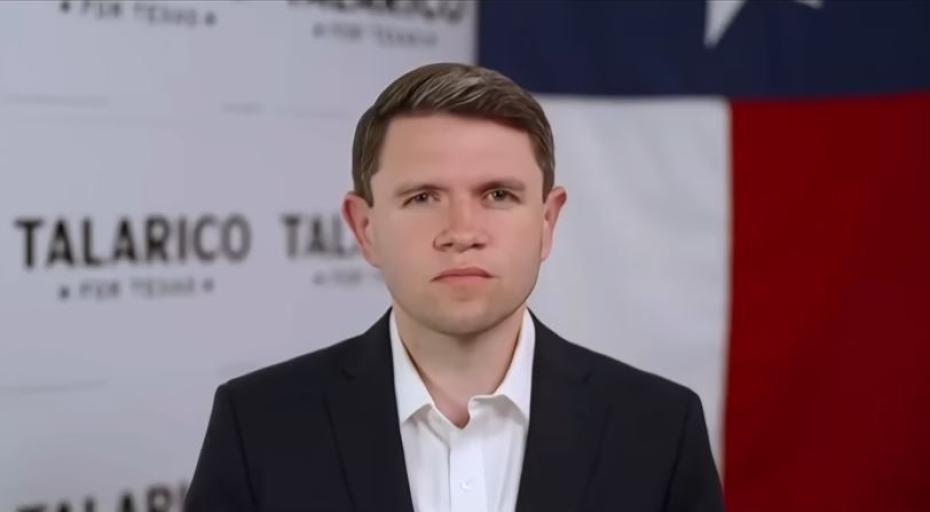
On September 18, the subject was Democrat James Talarico, who has a history of inflammatory statements about religion and transgender issues. Bennett led into Landers’ trip to Texas to report on high hopes for Talarico: “But, this year, Republican divisions, political scandals, rising prices, and local fights over big tech are giving Democrats new hope of an upset in the U.S. Senate race there.” Landers compared Talarico, “running as a moderate, guided by his Christian faith,” to his Republican opponent, Texas Attorney General Ken Paxton, described by one voter she interviewed as “kind of dirty right now.”
Even the rare negative comments on Democrats sometimes had caveats, with Landers portraying Talarico as having been unfairly attacked: “But his critics have forced him to walk back past controversial comments on social issues,” including Talarico’s claim that “God is nonbinary.” The News Hour never noted Talarico’s anti-scientific take on biology, like his 2021 claim that “there are six really common biological sexes,” and never caught up with a resurfaced clip from Talarico calling capitalism an “oppressive” system that should be “dismantled.”
Rare Exceptions to the Rule
Among the few positive mentions of Republicans was a back-handed compliment from Brooks, who on September 11 said he was surprised to enjoy Secretary of Health and Human Services Robert F. Kennedy Jr.’s speech at the two-day Republican midterm convention: “He really tried to describe why so many working-class voters who voted for his uncle and his dad in the ‘60s, then became Reagan Democrats under -- in the `80s, and then became Trump Republicans in 2016….it was a very persuasive and to my Republican friends a very compelling story.”
In fact, four of the six positive GOP comments originated from the midterm convention, including generic statements from voters voicing support for Republican politicians JD Vance and Marco Rubio.
METHODOLOGY:
MRC staffers tallied all clearly positive and negative statements from non-partisan sources made on the PBS News Hour in the month of September 2026, including: statements by co-anchors Geoff Bennett and Amna Nawaz; the “Politics Monday” duo Amy Walter of the Cook Political Report and Tamara Keith of National Public Radio; the Friday political team of David Brooks (National Review’s Ramesh Ponnuru filling in once) and MS NOW host Jonathan Capehart; all PBS reporters and eligible guests/talking heads. This excludes coverage that merely reflects the partisan back-and-forth of the campaign, in order to isolate the spin being imparted by the networks themselves (unless there are cross-party breaks, in which a Republican offers a positive statement about a Democrat, or vice versa; those are counted). It also excludes “horse race assessments” about a candidate or party’s prospects for winning or losing that are not intertwined with another issue.