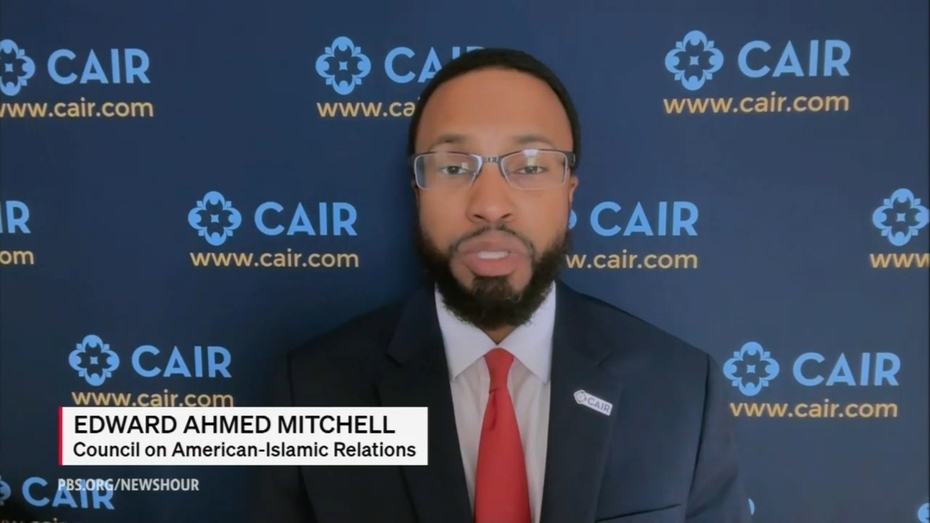
CAIR, perpetually coddled on (previously public) media like PBS and NPR, has been labeled a terrorist group by the state of Texas as well as United Arab Emirates (UAE). Democratic Senate Minority Leader Charles Schumer has also linked CAIR to terrorism, noting that the group's co-founders had "intimate links to Hamas.” The FBI cut off "high-level cooperation with the group" way back in 2008.
Most disgusting, CAIR's executive director, Nihad Awad, declared himself happy about the October 7 massacre while speaking to the group American Muslims for Palestine (notably, Awad is still CAIR's executive director). None of that sordid history bothered PBS. They set up CAIR to denounce America.
PBS @NewsHour anchor Geoff Bennett set up a CAIR leader to denounce America as a terribly "Islamophobic" place in the aftermath of the San Diego mosque shooting. Edward Ahmad Mitchell made the shooting deaths about rhetoric from Trump and the Republicans, just the way PBS likes… pic.twitter.com/EIzRmIqr8N
— Tim Graham (@TimJGraham) May 21, 2026
Anchor Geoff Bennett: Attacks on houses of worship remain relatively rare in the U.S., but incidents targeting religious communities have risen in recent years. Last year, six people were killed in shootings at churches in Michigan and Minneapolis. Temple Israel Synagogue in Detroit, which was targeted in an attack two months ago, said in a statement: "The images coming from San Diego are all too familiar to us." The synagogue also called for $1 per month to protect houses of worship….
We turn now to Edward Ahmed Mitchell, deputy director of the Council on American-Islamic Relations….How has this shooting in the broader rise in anti-Muslim incidents across the country affected Muslim communities psychologically and emotionally?
Edward Ahmed Mitchell: Anti-Muslim bigotry in the United States is completely out of control. We have elected officials, members of Congress, governors who have in recent months said that American Muslims should be destroyed, that Islam has no place in America, that we should ban the practice of Islam, that mosques are military outposts….It's time for Islamophobia to no longer be the last publicly acceptable form of bigotry in our country. And that starts from the top down.
Another fact skipped was the controversy over the San Diego mosque’s own Imam, Taha Hassane, who said in a video days after the October 7 massacre: “This did not start last week or on October 7. This is the result of brutal Zionist occupation and genocide…Resistance is justified when people are under occupation and don’t let them change that narrative.” But Bennett set up CAIR to be an anti-hate group:
Bennett: The Associated Press reports that the manifesto that was left behind had hateful rhetoric toward Jewish people, Muslims, Islam, the LGBTQ community, Black people, women, the political left and right. At this point, what's the path forward here? What's it going to take to really lower the temperature?
Geoff Bennett to guest from Israel-loathing Muslim pressure group CAIR: "...the manifesto that was left behind had hateful rhetoric toward Jewish people, Muslims, Islam, the LGBTQ community, black people, women....What's it going to take to really lower the temperature?" pic.twitter.com/HOCUnuWyDj
— Clay Waters (@claywaters44) May 20, 2026
Mitchell is precisely the wrong person to ask about lowering rhetorical temperature, given CAIR’s shameful history, including its executive director (who is still there) celebrating October 7.
Compare this Islam-sympathetic angle to News Hour’s response to the Annunciation Catholic Church shooting in Minneapolis by a transgender (biological male) in August 2025. Nothing about anti-Catholic/anti-Christian hatred. Instead, PBS invited Minneapolis Democratic mayor James Frey to emotionally push gun control.
Bennett: Minnesota has a red flag law that allows firearms to be temporarily removed from people who are deemed to be a danger to themselves or to others. We don`t know enough about what transpired to know whether that would have prevented this tragedy. But how does it work? And what more needs to be done at the state and federal level to prevent another tragedy like this from happening again?
Minneapolis Mayor Jacob Frey: ….let`s just be very real here. We have too many guns in America. When you have more guns than you have people, you have got a problem. When people are able to get guns that are in some form of severe mental health crisis, you got a problem….
A transcript is available, click “Expand.”
PBS News Hour
5/19/26
7:06:57 p.m.
Anchor Geoff Bennett: This shooting at San Diego's Islamic Center has understandably sent shockwaves to the Muslim community here in the U.S. For more, we turn now to Edward Ahmed Mitchell, deputy director of the Council on American-Islamic Relations. Thank you for being with us.
Edward Ahmed Mitchell: Thank you for having me.
Geoff Bennett: How has this shooting in the broader rise in anti-Muslim incidents across the country affected Muslim communities psychologically and emotional?
Edward Ahmed Mitchell: Anti-Muslim bigotry in the United States is completely out of control. We have elected officials, members of Congress, governors who have in recent months said that American Muslims should be destroyed, that Islam has no place in America, that we should ban the practice of Islam, that mosques are military outposts.
Just last week, at a congressional hearing, that language was used. And so, when you see that sort of anti-Muslim hate, it's no surprise that someone took it very seriously and engaged in a horrific act of violence.
So American Muslims, sadly, are accustomed to this. This mosque had security there for a reason, because we know about the potential threat. Now we feel, after this incident, it's time for this to end. It's time for Islamophobia to no longer be the last publicly acceptable form of bigotry in our country. And that starts from the top down.
Geoff Bennett: To your point about the level of security, we heard from the imam of the Islamic Center. He said the center had done everything possible to prevent that kind of attack. They applied for DHS grants. They employed armed security. They conducted drills. They had cameras inside and out.
What challenges do mosques, houses of worship face when it comes to protecting themselves in this day and age?
Edward Ahmed Mitchell: Yes. Well, look, a house of worship is not a military fortress. It's a place where people come to worship, whether you're going to synagogue, a church, or a mosque. And so it's very difficult to impose significant security restrictions without interfering with its ability to be welcoming to people of different faiths and, of course, the people there to worship.
Having said that, it's absolutely a must, especially for mosques and other targeted houses of worship, to have security cameras, to have an armed guard, especially for major events, and especially if there's a school there. And we saw the benefit of this.
Amin Abdullah, the security guard there, saved countless lives by combating these attackers, by engaging in a firefight with them, and scaring them away, and losing his life in the process. And so I can only imagine what would have happened if he hadn't been there at all.
But it just goes to show you that even a security guard cannot stop the violence. That's why we have to stop the root of it, which is anti-Muslim hate, rampant anti-Muslim hate, tolerated by our government, spread by our government and certain media personalities. Addressing that is the best way to stop this ongoing threat to mosques.
Geoff Bennett: You mentioned the security guard. When tragedies like this happen, we all too often focus on the gunmen, the motives. There's usually less attention on the victims.
What more should we know about Amin Abdullah, this father of eight?
Edward Ahmed Mitchell: Yes. Well, there were three members of the San Diego Muslim community murdered in this incident. Amin Abdullah, obviously, as the security guard, has been widely recognized for saving lives, but also the other two gentlemen there.
One of them actually, we're told, ran into the building after Amin was killed and went into the building trying to help, and he himself was killed as well. Another brother there was just killed as a bystander. And so all three of these men were beloved, respected members of that community.
The Islamic Center of San Diego is one of the most prominent mosques in California and across the country. And so this attack is horrific, and that's why the community is standing strongly with the families of the victims and doing everything they can to make sure that they are supported in this horrible time, and also to make sure that this doesn't happen to anyone else again in the future, God willing.
Geoff Bennett: In the roughly 30 seconds we have left, the Associated Press reports that the manifesto that was left behind had hateful rhetoric toward Jewish people, Muslims, Islam, the LGBTQ community, Black people, women, the political left and right.
At this point, what's the path forward here? What's it going to take to really lower the temperature
Edward Ahmed Mitchell: Yes, look, this starts from the top down. As I said, if the president of the United States is engaging in open bigotry against various communities and members of Congress and governors in Texas and Florida, other states are doing that, it's no surprise you're going to see hateful rhetoric turning to hate crimes.
So we have to start with our political leaders. They have got to stop fomenting hate against various Americans. This is all our country. Everyone has the right to be here and live in peace and worship in peace. And so we need our political leaders to stop spreading hate, because it is endangering lives.
Geoff Bennett: Edward Ahmed Mitchell, thank you for your time this evening. We appreciate it.
Edward Ahmed Mitchell: Thank you.