PBS News Hour guest and anti-Trump activist Miles Taylor of “Anonymous” media fame whined about President Trump’s top adviser calling the Democratic Party a domestic extremist organization in an August 27, 2025 segment: “That’s really, really scary language.”
So it’s fascinating how often PBS itself uses similar “really scary” hostile labeling habits against conservatives but almost never against liberals, as a new Media Research Center study reveals.
MRC analysts counted up the “left-wing” and “right-wing” style ideological labels used by anchors, reporters, and contributors on the PBS News Hour regarding American politics from December 1, 2024 through November 30, 2025. PBS News Weekend programs were not included.
KEY FINDINGS:
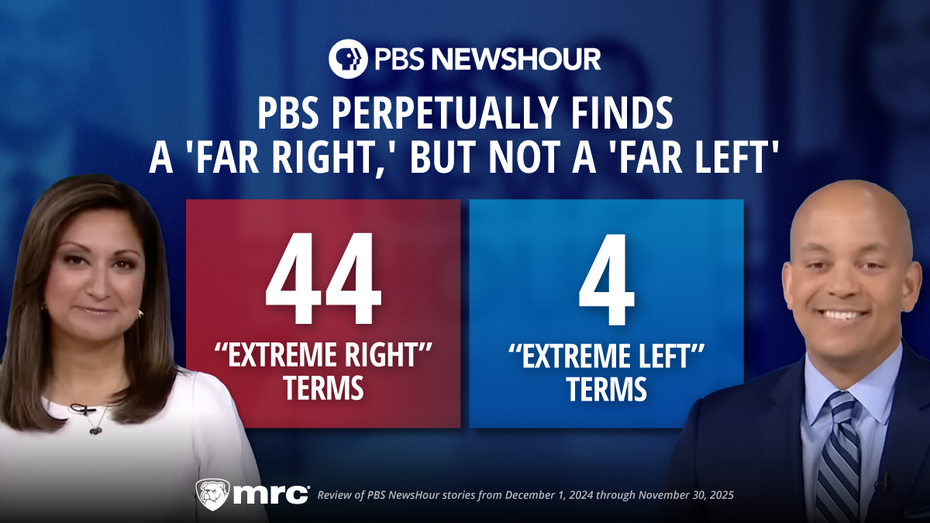
■ PBS staff used 44 variations of "far-right" labels and only 4 of "far-left" labels, a ratio of 11:1.
■ PBS staff also used mere "right-wing" and "left-wing" labels at a disparity of 17-12. So overall, the labeling disparity was 61-16.
■ The figures remained uneven after President Trump signed the bill rescinding federal funding from PBS and NPR on July 24, with 11 variations of “far-right” labels and 2 of “far-left” ones. Overall, the post-July 24 labeling disparity was 17-9. (Note: Coverage of the assassination of conservative activist Charlie Kirk began September 10, 2025, which may have skewed the post-July 24 raw figures somewhat toward balance.)
Even those stark figures understate the full extent of PBS’s slant. Many of the “left” labels came with important context: Some were used by PBS staff while claiming denial that the label applied. Generic “left” labels were sometimes mentioned in tandem with a similar “right” label (i.e. “whether you’re far left or far right…”). Many examples occurred of attribution -- promoting someone outside PBS calling a person or group left-wing, not PBS itself.
By contrast, “right” labels were almost exclusively hostile descriptions emanating straight from the mouths of reporters and other PBS personalities. While some of the targets earned their extreme epithets, like “far right” for neo-Nazi influencer Nick Fuentes, others tagged included members of Congress, Elon Musk, and critics of the left-wing pieties of the new Pope.
This year’s labeling disparity matched the pattern documented in our campaign-year study last December, confirming the PBS News Hour’s place as the most slanted of all the networks in terms of labeling. Not even the July 2025 loss of federal funding stopped it.
Some examples:
“Far-right” labels vs. “far-left” labels: 18-3
Nawaz on July 9, 2025 said: “Now some of President Trump’s far-right allies are frustrated that the administration appears to be ready to move on from the Epstein investigation.”
Nawaz on August 13, 2025 described Laura Loomer as “the controversial far-right activist who has the president’s ear,” one of many epithets directed toward the controversial figure.
Veteran reporter Judy Woodruff on October 22, 2025 benignly labeled the radical-left podcaster Mahdi Hasan “liberal,” preserving the harsh descriptions for his opponents. Woodruff: “And in July, Jubilee released an episode of "Surrounded" with liberal commentator Mehdi Hasan. Clips quickly ping-ponged around the Internet showing Hasan confronting 20 far-right conservatives.”
One of the very few “far-left” labels came on August 19, 2025 from special correspondent Simon Ostrovsky, and even that was an attribution: “While most Republicans and most Christians still support Ukraine, there's a subculture on the right and on the far left who are increasingly hostile, according to Mark Tooley, president of the Institute on Religion And democracy.”
“Hard right” vs “hard left” labels: 4-0
Reporter Lisa Desjardins said during the jockeying for the House Speaker position on January 3, 2025: “To become Speaker of the House, [Rep. Mike] Johnson needed 218 votes, and, initially, he received only 216. Three Republicans voted against him, voted for someone else. And those members were members of the hard right. All three of them, Thomas Massie of Kentucky, Ralph Norman of South Carolina, Keith Self of Oklahoma, prominent fiscal hawks, they care about the debt and deficit….”
There were no examples of “hard-left” labels within the confines of the study.
“Extreme” right vs. “extreme” left labels: 8-1
On June 9, 2025, former News Hour White House correspondent Laura Barron-Lopez, now at the left-wing network MS NOW, claimed that “President Trump has a long history of amplifying messages and figures embraced by white supremacists and other domestic extremists….”
On December 13, 2024, David Brooks provided the sole use of “extreme” to describe the left, and it took the murder of UnitedHealthcare CEO Brian Thompson. Brooks noted how “progressive elites on the very extremes [had gone] off the fringes.”
“Hard-line” right vs. “hard-line” left labels: 14-0
Just as in the previous News Hour labeling study, not a single “hard-line” leftist was to be found on PBS, only on the right, and especially concerning Trump’s enforcement of immigration law.
Nawaz reported on January 22, 2025: “Day by day, the president’s hard-line immigration policy is taking shape. A new executive order targeting migrants at the southern border comes as the U.S. military is beefing up its presence there.”
Bennett’s show introduction from April 3, 2025 promised to show “How the Trump administration has restarted the practice of family detention as part of its hard-line immigration policies.”
And Nawaz noted “hard-line conservatives” had refused to support Trump’s budget framework in an April 10, 2025 report.
“Right wing” vs “left wing” labels: 17-12
On Valentine’s Day 2025, alleged PBS conservative David Brooks showed no love for Trump’s DOGE cost-cutting attempts: “And so what we're seeing is not populism. What we're seeing is a sort of Ivy League right-wing nihilism.”
Co-anchor Geoff Bennett issued a theologically dubious pronouncement about new Pope Leo XI’s politically correct social media on May 9, 2025: “And his posts have suggested that he supports protecting immigrants, reducing gun violence, combating climate change, certainly in line with the Gospel, maybe not in line with right-wing politics.”
Bennett opened the September 10, 2025 show, following the assassination of conservative activist and Turning Point USA Founder Charlie Kirk: “The influential right-wing activist Charlie Kirk is shot and killed at an event in Utah.”
One of the few genuine “left-wing” labels (without context) came from co-anchor Bennett on September 23, 2025, and even that was a semi-defense of the labeled group, a deserving target: “President Trump is targeting the left-wing Antifa movement, labeling it a domestic terrorist organization, even though no such designation exists under U.S. law.”
Labeling Disparity by Guests: 34-19. The disparity held to a less extreme extent with the guests PBS invited into the studio or who appeared remotely to pontificate on current news. Once again, many of the “left-wing” mentions came with strong caveats. A September 17, 2025 guest, former FBI agent turned MS Now commentator Asha Rangappa, used the term only to defend the left. “There is left-wing political violence, but compared to other politically motivated violence, it is not the largest percentage of the instances that we have seen.”
Sidebar: The labeling bias reached overseas as well. PBS staffers issued many unflattering labels to tar Prime Minister Benjamin Netanyahu’s government in Israel, including two figures fairly obscure in America: Israel’s national security minister Itamar Ben-Gvir and finance minister Bezalel Smotrich were each planted with the same “far right” label four times.
METHODOLOGY:
MRC analysts tabulated every use of the phrases “far right, “hard right,” “right wing, “far left,” “hard left,” “left wing,” “extreme,” “hard-line” (and all variations of those phrases, i.e. with or without hyphens or spaces) pertaining to political figures, policies, and movements in American politics, that were said on air by PBS News Hour personalities (anchors, reporters, commentators, and occasional substitute commentators) between December 1, 2024 – November 30, 2025. Labels spoken by guests were also tallied. Names of organizations were not included. Clips of politicians or other talking heads using the phrases were not included.