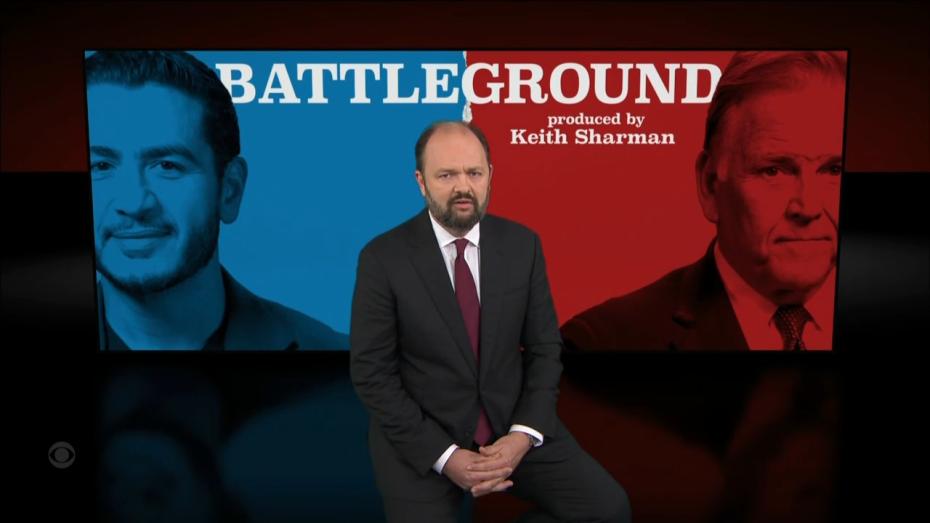
On Sunday night, just a few days prior to election day, CBS 60 Minutes featured an election preview of the Michigan Senate race between Abdul El-Sayed and Mike Rogers, with new correspondent Ross Douthat pushing El-Sayed on his socialist views and disdain for Israel. He also blamed any difficulties in Rogers’s winning in Michigan on Trump’s “unpopularity.”
However, after a particularly strong election preview, 60 Minutes went back to its truly liberal roots as correspondent Matt Gutman placed partial blame on the U.S. for Cuba’s crises.
In the introduction to the Michigan story, Douthat painted El-Sayed as possibly the “nation’s first Muslim Senator” who was “running on transformation,” through the far-left policies like “Medicare-for-all" and “an arms embargo on Israel.
In 60 Minutes' lead story on the Michigan Senate race, Ross Douthat painted Abdul El-Sayed as running on “transformation” and far-left policies like Medicare-for-all, while portraying Mike Rogers as somebody “eager to paint his opponent as a radical” while trying to win “in the… pic.twitter.com/SNQ03X64rw
— Nick (@nspin310) November 2, 2026
For his description of Rogers, he first described Rogers as “eager to paint his opponent as a radical,” and said Rogers “tries to stay inside state lines on state policies,” with focus on “Michigan jobs and education.”
Then came the Trump frame of the story:

The test for Rogers is whether a Republican can win in the shadow of inflation, war, and President Donald Trump's unpopularity.
For El-Sayed, Douthat claimed it as a “test” for “whether ideas that thrill the progressive wing of the Democratic Party are what Middle America wants right now.”
WATCH: el-Sayed denies being a socialist, says opposition to single-payer belies ignorance of how capitalism works pic.twitter.com/IGKH4u3URQ
— Jorge Bonilla (@BonillaJL) November 2, 2026
Now into the actual story, Douthat brought up his connection to socialism: “He's often associated with the Democratic Socialists of America, but he isn't a member, and he keeps his distance from the label."
He then straight up asked El-Sayed, “Were you ever a socialist?” El-Sayed responded, “No. I'm a capitalist who understands the idea that you should have guaranteed healthcare in the country, anybody who tells you that's anti-capitalist is not really understanding how capitalism works."
Douthat then turned to Republican Mike Rogers and said he could “sound like a throwback Republican” due to his FBI and Army background. He also then detailed how Rogers has tried to “persuade African Americans that El-Sayed is taking them for granted.”
But, he then painted doom for Rogers due to his connection with Trump: “For his pitch to work, Michigan voters have to believe that a Republican senator can fix a Republican president's policies.”

Douthat decided not to mention the Muslim Brotherhood controversy directly in his El-Sayed questioning, likely after his constant disdain for the question, but he mentioned the alleged ties in his voiceover, making a connection to Trump’s campaigning for Rogers.
Instead, he… pic.twitter.com/xwm0DGtsu3— Nick (@nspin310) November 2, 2026
In terms of one of the bigger controversies on the stretch for El-Sayed, Douthat connected the alleged ties ot the Muslim Brotherhood as a Trump attack: (Click "expand")
TRUMP [At Rally]: "I'm here to keep a jihadist Muslim Brotherhood member from becoming a United States senator."
DOUTHAT: The president is talking about an Islamist movement whose offshoots were recently designated as terrorist groups. Rogers has also accused his opponent of having links to the Muslim Brotherhood, citing a 2012 letter that El-Sayed signed after the Arab Spring in support of Egypt's new democratically elected government, which was backed by the Brotherhood. El-Sayed has declined to comment on the letter but says he disavows the Muslim Brotherhood. He argues that Republicans are targeting his Islamic faith.
Abdul El-Sayed: I never get the question 'does Palestine have a right to exist'
Douthat: “Does Palestine have a right to exist?”
Abdul: “Yes!”
Douthat: Does Israel have the right to exist?
Abdul: “Uh, yes, if there is a-“
Douthat: “Wait, you said..”
Abdul: “Let me just-“ pic.twitter.com/j9h0RWaJTf— DSA Watch (@DSA_Watch) November 2, 2026
Douthat did not directly ask El-Sayed about his Muslim Brotherhood ties, likely after his blowups when being asked the questions in the past few weeks. In one of the more notable exchanges, Douthat pressed El-Sayed on his anti-Israel views, and he seemed more eager to answer if Palestine had the right to exist than to a question on Israel: (Click “expand”):
EL-SAYED: I don't ever get the question of, "Does Palestine have the right to exist?"
DOUTHAT: Does Palestine have the right to exist?
EL-SAYED: Yes.
DOUTHAT: Does Israel have the right to exist?
EL-SAYED: So - yes. If there is a shared understanding -
DOUTHAT Wait. You said - you said -
EL-SAYED: Let me just-- let me just-- let me just-- understand. I believe, and this is the problem with this debate. We start from where we sit rather than start from principles. I believe in equal rights to peace, dignity, and self-determination for Palestinians and Jewish Israelis alike. If the Palestinian people decide and the Israeli people decide that they want two states for two people, and they decide that on equal terms, I'm for it. If they decide that they want one state shared in a different way, I'm for that.
Douthat also mentioned El-sayed’s “Hurt people, hurt people” remarks after the Temple Israel terrorist attack in Michigan this year, and said, “To Rogers, his opponent's rhetoric is feeding an atmosphere of antisemitism.

After Ross Douthat’s El-Sayed/Rogers piece, 60 Minutes turned to blame the US for Cuba’s current crises in its second story.
Correspondent Matt Gutman spent much of his story in a Cuban hospital to blame the US for electrical blackouts that impact hospital operations. pic.twitter.com/kEp6vcG1JT— Nick (@nspin310) November 2, 2026
After the particularly fair election preview, 60 Minutes moved in a different direction to blame the U.S. for much of Cuba’s current crises, returning to a story aired that partially aired on CBS Mornings earlier this month. CBS reporter Matt Gutman called Cuba a “country in freefall” in his own introduction.
Gutman interviewed a Cuban Deputy Foreign Minister, who was heavily featured as the main interviewee throughout the story, to blame all of Cuba’s problems on the US. For the emotional pull, Gutman spent much of his story in a Cuban hospital to blame the US for electrical blackouts that impact hospital operations.
He then detailed a blackout situation that the Cuban regime blamed on the US: “We're in the pediatric ER right now and, as so often happens here in Cuba now, the electricity just turned off, and this is that interim period between when the electricity turns off, and the generator turns on. These are the critical moments here.”
Later, Gutman asked about economic reforms being implemented and asked: “Why not go for political reforms as well?”
But, stuffed at the very end of his story, Gutman revealed that a baby showcased in the story died at a hospital, and asked the Cuban official he was interviewing,… https://t.co/k6rJJCnSEi pic.twitter.com/SWpGc3psbN— Nick (@nspin310) November 2, 2026
Stuffed at the end of the story, Gutman then placed blame on Cuba not making changes to “appease the US”:
Do you feel that you owe it to the parents of the children we saw suffering in those hospitals to make some sort of change that would appease the United States?
Even though Douthat made some strides for the show in fair eleciton coverage, the Cubs story showcased the same elements of the same old 60 Minutes have still dominated the show’s newest season.
The transcript is below. Click "expand":
CBS’s 60 Minutes
November 2, 2026
7:50:18 PM Eastern
ROSS DOUTHAT: This Tuesday, control of the U.S. Senate may be decided in the battleground state of Michigan. The Democratic nominee, Abdul El-Sayed, could be the nation's first Muslim senator, and he's running on transformation – busting monopolies, "Medicare For All," an arms embargo on Israel.
The Republican candidate, former congressman Mike Rogers, is eager to paint his opponent as a radical – but on policy, he tries to stay inside state lines, focused on Michigan jobs and education. The test for Rogers is whether a Republican can win in the shadow of inflation, war and President Donald Trump's unpopularity.
The test for El-Sayed is whether ideas that thrill the progressive wing of the Democratic Party are what Middle America wants right now. The contest is close, contentious, and it's left the two men without a kind word to say about each other.
[Story begins]
In the home stretch of an expensive, bruising, and consequential Senate race, we went to speak to both candidates, and see them in action.
The son of Egyptian immigrants, Abdul El-Sayed won the Democratic primary against a more centrist rival by a sliver of a percentage point. But he has big ambitions – not just to beat the Republican party, but to remake his own.
After a Rhodes Scholarship and a medical degree from Columbia University, El-Sayed went straight into public health administration and then politics.
He's often associated with the Democratic Socialists of America – but he isn't a member, and he keeps his distance from the label.
[To El-Sayed] Pick one economic issue that you think should be the priority for the next Congress.
ABDUL EL-SAYED (D-MI): Monopolies and oligopolies. I'm a capitalist. If you read Adam Smith, he'll tell you the biggest risk to capitalism was never government regulation. It was always monopoly and oligopoly.
DOUTHAT: You ran for office-- in 2018?
EL-SAYED: Uh-huh.
DOUTHAT: Right? For the first time. You were endorsed by Bernie Sanders in that race. Were you ever a socialist?
EL-SAYED: No. I'm a capitalist who understands the idea that you should have guaranteed healthcare in the country, anybody who tells you that's anti-capitalist is not really understanding how capitalism works.
DOUTHAT: El-Sayed is promising a version of Medicare For All that he says would leave private health insurance options intact. He would fund it, in part, with a sweeping tax on billionaire wealth.
On the trail, though, he says healthcare is no longer voters' top concern.
[To El-Sayed] What is the most important issue that you hear about from Michigan voters in this campaign? Pick one.
EL-SAYED: I think right now we are barreling toward a world where the most important issue I hear about every day is AI.
DOUTHAT: Tell me about that.
EL-SAYED: It comes in-- in two different ways. One is students saying, "So I just took $60,000 in loans and the job that I was supposed to have on the back end doesn't exist anymore or might not exist in ten years." Or it's folks in rural communities who say, "They're trying to put a data center in my backyard. I already can't afford my utilities and I'm worried about what it's going to mean for our water."
DOUTHAT: El-Sayed wants a Cabinet-level agency to regulate AI. And for the frontier AI research that some fear threatens the human race …
[TO El-Sayed] Full on pause?
EL-SAYED: Full on pause.
DOUTHAT: Where the 42-year-old Democrat sometimes sounds like a candidate for president, his Republican rival Mike Rogers is trying to keep things local.
Michigan hasn't elected a republican to the Senate in decades. Rogers hopes to make that a virtue.
FMR. REP. MIKE ROGERS (D-MI): This is a change election in Michigan. And that's why I don't really care what's happening (LAUGH) around the country. I need to fix Michigan.
DOUTHAT: In a populist era, Rogers can sound like a throwback Republican. A former Army officer and FBI agent, he left Congress after 14 years just as Donald Trump ascended. And his platform sometimes channels the compassionate conservative rhetoric of president George W. Bush.
[To Rogers] So what's the number one piece of legislation you'd want to work on on a bipartisan basis if you were in the Senate?
ROGERS: Reading. Literacy. I'm a big military family. My father, my brother, me, our son is fourth generation. Patriotism runs deep in our family. One of the big reasons they were missing recruiting during COVID and other places was that kids weren't reading well enough to pass the test in America in 2026. If we don't change that, we are all in trouble.
DOUTHAT: When El-Sayed recently took a bus tour with Democratic Socialist star Alexandria Ocasio-Cortez through Trump country in Michigan's Upper Peninsula, they weren't talking about literacy...
EL-SAYED [At campaign event with Rep. AOC]: "Shouldn't be this hard in the richest, most powerful country in the history of the world to afford a tank of gas"
DOUTHAT: While the Democrat woos MAGA voters, the 63-year old Rogers has been going into predominantly Black neighborhoods that rarely see a republican, trying to persuade African Americans that El-Sayed is taking them for granted.
ROGERS [At Campaign Event]: "He went to New York with AOC to talk about how they're going to change the world in 2028. You know what I want to do? I wanna take care of Flint. I wanna take care of every Michigander who has kids and grandkids who want to stay in this state."
DOUTHAT: For his pitch to work, Michigan voters have to believe that a Republican senator can fix a Republican president's policies. Trump's trade wars – especially the tariffs on Canada, Michigan's neighbor and trading partner – have cost the state an estimated $23 billion since January 2025.
ROGERS: I don't like the Canadian tariffs. I've said so. I've, you know, raised my concerns to the secretary of-- commerce.
DOUTHAT: And what did he say?
ROGERS: "I'll get back to ya."
DOUTHAT: Why can't other Republican senators fix it, though? There's a Republican Senate majority. Why can't they get the White House to change course?
ROGERS: Well, you need one more Republican senator there. That's how you do it.
DOUTHAT: Would you support, as a Republican senator, trying to override the president on tariffs that you disagree with like the Canadian tariffs?
ROGERS: If I can't work it out-- and it came to that, yeah. Absolutely.
DOUTHAT: One of El-Sayed's attack lines is that a vote for Rogers is effectively a vote for Trump.
The Republican candidate seems to be looking for daylight with the president while avoiding direct confrontation. He supported the unpopular war with Iran. But now says it needs to, quote, "wind" down.
When it comes to another issue on voters' minds this fall, Rogers chooses his words carefully.
[To Rogers] Do you think that the Trump administration has a corruption problem?
ROGERS: Well, I can tell you this. I'm an FBI agent by training.
DOUTHAT: And what did you work on as an FBI agent?
ROGERS: Organized crime and public corruption.
DOUTHAT: And public corruption. Yes.
ROGERS: Yeah.
DOUTHAT: Yes.
ROGERS: So, I'm gonna act as a United States senator with the best interests of Michigan. I can tell you that right now.
DOUTHAT: Can you tell me a little bit more about what that would mean?
ROGERS: I'll take the facts as I see them and I'll make a decision based on that.
DOUTHAT: The president of the United States accepted a jet from a Middle Eastern nation. Do you think he should have done that?
ROGERS: I mean, that's not what I would have done. But that's - I don't think it's illegal for the president to do that.
DOUTHAT: It's a delicate relationship. President Trump needs Rogers to flip the seat. Rogers needs the president to turn out the party base.
They campaigned together in Port Huron, Michigan, last week, where Mr. Trump trained his fire on El-Sayed.
PRESIDENT TRUMP [At Rally]: "I'm here to keep a jihadist Muslim Brotherhood member from becoming a United States senator."
DOUTHAT: The president is talking about an Islamist movement whose offshoots were recently designated as terrorist groups. Rogers has also accused his opponent of having links to the Muslim Brotherhood, citing a 2012 letter that El-Sayed signed after the Arab Spring in support of Egypt's new democratically elected government, which was backed by the Brotherhood.
El-Sayed has declined to comment on the letter but says he disavows the Muslim Brotherhood. He argues that Republicans are targeting his Islamic faith.
[To El-Sayed] There's a lot of people, Muslim, Christian, otherwise, who are raised in religion and it doesn't stick. Why did faith stick for you?
EL-SAYED: I think anybody of faith has on again, off again relationships with one's own faith. In my younger years, I certainly rebelled. And it was something that-- that kinda came back to me in college.
DOUTHAT: Tell me something about how that faith shapes your politics.
EL-SAYED: There is this - notion of speak the truth, even if it be against yourself. And I try to be, like, radically honest.
DOUTHAT: One place where El-Sayed casts himself as a truth-teller is the debate over U.S. support for Israel.
[To El-Sayed] In your view, what's wrong with America's relationship with Israel?
EL-SAYED: Number one, we have been told that we are pursuing a two-state solution, only to aid, arm, and abet the very people who are trying to foreclose on the possibility of a second state. So it's incoherent on its own terms. Number two, I don't know about you, but I don't pay my taxes to buy another country a bomb or a tank. That's Israel. That's Egypt. That's Saudi Arabia. That's Pakistan. Three: the state of Israel did a genocide.
ROGERS: His language is wrong. They use terms like genocide.
DOUTHAT: In the argument over Israel's war in Gaza, following the October 7th attacks by Hamas, Rogers leaves no doubt which side he's on.
ROGERS: I passionately defend Israel's right to defend itself and to exist as a Jewish state. That sets me at odds with my opponent right off the bat. He refuses to even acknowledge that Israel has the right to exist.
EL-SAYED: I don't ever get the question of, "Does Palestine have the right to exist?"
DOUTHAT: Does Palestine have the right to exist?
EL-SAYED: Yes.
DOUTHAT: Does Israel have the right to exist?
EL-SAYED: So - yes. If there is a shared understanding -
DOUTHAT Wait. You said- you said--
EL-SAYED: Let me just-- let me just-- let me just-- understand. I believe, and this is the problem with this debate. We start from where we sit rather than start from principles. I believe in equal rights to peace, dignity, and self-determination for Palestinians and Jewish Israelis alike. If the Palestinian people decide and the Israeli people decide that they want two states for two people, and they decide that on equal terms, I'm for it. If they decide that they want one state shared in a different way, I'm for that.
DOUTHAT: In a state with one of the nation's largest Arab American populations – and about 100,000 Jewish voters – the Middle East is territory where the campaign's national and local elements converge.
This past March, after a terrorist attack on a Michigan synagogue and preschool, El-Sayed condemned the violence.
EL-SAYED [After the Temple Israel Attack]: "There is never a justification for attacking innocent people or houses of worship. Never.''
DOUTHAT: But he added:
EL-SAYED: "Hurt people hurt people"
DOUTHAT: Seeming to put blame on Israel. He later apologized.
ROGERS [At Event]: "So you've either got to pick your team. You want to represent Palestine, or you want to represent Michigan? I want to represent Michigan!"
DOUTHAT: To Rogers, his opponent's rhetoric is feeding an atmosphere of antisemitism.
ROGERS: There are Jewish students at University of Michigan that my wife and I talk to who have to hide their Star of David to walk across campus because the harassment is so bad. Think of that.
DOUTHAT: In a close election, the Rogers campaign hopes that Jewish Michiganders, usually a reliable Democratic constituency, could be one of its keys to victory.
DOUTHAT: Do you think that you are saying enough to reassure those voters that you are on their side?
EL-SAYED: Wherever our disagreements are when it comes to Israel, there are a lot more things that we agree on here. When it comes to standing up for Jewish-Americans, I will be right there.
DOUTHAT: However the Jewish vote breaks, the state's more than 200,000 Arab Americans are expected to turn out to vote for El-Sayed in record numbers.
It's one more variable in a race filled with them – where the winning Michigan coalition could be a national surprise.
[To El-Sayed] What's the biggest thing that you think is different in U.S. politics if you win?
EL-SAYED: The ability to run a campaign and win against big money by engaging with people. Having a conversation about who we are and who we want to be.
DOUTHAT: What's the biggest thing that's different about American politics if you win this election?
ROGERS: Well, I'm not sure about American politics, but I'm gonna change the politics of Michigan, for sure. Cause you're gonna have somebody who's an advocate for the state of Michigan.
DOUTHAT: One close race, two very different campaigns – and an election whose outcome will reverberate far beyond the state of Michigan.
(...)
8:07:22 PM Eastern
MATT GUTMAN: Cuba has been under -- rule since the 1960s. The Cuban government employs most of the workers and runs the hospitals and schools. Opposition parties are illegal. For decades, a U.S. Embargo cut the island off from American trade.
Now the Trump Administration has tightened that vice, strangling its oil supply and threatening to sanction those who do business with the Cuban regime, making it nearly impossible for the government to buy food, fuel, or medicine.
Washington says the failure is Havana's, a corrupt communist regime that has mismanaged the country for decades. Havana blames Washington, saying the sanctions are designed to turn Cuba into a failed state. The Trump Administration wants Havana to know there are, quote, no escape valves. It has even threatened to take Cuba. Each side blames the other. Caught between them are more than 9 million Cubans. Last month we travelled there and found a country in freefall.
In Cuba today, the basics have become luxuries: Pharmacy shelves are bare, lines for bread stretch around the block, and during daily blackouts, most of the country disappears into darkness. Cuba’s crisis has been decades in the making. Its leaders have jailed critics, limited free speech and Washington says the regime has hoarded billions of dollars, but Havana's government blames the U.S.
CUBA DEP. F.M. CARLOS FERNÁNDEZ DE COSSÍO: The United States has no legitimacy to what they're claiming. They just have brutal power against the whole population of another country. That is criminal.
GUTMAN: Carlos Fernández de Cossío is Cuba's deputy foreign minister, and a main negotiator with the U.S.
[To De Cossio] How are the restrictions imposed earlier this year different from the embargo that has been in place effectively for over 60 years?
FERNÁNDEZ DE COSSÍO: They've become much tougher which means now the U.S. threatens with punishment, with coercive measures or sanctions, countries and their companies that engage commercially with Cuba.
GUTMAN: The streets are dark in Old Havana where it used to be glittering and light at night. People tell me on the street that they are hungry. There are breadlines. Does it feel like this country is falling apart?
FERNÁNDEZ DE COSSÍO: It's not falling apart, but it's suffering the pain.
GUTMAN: Made worse by the loss of its powerful benefactors. First it was the Soviet Union, then Venezuela. When the U.S. captured Venezuelan president, Nicolás Maduro, Cuba lost its main oil supplier. And the crisis was desperate inside the country's hospitals- long a point of pride here. On the day we visited the William Soler Hospital, we saw this infant being rushed into the intensive care unit. Dehydrated and suffering from malnutrition, he was barely responsive.
[To Dr. Chong] What is the prognosis for this baby?
DR. ALEJANDRO CHONG (In Spanish/English translation): Right now, his prognosis is critical. That means his life is in immediate danger. He could die at any moment.
GUTMAN: Dr. Alejandro Chong is the head of the ICU. He and his team cleared the baby's airways and just in case he stopped breathing, prepared a ventilator.The infant was about 2 months old. He weighed less than five pounds. He had no name and no family.We were told he was abandoned and brought in by protective services. That little shriek was a positive sign. But stabilizing him was only the first step.
DR. CHONG (In Spanish/English translation): After this, he'll need nutritional support, which is where things get more difficult for us. In other parts of the world, patients like this are given specialized formulas, many of which come from the United States. We have to make do with formulas made from malanga, a starchy root vegetable, and chicken.
GUTMAN: Doctors in Cuba make compromises like that on every shift. Just 90 miles from the U.S., Cuba has always imported much of what it needs - now the U.S. restrictions are making it harder to import food and medical supplies. Washington says it does not intend to restrict those goods, but many foreign companies, fearful of U.S. penalties, won't sell them to Cuba.Cuba's problems long predate the Trump administration's new sanctions.
For decades, the U.S. says the regime mismanaged Cuba's economy and let its infrastructure crumble.But since early January, Cuban officials say, only a single tanker of oil has reached the island, crippling the country's electrical grid. We're in the pediatric ER right now and, as so often happens here in Cuba now, the electricity just turned off and this is that interim period — between when the electricity turns off and the generator turns on – these are the critical moments here.
(...)
8:17:02 PM Eastern
GUTMAN: Secretary Rubio declined our request for an interview. But in a statement, a spokesman said:
"The failing Cuban regime continues to blame the U.S. and everyone else for their own incompetence and corruption."
"They hide billions in overseas bank accounts instead of investing in electricity, infrastructure….and the daily needs of its people"
GUTMAN: You blame the United States but it is your government that built the power plants, that set the wages, that let the infrastructure here crumble. How much responsibility does your government bear here?
FERNANDEZ DE COSSIO: Every government has responsibility for their people. In the U.S., how much responsibility does the government have for the standard of living, for the affordability of people for crime in the cities, for drugs. Every government has responsibility.
GUTMAN: But what responsibility does your government bear?
FERNANDEZ DE COSSIO: The unique position of Cuba is that in addition to whatever responsibility the government has, it has an external, very powerful factor having an influence in the reality of the population. But our government has a lot of responsibility because there could be decisions that could have been better.
GUTMAN: This year, Cuba made the biggest economic reforms in more than six decades, including dropping its monopolies on fuel, banking and pharmacies. U.S. companies have started exporting fuel to Cuba's private sector. But it's prohibitively expensive. For most Cubans, staples are further out of reach. A carton of eggs can cost more than a month's salary. That reality has forced people to find their own solutions.At this street market, we found medicine for sale – part of a thriving black market.
[To Fernandez de Cossio] Cuba enacted just this past summer 176 economic reforms. You yourself have said that this has revolutionized the economy here in Cuba.
FERNANDEZ DE COSSIO: Correct.
GUTMAN: Why not go for political reforms as well?
FERNANDEZ DE COSSIO: Well, I believe that rather than in Cuba, it is in the U.S. where it should be political reform. Cuba does not threaten the U.S. or any country.
GUTMAN: When it comes to its own country, Cuba has cracked down on dissidents and almost no one we met was willing to openly criticize the Cuban government.
[To Fernandez de Cossio]: How do you see this impasse ending?
FERNANDEZ DE COSSIO: With a change of attitude from the United States.
GUTMAN: Do you think that's going to happen?
FERNANDEZ DE COSSIO: We hope so, we see every reason for that to occur. what we see no reason is for the U.S. government to continue to punish the whole population of a country. How long is that sustainable? How acceptable is that? Just because power exists in the hands of the United States. Does everybody have to bend to that?
GUTMAN: Back at William Soler Hospital, that 2-month-old baby, who desperately needed formula, he did make it out of the ICU. But this weekend we checked in with Dr. Chong. He told us the baby had suffered respiratory complications and was readmitted to the ICU, where he died on Thursday.
[To Fernandez de Cossio] Do you feel that you owe it to the parents of the children we saw suffering in those hospitals to make some sort of change that would appease the United States?
FERNANDEZ DE COSSIO: We owe it to them to do as much as we can to ease the situation that the population faces, to ensure that they continue to live in a sovereign nation. We owe it to them to protect them from being overtaken by a superpower whose interest is not their livelihoods. It is our responsibility to protect our people from that and to do as much as possible to improve their welfare.
(...)