Unsurprisingly, the newest episode of 60 Minutes continued the trend of the newest season being anything but “MAGA-coded,” with a story bashing deportations from former VICE News correspondent Gianna Toboni, featuring a man, described as a "Texas father," who was in the U.S. illegally for many years. Furthermore, there was another story on Sunday’s show from longtime correspondent Bill Whitaker, which promoted Colorado Democrats while bashing the Trump Administration on the Tina Peters case and her recent commutation.
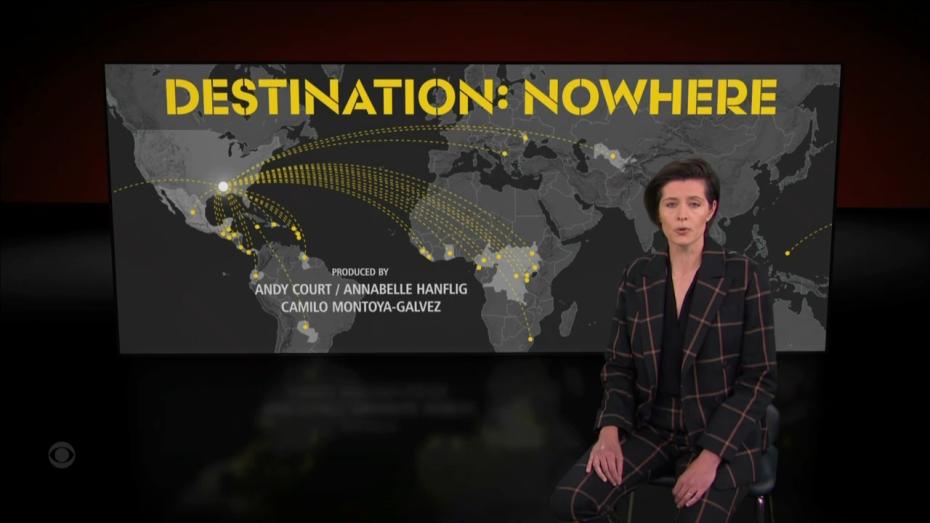
In a story titled “Destination: Nowhere,” Toboni’s introduction decried deportations by ICE to so-called “third countries” and “places where they may have never been and may not speak the language.”
The actual story began with footage of a man with a deportation order and warrant, Moussa Diawara, being arrested by DHS agents. Toboni sobly described his deportation:
Sunday’s newest episode of 60 Minutes led with a story decrying deportations to “third countries” by Gianna Toboni, formerly of VICE News. The featured deportee had a deportation order, but Tobini complained that “past administrations rarely deported people” in his situation.… pic.twitter.com/4K4P2vsBq1
— Nick (@nspin310) October 26, 2026
After three weeks in ICE detention in Texas, without being able to speak to his lawyer or a judge, he was put on a plane and deported to West Africa. And that's where we met him two months after his arrest, thousands of miles away from his Texas home.
Later, Toboni noted Diawara was in the country illegally as he “overstayed a tourist visa” and was allowed to be deported by a judge in 2012. Still, Toboni decried the deportation and said, “Past administrations rarely deported people in Diawara's situation.”
Toboni also claimed Diawara said he did not feel safe in his home country because he recently converted to Christianity:
Funnily enough, the ‘60 Minutes’ story claimed he filed a fear claim of being deported back to his home country because “He’d converted to Christianity,” and Mali was “a muslim-majority nation with an Islamist insurgency.” https://t.co/IHN1X0wEDI pic.twitter.com/HcwTheMC1Y
— Nick (@nspin310) October 26, 2026
Part of the reason he didn't feel safe, he told us, is that he'd converted to Christianity. Mali's a muslim-majority nation with an Islamist insurgency.
After more somber descriptions of Diawara in the place where he was deported to, Toboni started to give to the DHS perspective and said: “DHS questioned the credibility of Diawara's arguments for fearing persecution in Mali.” In the story, Percival claimed there was “fraud” in fear claims.
Proving his point, after the story aired, Percival revealed Diawara’s fear claim was that he was “gay,” not because he was a Christian as the story claimed:
This illegal alien is @60Minutes poster child for what it claims are wrongful deportations. I pulled his file. His claimed reason for fearing Mali was that he is “gay,” just in case you’re wondering how bad the immigration fraud problem is. https://t.co/zlTTNudG9w
— James Percival (@DHSGenCounsel) October 26, 2026
Percival then added more explanation for “third country” deportation, like countries not wanting to take back violent criminals, before Toboni followed with more questions about deportations to Ghana.
The seeming point of the ‘60 Minutes’ deportation story: Trying to claim the US and the Trump Administration have violated international law with the “third-country” deportations:
TOBONI: Immigration attorney Meredyth Yoon says the U.S. Government was warned about Ghana's… https://t.co/YHxxPOOSOb pic.twitter.com/cDOTPq5Eag— Nick (@nspin310) October 26, 2026
Later, Toboni got to the apparent point of the story, which was claims of the U.S. violating international law with deportation methods:
Immigration attorney Meredyth Yoon says the U.S. government was warned about Ghana's conduct in a lawsuit last year. Despite this, the U.S. sent 10 more flights to Ghana, which Yoon believes is a violation of international law.
In continued deportation bashing, Toboni then seemed to claim the Trump Administration was not deporting violent criminals, and complained, “What our reporting also reveals though is that a lot of these people are nurses. They're moms. They're Uber drivers. Is that part of what this administration is trying to do, remove these folks?”
Percival responded, “This administration is following the law that Congress has passed. There are a lot of people in this population that we talk about, who committed very serious crimes. And people should be very happy with President Trump for getting these serious criminals out of the country.”
In more response to the story ICE posted on X, “60 Minutes wants to give criminals and fraudsters a free pass to roam American streets. It’s not going to happen. It’s simple: If you’re in the U.S. illegally, ICE is removing you. Whether to your home country or a third country, you’re leaving.”
The second story of the night from ‘60 Minutes’ also was not very “MAGA-coded,” as Bill Whitaker bashed Democratic Colorado Governor Jared Polis’s commutation of Tina Peters and instilled more liberal Trump midterm interference fears just a week before the election. pic.twitter.com/5RjkwKqVQw
— Nick (@nspin310) October 26, 2026
The second story of the night did not wither in its Trump Attacks as Bill Whitaker hit Colorado Democratic Governor Jared Polis’ commutation of Tina Peters, something President Trump advocated for, and Whitaker, using the term “critics say,” claimed led to federal aid for the state not being approved
Whtiaker’s introduction also continued to peddle liberal midterm election fears of Trump interference: “On the eve of the midterms, President Trump won't stop talking about voter fraud. Yet he has gone to extraordinary lengths for an election official convicted of helping breach the very voting system she swore to protect.”
In the process of his story, he promoted Colorado Democrats, like Secretary of State Jena Griswold and current Attorney General Phil Weiser. He even gleefully described Weiser’s role in the Peters’ case:
In the Peters story, Whitaker promoted other Colorado Democrats, like Jena Griswold and current AG and gubernatorial candidate Phil Weiser, to hit Polis and bash the Trump Administration for “bullying” the state over the case. https://t.co/eq9IuU7nMG pic.twitter.com/RasqVvoEry
— Nick (@nspin310) October 26, 2026
Colorado's Democratic Attorney General Phil Weiser's office helped convict and imprison Tina Peters in connection with tampering with voting machines.
Notably, Whitaker made no mention that Weiser was the Democratic nominee for governor in the state. Whitaker also promoted Griswold, with no mention that Griswold tried to remove Trump from the ballot in Colorado in the 2024 presidential election.
Another week of 60 Minutes continuing to display that little has changed in their story selection, which has favored liberal stories at a five-to-one ratio compared to conservative ones in the previous six seasons.
The transcript is below. Click "expand":
CBS’s 60 Minutes
October 25, 2026
7:04:43 PM Eastern
[Story Title: Destination: Nowhere]
GIANNA TOBONI: Nearly one million people were deported from the U.S. during the first year and a half of President Trump's second term. Most were returned to their country of origin. About 25,000, though, were sent somewhere else. Places where they may have never been and may not speak the language.
They're called "Third countries" because they're not the U.S. and not the person's home country. Iranians were sent to Panama. Cubans to the Central African Republic. Deportations like these can be legal, and past administrations have carried them out, but not at this scale.
Our five-month investigation uncovered cases in which people ended up in places where U.S. Immigration judges said they would likely be persecuted or tortured.
[Story begins]On July 11th, Moussa Diawara, who's been in the U.S. for 25 years with no criminal record – was wrapping up his night shift as an Uber driver, heading to the home in the Houston suburbs he owns with his wife and children, who are U.S. citizens.But when he pulled up, U.S. Immigration and Customs Enforcement agents were waiting for him.
DHS AGENT: Sir, we got a warrant for your arrest of a removal outside of the U.S. Okay?
TOBINI: After three weeks in ICE detention in Texas – without being able to speak to his lawyer or a judge – he was put on a plane and deported to West Africa.
And that's where we met him two months after his arrest, thousands of miles away from his Texas home.
MOUSSA DIAWARA: For me it was like-- an-- a nightmare. That's like, "Oh, my God, what's happened?
TOBONI: It just didn't feel real.
DIAWARA: I still say to myself, "This isn't real. This is me?
TOBONI: Twenty five years ago, Diawara entered the U.S. and overstayed a tourist visa. He applied for refugee protection, arguing he would be persecuted if he were returned to Mali – the war-torn African country he's from. In 2012, a U.S. immigration judge ruled he could be deported, but not to Mali. As a result of the ruling, he was able to get a U.S. work permit.
Past administrations rarely deported people in Diawara's situation. But as part of the Trump administration's mass deportation operation, ICE has deported 25,000 people to dozens of third countries that in return receive millions of dollars in aid or other benefits from the U.S.
On July 31st, Diawara landed in a place he'd never been – Ghana. He says that he and others were detained in this hotel by armed guards and not allowed to make phone calls.
DIAWARA: I cannot call my wife, I can't contact my lawyer. I can't talk to no one. I tell them, "This is kidnapping. You guys kidnapped us."
TOBONI: Do you have any connection to Ghana?
DIAWARA: I don't have any connection.
TOBONI: Do you know anyone there?
DIAWARA: I don't know no one to Ghana.
TOBONI Within five days, Diawara says, Ghanaian officials forced him onto a flight to the very country a U.S. judge said he could not be deported to — Mali.
This is where he was when we first managed to contact him in August: homeless and in hiding in Mali.
Part of the reason he didn't feel safe, he told us, is that he'd converted to Christianity. Mali's a Muslim-majority nation with an Islamist insurgency. Diawara told us he was dropped here with no money, or ID.
DIAWARA: That bench is my bed for the last two weeks. Oh, Jesus Christ.
TOBONI: After three weeks in Mali, with the help of some local truckers, he escaped to another African country, which he asked us not to disclose.
[To Diawara] Little bit different than a Texas grocery store.
DIAWARA: Oh, yes. No, big difference.
For me, America was everything. I called America my home, because I'm 57 now. I move in America when I was 32. I don't know no where.
TOBONI: The U.S. government's position is that you overstayed your visa. You were in the country illegally for a period of time. That they had an order of deportation. They couldn't send you to Mali, but they could send you to a third country and that's what happened.
DIAWARA: They can send me to third country. But not back to my country of origin. And that's what they do. They do something wrong.
TOBONI: In a statement, the Department of Homeland Security told us Ghana had provided the U.S. with "diplomatic assurances for his safety." DHS also questioned the credibility of Diawara's arguments for fearing persecution in Mali.
JAMES PERCIVAL: You know, I think a lot of people who make fear claims-- do not make credible ones. There's a lot of fraud there, and so if somebody found themselves in a different country and decided they'd rather go home then that's their decision
TOBONI: James Percival, the top lawyer for the Department of Homeland Security, told us third-country deportations are widely misunderstood.
PERCIVAL: I absolutely believe with all of my heart that these third-country removals have stopped crimes from happening and kept Americans safer and that is our fundamental obligation at the Department of Homeland Security.
TOBONI: Why does the U.S. deport people to third countries?
PERCIVAL: So like one example is somebody, maybe they're a serious criminal, and the country just won't take them back. Another is sometimes aliens get a country-specific form of relief where the immigration judge says, "You need to leave the United States but you have to go somewhere other than your home country."
TOBONI: When an immigration judge rules that someone cannot safely be sent back to their home country, it's called "withholding of removal." Moussa Diawara had that protection. So did dozens of others on his deportation flight.
We obtained the names of all 63 people on Diawara's flight, which left Texas on July 30th and stopped in Sierra Leone, the Central African Republic and Ghana. Seventeen of the 19 people we reached who were sent to Ghana told us the same thing: Ghana quickly transported them, against their will, to countries that U.S. immigration judges had ruled they should not be returned to.
[To Percival] Are you aware of cases where Ghana has sent people against their will to a country, their home country where they have a withholding of removal?
PERCIVAL: I'm not aware of any such cases.
TOBONI: Do you think these people are voluntarily going back?
PERCIVAL: Either they would choose to go home, and they might not always be truthful about the fact that they consented, so that's one possibility. The other possibility is that the foreign government applied their own procedures and, consistent with international law, determined that it was acceptable to return them home.
TOBONI: I mean what we have seen in case after case in one flight we looked into, almost every single person on the flight within days after arriving in Ghana were sent back to their home country where a U.S. judge has said, "It is more than likely that they will face persecution or torture."
PERCIVAL: I mean I think I already answered this question number one-- they can always consent to go home and that may very well be what occurred. And number two—
TOBONI: But that's clearly not what's happening, right. They're clearly not consenting—
PERCIVAL: Well--
TOBONI: I don't know if you've seen this video of a woman being dragged to her deportation flight to her home country where she had a withholding of removal. She is resisting. Have you seen this video?
PERCIVAL: I have not seen that video.
TOBONI: An eyewitness confirmed those are Ghanaian officials pulling this woman, Rabbiatu Kuyateh, a nurse who lived in the U.S. for 30 years.
[To Diawara] Do you think the U.S. knew that you would end up in Mali?
DIAWARA: 100%.
TOBONI: Why?
Diawara showed us a document he says U.S. officials gave him on the deportation flight, along with a small supply of his medication.
DIAWARA: They say here “Destination: S-H-R-C Mali."
TOBONI: S-H-R-C stands for special high-risk charter, referring to the kind of flight he was on.
DIAWARA: So they know 100% I'm going to Mali.
(...)
7:13:46 PM Eastern
MEREDYTH YOON: There's no way that U.S. officials don't know what Ghana is doing to people that the U.S. deports there.
TOBONI: Immigration attorney Meredyth Yoon says the U.S. government was warned about Ghana's conduct in a lawsuit last year. Despite this, the U.S. sent 10 more flights to Ghana, which Yoon believes is a violation of international law.
[To Yoon] Why do you think the U.S. violated international law if they didn't send Moussa straight to Mali. They sent him to Ghana, who sent him to Mali.
YOON: They sent him to Ghana, with full knowledge that Ghana is systematically deporting refugees back to the very countries they fled.
TOBONI: [To Percival] I just sort of wonder if the U.S. government is sort of looking the other way when there's evidence in front of them
PERCIVAL: I mean, I think you've asked me the same question about five times. I'd really like to talk about the public safety threats associated with this population of aliens and the fact that every administration before President Trump absolutely abdicated their responsibility to the American people by letting criminals back on the street and doing no diplomatic efforts to get these people out of our country.
TOBONI: Percival says "third countries" like Eswatini and South Sudan have agreed to accept deportees with criminal records for first-degree murder, armed robbery, kidnapping, and sexual assault when their home countries refused to take them back.
[To Percival] What percentage of folks who have been detained and deported are violent offenders?
PERCIVAL: So I don't have that figure off the top of my head.
TOBONI: Of the 63 people on Diawara's flight to Africa, we found a criminal charge or conviction for 19%, including theft, assault, drugs and weapons possession. For everyone else, we found either traffic violations… or no criminal record at all.
[To Percival] What our reporting also reveals though is that a lot of these people are nurses. They're moms. They're Uber drivers. Is that part of what this administration is trying to do, remove these folks?
PERCIVAL: This administration is following the law that Congress has passed. There are a lot of people in this population that we talk about, who committed very serious crimes. And people should be very happy with President Trump for getting these serious criminals out of the country.
DIAWARA: I'm not a criminal. I'm raising two child. I'm a married man and I'm working and paying taxes.
TOBONI: Last month, a federal appeals court upheld a ruling in a class action lawsuit that found the Trump administration's third-country policy "unlawful" because it denied deportees due process. But the Supreme Court has allowed these deportations to continue until it hears the case in December.
As for Moussa Diawara, his attorney has asked a federal judge in D.C. to order him returned to the U.S.
(...)7:21:02 PM Eastern
[Story Title: #FreeTinaPeters]
(...)
7:21:02 PM Eastern
[Story Title: #FreeTinaPeters]
BILL WHITAKER: On the eve of the midterms, President Trump won't stop talking about voter fraud. Yet he has gone to extraordinary lengths for an election official convicted of helping breach the very voting system she swore to protect. Tina Peters, once Mesa County, Colorado's top election official, used her office to pursue the president's claim, never backed by evidence, that rigged voting machines cost him the 2020 election.
A Colorado jury convicted her. A judge sentenced her to nine years. Mr. Trump wanted her freed. How he went about it, critics say, reveals how far he'll go to advance his agenda and punish those who stand in his way.
[Story begins]
In Colorado, the cost of that punishment came into focus with a fire in August of 2025.
It was one of the worst wildfires in Colorado history, scorching nearly 138,000 acres. It left almost all of Kathleen Kelly's 2,000 acre ranch in ashes.
WHITAKER: Did you see it moving toward you?
KATHLEEN KELLY: Yeah.
WHITAKER: What's that like? What goes through your head?
KELLY: It's like watching a monster crawl across the earth.This tells you about the fire right here.
WHITAKER: So it came right up to your house?
KELLY: Yeah.
WHITAKER: Kelly, a retired schoolteacher, says the Lee fire tore through the ranch her father built in 1949, leaving behind an apocalyptic wasteland.
[To Kelly] You said it was like hell opening up.
KELLY: Yes. There are people whose whole livelihoods depend upon the buildings, the structures, the things that they built over years, who lost everything.
GOV. JARED POLIS (D-CO): A lot of the damage was oil and gas infrastructure, some homes, buildings. It absolutely met the requirements for a federal disaster declaration.
WHITAKER: Even so, the Trump administration denied Democratic Gov. Jared Polis' plea for federal aid.
POLIS: These are disasters that are larger than any particular state can pay for and handle at one time. We had not been turned down for one. I think it's been decades since-- that's occurred.
WHITAKER: What was different this time?
POLIS: Well, you know obviously I'm not the one to ask, right? The person to ask is the White House and the president.
WHITAKER: What was different this time, critics say, was President Trump's fixation on Tina Peters, who has long championed his false claims about rigged voting machines.
Colorado's Democratic Attorney General Phil Weiser's office helped convict and imprison Tina Peters in connection with tampering with voting machines.
COLORADO AG PHIL WEISER (D-CANDIDATE FOR CO GOVERNOR): President Trump has said he doesn't like that Tina Peters was sentenced and serving this nine year sentence. So he said, "I'm gonna punish Colorado."
WHITAKER: Last year, as the Lee fire raged across northwest Colorado, the president warned on social media: "If she is not released, I'm going to take harsh measures."
WEISER: That was the statement the president made. And then the consequences started to follow. "If Colorado doesn't wanna lose these benefits, it might consider treating the Tina Peters case differently."
WHITAKER: The White House insists denying wildfire aid had nothing to do with Peters. Spokesperson Lauren Bis said "There is no politicization to the president's decisions on disaster relief."
But the fire aid was only the beginning. The Trump administration threatened to withhold food aid from the state's neediest families, canceled $109 million in transportation funding, and moved to dismantle the National Center for Atmospheric Research in Boulder - actions the administration described as a series of independent agency decisions.
WEISER: The threats were not hidden, they were not subtle, they were out in the open, and we're fighting back.
WHITAKER: So you are suing the president. On what basis?
WEISER: The president using bullying, using threats to take away our sovereignty… President doesn't get to tell us what to do. That's for us to decide.
WHITAKER: So when the president posts, "Free Tina Peters," what does that say to you?
WEISER: I don't get it. The president appears to think that there's some injustice here.
CO SECRETARY OF STATE JENA GRISWOLD (D): She was elected by her county to uphold the elections. Instead-- she attacked the elections from within.Colorado's Democratic Secretary of State Jena Griswold, who oversees state elections, said Peters helped an election conspiracy theorist pose as a county employee, gave him access to secure voting equipment and allowed him to copy its proprietary software.
GRISWOLD: Tina Peters ordered that her video surveillance cameras be turned off and then took images of the voting equipment and shared it with a network of election deniers.
WHITAKER: Griswold discovered the breach when copies of the data surfaced at a conference devoted to claims of election fraud where Peters spoke.
WHITAKER: What was harmed by her actions?
GRISWOLD: Voting equipment, confidence in Colorado elections and American elections, and election workers.
TINA PETERS (Arrest Bodycam Video): You let go of me. Let go of me!
WHITAKER: Peters was charged with obstruction for refusing to cooperate with an investigation into the voting machine breach.
PETERS (Bodycam video): For what?
OFFICER (Bodycam video): Obstruction
WHITAKER: She was indicted a month later on 10 criminal counts, which elevated her standing among election skeptics even higher.
She was all smiles on her way to court in 2024. After a two week trial, a jury found her guilty of state charges: three misdemeanors, four felonies.
JUDGE MATTHEW BARRETT: [To Peters] You are no hero. You abused your position, and you're a charlatan.
WHITAKER: Mesa County District Court Judge Matthew Barrett sentenced Peters to nearly nine years in prison.
JUDGE BARRETT: I'm convinced you would do it all over again if you could. You're as defiant as a defendant as this court has ever seen.
WHITAKER: Matt Crane, who leads the Colorado County Clerks Association, says Peters' actions and the president's support for her have fueled distrust of election workers, making them targets of threats and intimidation.
MATT CRANE As election officials, we don't have the kind of megaphone that the president of the United States has. He has-- he has much more ability to spread disinformation and lies about our election process-- than we do to spread the truth about what really happens.
WHITAKER: And you are a Republican.
CRANE: I am a Republican. Yes, sir.
WHITAKER: So this is not a partisan issue for you?
CRANE: This is not a partisan issue
WHITAKER: But in May of 2025, President Trump made it one. He called Peters a "hostage being held in a Colorado prison by the Democrats for political reasons." He also called her a patriot.
WEISER: I feel like we're in "Alice in Wonderland." When someone breaks the law, they're not a patriot. When someone seeks to undermine the integrity of our elections, lying about it, that's not a patriotic act. That's undermining the core, the foundation of a democratic republic.
WHITAKER: President Trump issued a pardon for Peters – but it had no legal effect since she was convicted on state not federal charges.President Trump continued to build up peters while tearing into Colorado Gov. Jared Polis.
PRESIDENT TRUMP: The governor of Colorado is a weak and pathetic man
WHITAKER: [To Polis] President Trump is known for using colorful language. He called you "the sleaze bag governor of Colorado."
POLIS: I mean, whatever he wants to call me is fine.
...