Subsequently, Gabbard has sent criminal referrals to the Justice Department, but none of this has appeared on the lead morning and evenings newscasts of ABC, CBS, or NBC. During the impeachment, their evening newscasts hurled 93 percent negative coverage upon the President.
In contrast, it has been covered repeatedly on CBS’s streaming channel CBS News 24/7, the Fox News Channel, Newsmax, Newsmax2, and NewsNation. CNN hasn’t covered it, but MS NOW has mentioned it three times as proof Gabbard wants to “rewrite history.”
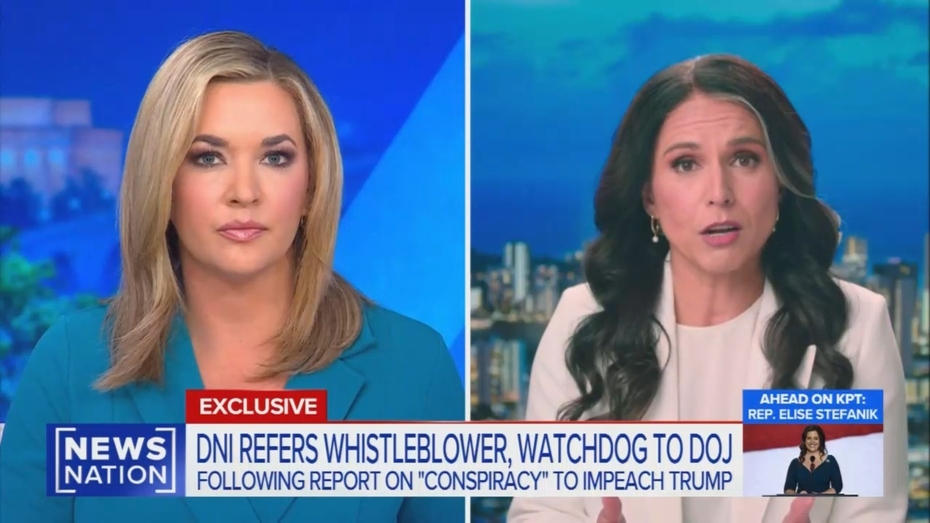
NewsNation, however, stood out as primetime host Katie Pavlich secured an exclusive Gabbard interview on Wednesday’s Katie Pavlich Tonight.
Pavlich reminded viewers these revelations matter because, along with foreign threats, “another threat to our constitutional republic is when the intelligence community is weaponized for political purposes.”
Before going into detail, Gabbard said “it is always the right time to expose the truth to the American people about the Deep State tactics that have been used time and time again, fundamentally to undermine the — the foundational principles of our republic,” including the right of voters to decide their leaders.
.@NewsNation’s @KatiePavlich: “You released new documentation this week showing what happened in the lead up to the impeachment of President Donald Trump in 2019. Can you tell us what you found and why now to release and declassify this information to the public?”@DNIGabbard:… pic.twitter.com/T84zfoirV4
— Curtis Houck (@CurtisHouck) April 16, 2026
Pavlich had Gabbard drill down on the inspector general’s ludicrous decision to continue treating Ciaramella’s political bomb as legitimate despite lacking first-hand knowledge (click “expand”):
GABBARD: The responsibility is with the inspector general to deem whether or not a complaint is — is credible and whether or not it is urgent. How do you find a complaint to be credible when there is zero evidence provided and there is zero first-hand knowledge provided, not only by the whistleblower, but by any witness in this case, and when the inspector general himself did not even request to see the documents that these individuals are referencing in their false accusations. And so — so, it was obviously, to me, part of this plot to change the standard, which the inspector general did, from requiring that there be either evidence or first-hand knowledge presented in order to determine whether or not a complaint is credible, to merely allowing for hearsay and nothing else.
PAVLICH: Is it ever —
GABBARD: This fed into this manufactured narrative.
PAVLICH: — yeah. Is it ever appropriate for politicians to be working with the intelligence community behind the scenes on an impeachment probe?
GABBARD: No. And this is — this why the fact that the so-called whistleblower, instead of going directly to the inspector general and filing a complaint, the fact that this whistleblower went directly to the House Intelligence Committee and Adam Schiff, specifically, and his team, really points to the politicization of intelligence —
PAVLICH: Yep.
GABBARD: — and the intelligence community. And again, the whistleblower process, which is really egregious because it is the channel for those to come and report complaints about things like politicized intelligence and the tactics of the Deep State being deployed.
Back at Just The News, Dunleavy explained the documents — which were written by “investigators for the intelligence community inspector general” — would have shown, if they were made available in October 2019, that Eric Ciaramella had “apologized for misleading the probe about such matters as his prior contact with staffers on the Democrat-led House Intelligence Committee, criticizing a GOP congressmen, recounting that he asked to hide his complaint from Republicans on the committee and close links to Joe Biden’s efforts in Ukraine.”
On October 4, 2019, all the inspector general told the committee was that Ciaramella “self-disclosed that [he] was a registered member of the Democratic Party” and “had prior professional relationship with one of the Democratic Presidential candidates for the 2020 election.”
Talk about vague!
Here’s what the intelligence committee actually learned about one of their own and what they covered up to help advance the impeachment of a man they desperately hated.
Dunleavy summarized the documents redacted for the House Intelligence Committee included “details relating to Ciaramella’s work with then-Vice President Joe Biden, the whistleblower’s long-term focus on Ukraine, Ciaramella’s travel to Ukraine with Biden, and the whistleblower’s presence at discussions about the alleged corruption of Ukrainian prosecutors[.]”
Here was how the documents appeared to members of the committee tasked with conducting oversight over the Deep State (click “expand”):
A yet-redacted questioner said during the 2019 session that “we will enter this interview of complainant [Ciaramella] dated August 20 into the record” as an exhibit. The exhibit appears to be a redacted version of a largely unredacted memo obtained by Just the News and made public Sunday.
“On page 27 of that, there is a section called ‘Potential for Bias’ and there appear to be three topics that the complainant mentioned could be used against [redacted] to demonstrate political bias,” the questioner told Atkinson, going on to note that two of the three buckets of Ciaramella’s self-admitted potential biases were largely redacted.
“The first says, ‘first complainant worked with…’ and then the remainder is redacted,” the questioner noted.
The largely-unredacted version of the memo, only released to the public half a decade later, stated that “first, Complainant worked closely with Vice President Biden as an expert on Ukraine. [Redacted] travelled with Biden to Ukraine and was part of conversations where [Ukrainian Prosecutor General Yuriy] Lutsenko corruption was discussed.”
Lutsenko had taken over the position after Shokin was fired following pressure from Biden.
(....)
The redacted questioner told Atkinson during the 2019 session, “You’ve now said today that the complainant worked closely with one of the presidential candidates for the 2020 election” and asked “is that what is redacted in the first bullet point here?”
“Yes,” Atkinson told the House investigators.
The redacted questioner noted to Atkinson in 2019 that “the second” section on Ciaramella’s biases “is entirely redacted.”
“Second, Complainant worked for the President Trump White House for [Redacted] as an [redacted] was then asked by [Redacted] to be [redacted],” the more unredacted version of the memo made public on Sunday said. “Complainant said this was a very stressful job and [redacted] became the target of right-wing bloggers, such as [Redacted], and conspiracy theorists, and later received death threats, which caused [redacted] to leave [redacted] White House position and return to CIA. [Redacted] then accepted [redacted]. Complainant believes that [Redacted], a former colleague at the NSC and current HPSCI staffer for Nunes, provided [Redacted] with information about Complainant for use in his threatening blogs.”
(....)
The redacted questioner said during the 2019 session that “the third” indicator of bias “is that the complainant is a registered Democrat.”
Atkinson went on to tell the House Intelligence Committee repeatedly in October 2019 that he and Ciaramella’s CIA supervisors did not believe the whistleblower’s complaint had been motivated by politics.
“I thought ... the reports that the complainant worked on were in line with the views of the Intelligence Community,” the watchdog said.
Atkinson continued: “Some of the work that the complainant did in [redacted] official capacity ... could be seen as political, but the complainant’s role in those reports, as far as I could tell, was not."
In addition to the three redacted portions of inspector general documents, Dunleavy said the intelligence community IG also hid from the House Intelligence Committee the fact that “the whistleblower’s allegations were based solely on second-hand or third-hand accounts about what Trump was alleged to have done and that Ciaramella had worked on his whistleblower efforts with a witness whose name was redacted but who told investigators that he was connected to disgraced FBI agent Peter Strzok[.]”
To see the relevant NewsNation transcript from April 15, click here.