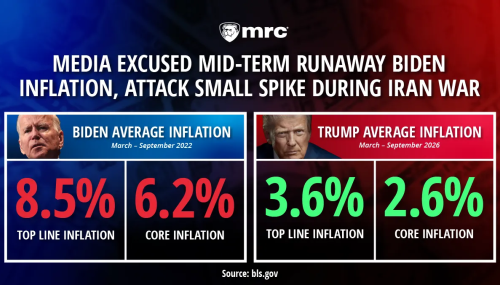
PBS joined the other networks in negatively spinning the official inflation numbers, which were comparatively tame compared to inflation during the Biden years. The Labor Department found the annual rate rose slightly to 3.7 percent. Four years ago, they reported the annual rate was 8.2 percent, more than double today's rate.
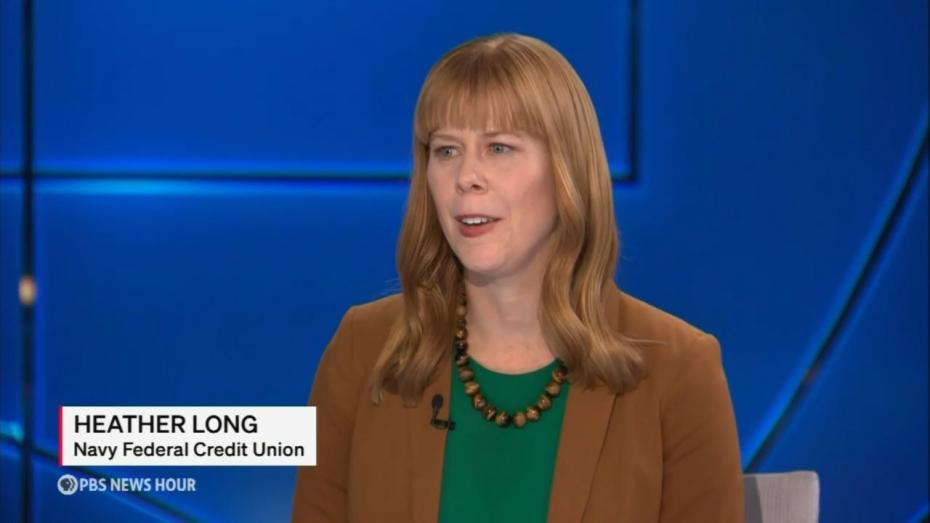
Former Washington Post columnist turned Navy Federal Credit Union economist Heather Long popped up again on Wednesday’s PBS News Hour to discuss the latest inflation report. Co-anchor Geoff Bennett led the show by filtering the figures through anti-Trump prism, along with Long.
In all, Long has appeared as a guest on the program seven times, twice during Trump I, zero times during the Biden Administration, and five times already during Trump II (plus one citation). More on that anomaly below.
PBS anchor Geoff Bennett opens with inflation spin: "Welcome to the News Hour. With the midterm elections just three weeks away, a new inflation report shows prices rising faster than expected, putting more pressure on Americans struggling with the cost of everyday essentials." https://t.co/qtwFllUG8B
— Clay Waters 🇮🇱 (@claywaters44) October 16, 2026
Co-anchor Geoff Bennett: Welcome to the News Hour. With the midterm elections just three weeks away, a new inflation report shows prices rising faster than expected, putting more pressure on Americans struggling with the cost of everyday essentials.
Amna Nawaz: Prices climbed 3.7 percent over the past year and by more than half-a-percent in just the last month. It's the largest monthly increase in five months. The price increase was driven by gasoline, up 9 percent in September. For more on all of this, I'm joined by Heather Long. She's vice president and chief economist at Navy Federal Credit Union.…let's start with that headline number, Consumer Price Index rising 3.7 percent from a year ago, rising faster than a month ago. How much of that is due to those rising gas prices?
Heather Long, Chief Economist, Navy Federal Credit Union: Yes, that's the key question. Half of it is coming from the high gas and diesel prices. But, honestly, the reason most people gasped today when they saw this data is because the other half is coming from everything else. Sure, it's spilling over into higher airfares and higher home heating oil, but the war in Iran is not causing medical care, dental care, toys, apparel. I hope nobody's shopping for a suit….and that’s what really caused the alarm bells today, that this is way more broad-based than we thought and that’s going to take a long time to ease.
Back to that strange gap: A Nexis transcript search indicates Long, who wrote for the Post from 2017-2025, was absent from the PBS News Hour (including the previous Weekend edition) for five years, from October 2, 2020 to October 14, 2025. Her first appearance was in November 2018.
In other words, the News Hour went the entire Biden Administration without hosting or even citing Long, who was and is one of their key sources for discussing bad economic news (inflation, job loss, recession) during Trump administrations. That’s even while inflation was consistently far higher during the Biden Administration.
Long brought the drama.
Nawaz: Heather, people are clearly feeling this pressure in lots of ways. Are we seeing consumers pull back or start to pull back on their spending in a significant way?
Long: The pain is definitely real right now. Since President Trump took office again, there's been no wage growth once you adjust for inflation. And we already see the strain, and you could hear it in some of those clips. People in the bottom 30 percent don't have any extra money and are reliant on credit cards and starting to miss payments. The real question is, how long can the middle class hold on?....
A bump in Social Security benefits for next January failed to alleviate Long’s concerns.
Long: ….But the question is, how much relief do we get in 2027? As we were talking about, there's a lot of parts of the economy that are really hot inflation right now. You can't just coupon your way out of that.
Long still writes for the Post, warning of the “K-shaped economy” under Trump, the idea that wealthy Americans are spending more and more -- the upward line of the K -- while the poor are buying less, forming the downward line.
When she did offer an occasional criticism of the high inflation during the Biden years, Long was nowhere to be seen on PBS.
A transcript is available, click “Expand.”
PBS News Hour
10/14/26
7:03:04 p.m. (ET)
Geoff Bennett: Welcome to the News Hour. With the midterm elections just three weeks away, a new inflation report shows prices rising faster than expected, putting more pressure on Americans struggling with the cost of everyday essentials.
Amna Nawaz: Prices climbed 3.7 percent over the past year and by more than half-a-percent in just the last month. It's the largest monthly increase in five months. The price increase was driven by gasoline, up 9 percent in September.
For more on all of this, I'm joined by Heather Long. She's vice president and chief economist at Navy Federal Credit Union.
Great to see you.
Heather Long, Chief Economist, Navy Federal Credit Union: Good to be here.
Amna Nawaz: Well, let's start with that headline number, Consumer Price Index rising 3.7 percent from a year ago, rising faster than a month ago. How much of that is due to those rising gas prices?
Heather Long: Yes, that's the key question.
Half of it is coming from the high gas and diesel prices. But, honestly, the reason most people gasped today when they saw this data is because the other half is coming from everything else. Sure, it's spilling over into higher airfares and higher home heating oil, but the war in Iran is not causing medical care, dental care, toys, apparel.
I hope nobody's shopping for a suit. Those really jumped up. Software prices. There were just so many items, repairing a car, that rose, and that's what really caused the alarm bells today that this is way more broad-based than we thought, and that's going to take a long time to ease.
Amna Nawaz: We saw core inflation, which excludes those energy and food prices, also edging higher. What does that say to you?
Heather Long: Yes, it says that this is more than a gas and oil problem, and that it's going to be harder to get it down than we expected.
The Federal Reserve will have to raise those interest rates again. It's already a pain point with the mortgage rates back above 7.5 percent. And so that's the pain that a lot of Americans feel, and probably the most important data point today, and people are feeling it, inflation up 3.7 percent, wage growth only 3 percent.
Amna Nawaz: And that combination of the higher inflation, weaker wage growth, we have talked about it before.
I want to take a listen to what two people, Andrew Larcher in South Dakota, and Craig Underwood, who's a farmer in California, had to say about the pressure they're feeling.
Andrew Larcher, Sioux Falls, South Dakota, Resident: I'm on VA disability as a 100 percent disabled veteran. And, given, when I get a month, I used to be able to afford things easily.
Now it gets to the point to where I have to really watch my budget. How much food can I afford a month, or how much -- or if I buy this much food, can I pay rent? Or can I afford the car? I don't have a car right now because there's no way that I can afford a car.
Craig Underwood, Fillmore, California, Resident: It's pretty hard for us to budget for a dramatic increase in the cost of diesel. It grinds on you know. When I wake up in the morning, I'm thinking about it. When I go to bed at night, I'm thinking about it. Trying to put it out of my brain in order to sleep. But you do think about it a lot.
Amna Nawaz: Heather, people are clearly feeling this pressure in lots of ways. Are we seeing consumers pull back or start to pull back on their spending in a significant way?
Heather Long: The pain is definitely real right now. Since President Trump took office again, there's been no wage growth once you adjust for inflation. And we already see the strain, and you could hear it in some of those clips.
People in the bottom 30 percent don't have any extra money and are reliant on credit cards and starting to miss payments. The real question is, how long can the middle class hold on? They have been surprisingly resilient, but we see more and more stories at Navy Federal Credit Union, just like that first clip you played, of people who are pulling back on groceries in order to try to have enough money to pay their other bills.
You can see them stretching every dollar. You can see them making those hard choices. We think it's going to be a more tepid holiday season as the hard choices are here.
Amna Nawaz: We should also mention Social Security benefits will see a bump in January. The cost of living adjustment is going to go up by about 3.6 percent. It's about $75 a month on average. It's the largest increase in three years, and it is a few months away.
But what kind of a difference can that make, and for whom?
Heather Long: Well, there's obviously a lot of people living on fixed incomes who are struggling right now. But, as you mentioned, 3.6 percent is the highest in three years. There's a lot of hope that inflation won't go much higher from here.
But the question is, how much relief do we get in 2027? As we were talking about, there's a lot of parts of the economy that are really hot inflation right now. You can't just coupon your way out of that.
Amna Nawaz: Heather Long, vice president, chief economist at Navy Federal Credit Union, thanks for being here.
Heather Long: Thanks.