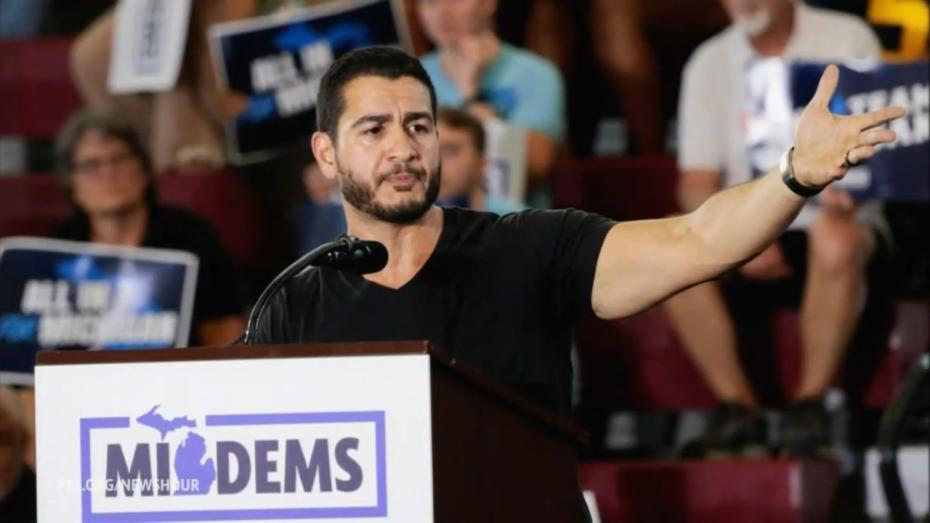
After discussing the Republican Party’s strained relationship with President Trump and next week’s GOP midterm convention, nicknamed by some as Trump-a-palooza, the PBS News Hour “Politics Monday” talk turned to the U.S. Senate race in Michigan and controversial Democratic nominee Abdul El-Sayed, and co-anchor Amna Nawaz fiercely defended El-Sayed against “anti-Islamic rhetoric.”
Nawaz opened the segment by trying to help El-Sayed wash his hands of his heartless comments about an Islamic terrorist attack against synagogue in Michigan:
Let's turn now to the Democrats, specifically in Michigan. We have been tracking this Senate race there and their nominee, Abdul El-Sayed, who apologized this weekend for comments that he made after a synagogue attack outside Detroit in March. He had condemned the attack and then said "Hurt people hurt people." That attack was carried out by a Lebanese man whose family had been killed in an Israeli strike. We now know El-Sayed has met with Jewish Democratic leaders, saying that he did make a mistake. He's still coming under attack from the president and with anti-Islamic rhetoric as well. But, Tam, this is the most fulsome apology we have seen from El-Sayed. And it comes after he narrowly won a primary. What are you looking at here?
El-Sayed's other controversies were ignored: His campaigning with streamer and 9/11 apologist Hasan Piker, or his own tasteless race-baiting comments about Usha Vance, wife of the vice president, about the couple’s "brown children." Nothing on the CBS News scoop that dug up some of el-Sayed's dopey deleted tweets calling for the same outrage over America's COVID death toll as for the murders of 9/11.
PBS host Amna Nawaz runs cover for Dem Senate candidate Abdul El-Sayed: "Amy [Walter], how do you look at the way the president and a lot of other Republicans are talking about El-Sayed, specifically putting his faith front and center and going so far as to call him a jihadist?" pic.twitter.com/EWrrkVDUhr
— Clay Waters 🇮🇱 (@claywaters44) September 3, 2026
Tamara Keith of National Public Radio was actually somewhat tougher on the Democrat than was the host:
Yes, I mean, I think that this is an acknowledgement that this is going to be a very close race. You can't just give up on any group of voters. And he has work to do to win over Jewish voters. That primary was incredibly bitter. And it centered in many ways around Jewish identity and around all kinds of things, that the AIPAC was spending really heavily for his opponent. And he attacked AIPAC. And it is all part of the stew that is this race and trying to bring unity to Democrats, who were just bitterly divided in the primary. And just today, vice president J.D. Vance was campaigning in Michigan. He said that he had with him the rabbi and security officials from the synagogue that had been attacked that El-Sayed addressed and then later apologized, much later, much, much later.
Nawaz wasn’t done shilling for El-Sayed. "Amy, how do you look at the way the president and a lot of other Republicans are talking about El-Sayed, specifically putting his faith front and center and going so far as to call him a jihadist?" She asked.
Walter stuck to the politics.
[...] the ad that is up right now by one of the Republican super PACs calls him dangerously radical. And that is the message that they're going to carry throughout this campaign. There's not -- that wasn't really very much of a surprise. Remember, there are a lot of Democrats who said, if we nominate El-Sayed that he is going to be a weaker general election candidate….
Keith pointed out later that "Republicans want El-Sayed to be part of the campaign in races all over the country, not just in Michigan. They are going to put him forward as the -- like, you don't want this to happen to America."
A transcript is available, click “expand” to read:
PBS News Hour
8/31/26
7:36:16 p.m.
Amna Nawaz: Let's turn now to the Democrats, specifically in Michigan. We have been tracking this Senate race there and their nominee, Abdul El-Sayed, who apologized this weekend for comments that he made after a synagogue attack outside Detroit in March. He had condemned the attack and then said "Hurt people hurt people."
That attack was carried out by a Lebanese man whose family had been killed in an Israeli strike. We now know El-Sayed has met with Jewish Democratic leaders, saying that he did make a mistake. He's still coming under attack from the president and with anti-Islamic rhetoric as well.
But, Tam, this is the most fulsome apology we have seen from El-Sayed. And it comes after he narrowly won a primary. What are you looking at here?
Tamara Keith: Yes, I mean, I think that this is an acknowledgement that this is going to be a very close race. You can't just give up on any group of voters. And he has work to do to win over Jewish voters.
That primary was incredibly bitter. And it centered in many ways around Jewish identity and around all kinds of things, that the AIPAC was spending really heavily for his opponent. And he attacked AIPAC. And it is all part of the stew that is this race and trying to bring unity to Democrats, who were just bitterly divided in the primary.
And just today, vice president J.D. Vance was campaigning in Michigan. He said that he had with him the rabbi and security officials from the synagogue that had been attacked that El-Sayed addressed and then later apologized, much later, much, much later.
Amna Nawaz: Amy, how do you look at the way the president and a lot of other Republicans are talking about El-Sayed, specifically putting his faith front and center and going so far as to call him a jihadist?
Amy Walter: Well, and the ad that is up right now by one of the Republican super PACs calls him dangerously radical. And that is the message that they're going to carry throughout this campaign. There's not -- that wasn't really very much of a surprise.
Remember, there are a lot of Democrats who said, if we nominate El-Sayed that he is going to be a weaker general election candidate. It really comes down to what this race is going to be about. If it's going to be about Donald Trump, and this is what Democrats are hoping El-Sayed does is pivot to make it about Trump, then that is beneficial to the Democrats, because this is a state where Trump is deeply unpopular.
If it is about El-Sayed, then it becomes easier for Republicans to win.
Tamara Keith: And, in fact, Republicans want El-Sayed to be part of the campaign in races all over the country, not just in Michigan. They are going to put him forward as the -- like, you don't want this to happen to America.