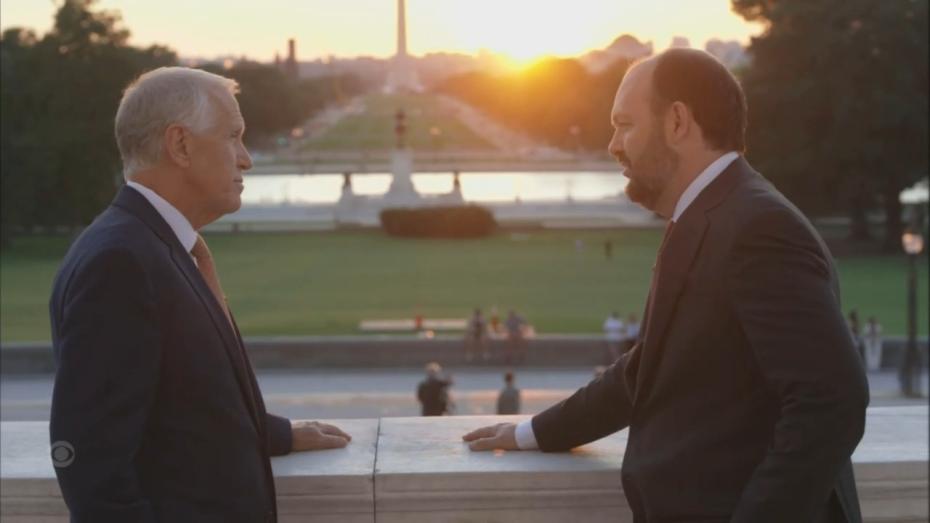
The newest episode of the “revamped” 60 Minutes on Sunday featured an interview with outgoing Republican Senator Thom Tillis, a vocal critic of some Trump Administration activities during the second term, to promote his new book titled How to Lose Friends and Antagonize Presidents. Near the end of the interview, which focused on Tillis’ disagreements with Trump and dislike of cabinet secretaries and advisors, correspondent Ross Douthat turned to discuss January 6th, as Tillis worried for democracy and “the risks of authoritarianism.”
In the introduction, Douthat painted Tillis favorably, as he asked, “Is it possible to be an effective Republican senator in the age of Donald Trump? Someone who makes deals and checks the White House, without becoming a political martyr or an ex-Republican?”
Douthat described the task for a Tillis as a “tightrope,” and added, “He votes like a reliable Republican while talking and maneuvering like a maverick. He's a caustic critic of many administration officials, all while insisting he just wants to help the president succeed.”
The Tillis interview introduction from Douthat also set out bleak expectations for the GOP in the midterms, describing it as a "potential midterm wipeout":
“As his party faces a potential midterm wipeout, we talked to him about his high-wire act, his relationship with President… https://t.co/fagYVXgh9v pic.twitter.com/0NaHLYSPsC— Nick (@nspin310) October 5, 2026
Douthat called Tillis’ action a “fascinating performance,” and he said Tillis was leaving the Senate. Douthat cast doubt on Republican midterm chances in the process:
As his party faces a potential midterm wipeout, we talked to him about his high-wire act, his relationship with President Trump, and whether it's possible to make the Senate great again.
Douthat continued, “Instead of fighting for his seat, Tillis has written an unfiltered, profanity-laced book. The title sounds like it's taking aim at President Trump.” He added that the book cover does have a picture of Trump, but instead pictures cabinet secretaries, like Secretary of Defense Pete Hegseth, and other advisors.”
The end of a ‘60 Minutes’ interview with outgoing NC Republican Senator Thom Tillis focused on the January 6th Capitol riot, as new correspondent Ross Douthat asked Tillis, who has a new book that hits Trump administration officials, about the “risks of authoritarianism” he… pic.twitter.com/THruHGkPkZ
— Nick (@nspin310) October 5, 2026
Later, after jumping over the Capitol subway tracks, Douthat and Tillis worried about the power of Congress:
In the second Trump administration, though, there's been too little legislative work for an energetic senator. Every recent White House, Tillis complains, has been eager to govern by executive order, but Trump 2.0 has been especially imperial.
The pair then turned to discussion on January 6th and democracy, as Douthat said, “The Tillis balancing act extends to the events of Jan. 6, 2021. He's still angry in a way that stands out among his Republican colleagues.”
However, in the discussion, Tillis did note his disapproval of the impeachment process, even though Douthat tried to push for some kind fo Tillis regret for his decision: (Click “expand”)
DOUTHAT: This was a moment when you, as a Republican senator, and your colleagues, you had all the leverage over him. You had the power to make sure he wasn't president again.
TILLIS: Yeah, but what you're doin' is a means-justifies-the-end rationalization. So, cheapening the impeachment process to prevent somebody from running in the future. I just don't buy it.
Finally, the interview reached its close amid the January 6th talk, with fears over democracy. The Democracy discussion really began after Douthat asked, “You talk a lot in your book about the risks of authoritarianism. What are you worried about?” Tillis’ response feared America becoming a “one-institution country,” which he said, “is exactly what we fought a Revolutionary War over.”
He added, “I mean, we will have a sort of dictator king if we're not careful.”Tillis then feared for Democracy and “how quickly we can lose it all”:
And all we've seen over the last four administrations is a constant escalation. I want checks and balances. I want all three branches to have their individual role and continue to check power as they have for 250 years. And I think because we've been such a successful democracy for so long, it's hard for the American people to understand how quickly we can lose it all.
The newest episode of 60 Minutes, once again, proved that CBS News under new editor-in-chief Bari Weiss has not all-of-a-sudden become “MAGA TV” or “CBS Newsmax.”
The transcript from 60 Minutes is below. Click "expand":
CBS’s 60 Minutes
October 4, 2026
8:13:13 PM Eastern
ROSS DOUTHAT: Is it possible to be an effective Republican senator in the age of Donald Trump? Someone who makes deals and checks the White House, without becoming a political martyr or an ex-Republican? This is the tightrope that Thom Tillis, the senior Senator from North Carolina, has been walking for the last two years. He votes like a reliable Republican while talking and maneuvering like a maverick. He's a caustic critic of many administration officials, all while insisting he just wants to help the president succeed.
It's been a fascinating performance. But now Tillis is heading for the exits, at the sprightly-for-a-senator age of 66, after crossing the White House one too many times. As his party faces a potential midterm wipeout, we talked to him about his high-wire act, his relationship with President Trump, and whether it's possible to make the Senate great again.
[Story begins]
SEN. THOM TILLIS (R-NC): Around here, if you're in motion, you're generally ahead. And if you're not, then you're behind.
DOUTHAT: Keeping up with Thom Tillis on Capitol Hill is not for the faint of heart. He knows the U.S. Capitol inside out: the passageways, staircases, the Capitol subway system, and miles of underground corridors that connect Senators' offices to the Capitol itself. When reporters manage to interpose themselves, they know they can rely on Tillis for a soundbite:
CNN REPORTER LAUREN FOX: Do you think that Senators even understand A.I.?
TILLIS: No. A lot of them can't spell it. They just don't have the experience.
DOUTHAT: Sometimes those soundbites reflect his beefs with the White House, an escalating series of fights that culminated when Tillis announced he was voting "no" on the One Big Beautiful Bill, arguing it would push too many low-income North Carolinians off Medicaid. In response, the president called Tillis "a talker and complainer, not a doer."
TILLIS: I respect the president. I still feel like we have an odd relationship, where I've clearly made him angry. But it took years before he even made the first negative comment about me. But I react to anybody on this earth the same way. If you come at me with what I think is unfair or incorrect data I'm going to come back after you.
DOUTHAT: The president threatened to find a primary challenger to run against Tillis. The senator announced that he would be retiring. Instead of fighting for his seat, Tillis has written an unfiltered, profanity-laced book. The title sounds like it's taking aim at President Trump.
TILLIS: It's a little take on Dale Carnegie, but it's "How to Lose Friends and Antagonize Presidents."
DOUTHAT: Any presidents in particular?
TILLIS: Well, I mean, the more recent one. But I did a good job of antagonizing Biden and a little bit with Obama back in the day.
DOUTHAT: But the cover doesn't feature President Trump. Instead, it features unflattering photos of some of Tillis' least favorite administration officials. It should be noted that he voted to confirm all of Trump's Cabinet nominees – including Secretary of Defense Pete Hegseth, a vote he now calls his "biggest regret."
[To Tillis] Do you hold him responsible for the struggle in the Iran War? Because you've said that you supported the initial decision to go to war.
TILLIS: I'm glad the president went in. You know, I think that they got so caught up after the immense success of the first strike that Hegseth probably didn't listen to his best military advice and say, "Now we should probably move to a different posture."
DOUTHAT: He's calling for Hegseth to resign. It is not the first time he's gone after big game in Trump's Cabinet. Earlier this year, he helped speed Kristi Noem's departure, when the deportation campaign in Minneapolis led to the deaths of two American citizens, Renee Good and Alex Pretti, at the hands of federal agents.
(...)
8:21:27 PM Eastern
DOUTHAT: In the second Trump administration, though, there's been too little legislative work for an energetic senator. Every recent White House, Tillis complains, has been eager to govern by executive order — but Trump 2.0 has been especially imperial.
[To Tillis] What don't they understand about the Senate and Congress
TILLIS: That we're a co-equal branch. And they're at our best when they treat us like a peer.
DOUTHAT: But this runs both ways, right? That they're more likely to treat you as a coequal branch if you act like a coequal branch. Do you think the Republican Senate in Trump 2.0 has acted like a coequal branch?
TILLIS: I think in some cases yes. In most cases no. And I would say the same thing for Democratic-controlled Senate under Biden and Obama. Look, we always make the mistake when our guy's in office of conveying power to the White House. And I've had a real problem with that because it almost always comes back to bite you.
DOUTHAT: Another thing that's come back to bite Republican senators, repeatedly, is the president's own words. As much as Tillis trains his fire on Trump's advisers, he also acknowledges what he calls Trump's "W-T-F moments": threatening to seize Greenland, casting himself as Jesus, or Easter day musings about annihilating Iran.
TILLIS: I think he said, "Open the f***ing strait"
DOUTHAT: Were you worried that we were going to start carpet bombing Iranian civilians?
TILLIS: No. And I've told the president this before. "I think you really need to understand the weight of your words and how literally people take you."
DOUTHAT: But how do you tell the difference between what people are supposed to take literally and what they aren't?
TILLIS: You know, I'd like to think that most of the time the president would be surrounded with people who would finally say, "Mr. President, if you do that, I'm walking out this door."
DOUTHAT: There's a Russian expression. "If only the tsar knew." Which means people don't want to blame the tsar when bad things happen. They want to blame his advisors. But in this case, with Trump, it's on him, right, in the end. Whoever he has around him, he's the czar.
TILLIS: Truman famously said that, "The buck stops here." I get that–
DOUTHAT: It's a good line.
TILLIS: I get that. But Truman had great advisers.
DOUTHAT: The Tillis balancing act extends to the events of Jan. 6, 2021. He's still angry in a way that stands out among his Republican colleagues.
TILLIS: Look, this was the first time in the history of this country that we had not had a completely peaceful transfer of power on that day. And that was despicable. The people that led the charge, the people that assaulted police officers, I wish they were still in prison and serving a very long sentence.
DOUTHAT: But they were there for the president.
TILLIS: Yeah, I think so. I found it disgusting.
DOUTHAT: But he wasn't disgusted enough to convict Trump in the impeachment trial. He says it was because the process was rushed and unsenatorial.
[To Tillis] I read your book, and one of your themes was that senators need leverage. This was a moment when you, as a Republican senator, and your colleagues, you had all the leverage over him. You had the power to make sure he wasn't president again.
TILLIS: Yeah, but what you're doin' is a means justifies the end rationalization. So, cheapening the impeachment process to prevent somebody from running in the future, I just don't buy it.
DOUTHAT: We're about to have a midterm election. Do you have any concerns about how this same president, who you've been condemning for Jan. 6 will react if Republicans have a bad night in the midterms?
TILLIS: I think there's a risk. I really do. It would be another political unforced error if we do that.
DOUTHAT: Earlier this year, Tillis used his parliamentary skills to circumvent the speaker of the House and get a long-promised plaque installed honoring the Capitol police and other officers for protecting Congress that day. It's mounted by the door that presidents take to deliver their inaugural addresses — and hand over power. As we made our way out onto that terrace, Tillis told us he hopes the plaque will be a reminder, and a warning — even if the current president seems unchastened.
[To Tillis] You talk a lot in your book about the risks of authoritarianism. What are you worried about?
TILLIS: The executive branch, with its outsized influence, threatening people in primaries, basically degrading their independence or eliminating it all together, then we become a one-institution country, which is exactly what we fought a Revolutionary War over. I mean, we will have a sort of dictator king if we're not careful.
DOUTHAT: It seems like there's a step change where presidents just ignore Congress or don't even try and get things passed.
TILLIS: Oh, I agree. And all we've seen over the last four administrations is a constant escalation. I want checks and balances. I want all three branches to have their individual role and continue to check power as they have for 250 years. And I think because we've been such a successful democracy for so long, it's hard for the American people to understand how quickly we can lose it all.
(...)