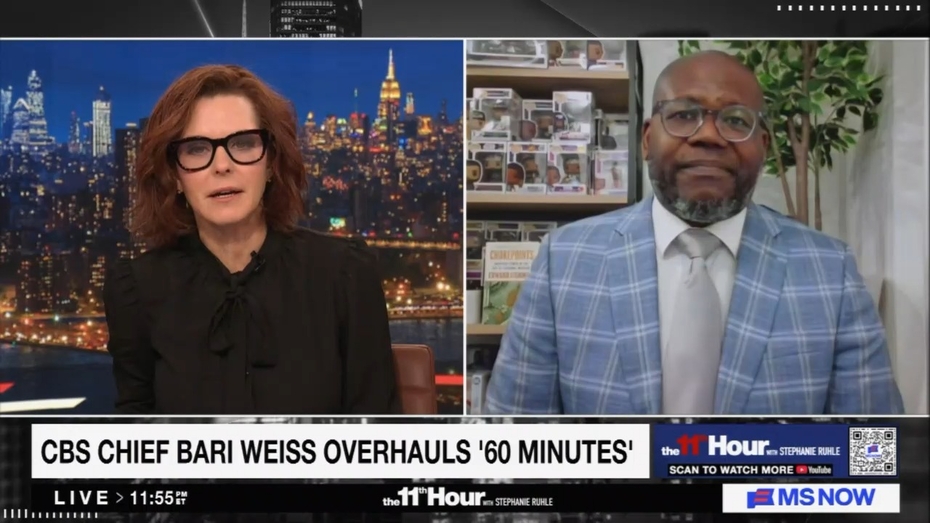
Ruhle introduced the segment with basic details, as she described Bari Weiss as “the controversial editor-in-chief.” She had a brief eulogy on the fired Cecilia Vega and Sharyn Alfonsi, noting Alfonsi’s “abruptly” pulled report on El Salvador mega prisons.
Ruhle then related the changes to the News Emmy ceremony on Wednesday night, which she attended:
What does it mean when an organization as important as 60 Minutes gets fully scrambled, and it happens a day after the Emmys?
After the announced changes to CBS's 60 Minutes, MS NOW's The 11th Hour decried the changes as host Stephanie Ruhle related the move to the News Emmys ceremony. Later, guest Jason Johnson called the moves at CBS part of a "state capture" of the network.
— Nick (@nspin310) May 29, 2026
Ruhle then asked what… pic.twitter.com/qJ2ulZBHEq
Johnson first made reference to how long-form news was on the decline due to the prevalence of short-form content. He then called the changes to 60 Minutes “damaging,” and acted as if the program had been pulled from the air by CBS and Weiss, which it was not:
So, the gutting of 60 Minutes is not just damaging as far as the information that the American people will be able to see. The lack of in-depth storytelling, the lack of consistent, in-depth storytelling that Americans will see. But it is also going to ruin a generation of young people who won't know what real long-form news looks like anymore.
He then claimed CBS was being captured by the “state”:
I still show segments from 60 Minutes to my students at Morgan State University, and the gutting, the state capture of CBS in general, and the destruction of 60 Minutes in particular, is a damage that we will not fully comprehend, probably for another generation.
After Johnson’s “state capture” comments did not receive a response from Ruhle, the host defended fired reporter Cecilia Vega and read her statement that called the firings and overall changes at 60 Minutes “censorship” and is “dangerous for our show and for our democracy.”
Ruhle then, after she read a provocative statement from Vega, said, “Cecilia Vega is not a provocateur. She is not a firebrand. We have never, ever heard anything like this from this woman.”
There has been many examples of Vega’s bias and provocativeness documented here at NewsBusters, including her comments calling Trump’s messaging “as dark as it has been” about immigrants during 2024 election night coverage.
Ruhle then asked Johnson, “What does this mean for our democracy?” Johnson replied once again with a claim of “state capture” as he compared the situation to countries with media censorship, like Russia:
It's not the complete censorship that we would see in Romania or Kenya or Russia, but it's something pretty close, and it's akin to it because once you have wealthy friends of an authoritarian or a proto-authoritarian regime buying large media outlets, people begin to self-censor. They begin to get rid of people who will ask difficult questions. They begin to spike stories that actually matter.
The part never mentioned in all the reports about CBS and Weiss that worry about the “state capture” or the future of democracy was how much of their news has remained biased, like a recent story from CBS Sunday Morning that was mesmerized by Iranian A.I. LEGO propaganda
As much as Ruhle and Johnson worry about “democracy” amid CBS changes, it is most definitely not right-wing MAGA CBS as some liberals allege.
The transcript is below. Click "expand":
MS NOW’s 11th Hour with Stephanie Ruhle
May 28, 2026
11:52:04 PM Eastern
STEPHANIE RUHLE: We are following major shakeups at CBS News from Bari Weiss today. The controversial editor-in-chief has named a new executive producer of 60 Minutes. Nick Bilton will replace Tanya Simon, who had been with the show for 30 years. The New York Times reports Bilton is a tech journalist and a filmmaker who has never worked in traditional broadcast news.
The Times also reports CBS News also fired Cecilia Vega, the program's first Latina correspondent, and Sharyn Alfonsi, whose segment on torture in Salvadoran prisons was pulled off the air abruptly last year by Ms. Weiss, who requested for more reporting. It aired in full at a later date.
Joining me now, Jason Johnson, a politics and journalism professor at Morgan State University. He's an MS NOW political contributor.
Okay, Jason, people might say, Stephanie, why does this matter? Why are we talking about personnel at another network? But here's the thing. I was at the Emmy Awards last night. We were lucky enough to be nominated, and being there reminded me of how important and influential 60 Minutes is. The program won two Emmys last night. It has been on the air for 58 years, and it's one of the only places that does true investigative journalism for the American people. Large-scale, expensive, detailed journalism at a time when we've got misinformation and disinformation, cannons booming from hilltops.
What does it mean when an organization as important as 60 Minutes gets fully scrambled, and it happens a day after the Emmys?
JASON JOHNSON: So, I'll say this in two ways, Stephanie. And I'm not trying to be glib when I say this. If you are in Generation X, if you are a baby boomer, if you are a millennial, probably the two most influential things in your perspective on journalism was Murphy brown and 60 Minutes.
These are the two things that sort of define what good journalism is supposed to be, how you're supposed to speak truth to power, how long-form journalism can still be accepted and profitable and reasonable, as opposed to short clips and TikToks and everything else like that.
So, the gutting of 60 Minutes is not just damaging as far as the information that the American people will be able to see. The lack of in-depth storytelling, the lack of consistent, in-depth storytelling that Americans will see. But it is also going to ruin a generation of young people who won't know what real long-form news looks like anymore.
They will be completely dependent on TikTok, completely dependent on Instagram, completely dependent on documentaries. I still show segments from 60 Minutes to my students at Morgan State University, and the gutting, the state capture of CBS in general, and the destruction of 60 Minutes in particular, is a damage that we will not fully comprehend, probably for another generation.
RUHLE: And to be clear, this argument that we hear all the time with this kind of journalism costs too much money. We're now in the universe of, you know, grab a ring light and go for clicks. It's one of the most successful shows. Alright. It brings in the big dollars.
But I want to share what Cecilia Vega said, right. She says her team has experienced efforts to insert political bias into stories and held back pitches out of fear of repercussions. She said this in a statement, quote, “let's call this what it is. Censorship, both imposed and self-driven. It is dangerous for the show and for our democracy.”
A spokesperson for the network responded by saying her claims are not based in reality. Let's be clear, Cecilia Vega is not a provocateur. She is not a firebrand. We have never, ever heard anything like this from this woman. Not publicly, not ever. What does when you hear something like this from Cecilia Vega? What does this mean for our democracy?
JOHNSON: Well, this is, the Columbia Journalism Review had a whole piece about this last summer. This is state capture, right?
It's not the complete censorship that we would see in Romania or Kenya or Russia, but it's something pretty close, and it's akin to it because once you have wealthy friends of an authoritarian or a proto-authoritarian regime buying large media outlets, people begin to self-censor. They begin to get rid of people who will ask difficult questions. They begin to spike stories that actually matter.
And Stephanie, you talk about this all the time, even if we start talking dollars and cents, right, 60 Minutes was making money. Barry Weiss has managed to destroy the ratings of almost everything else on CBS. So, from a pure dollars and cents standpoint, no one should trust her to make massive changes at the one moneymaker that they have left.
Which speaks to the fact that a lot of these moves are completely ideologically driven. They're not driven by news, and they're not driven by money. Because why would you destroy the last golden goose you still have left, and you're sort of crown jewel of news at CBS.
RUHLE: Big dollars buying big networks, and making no sense. Jason, thank you so much. I’m glad you joined us tonight.
(...)