"Everything before the word 'but' is horse s--." -- Jon Snow, Game of Thrones.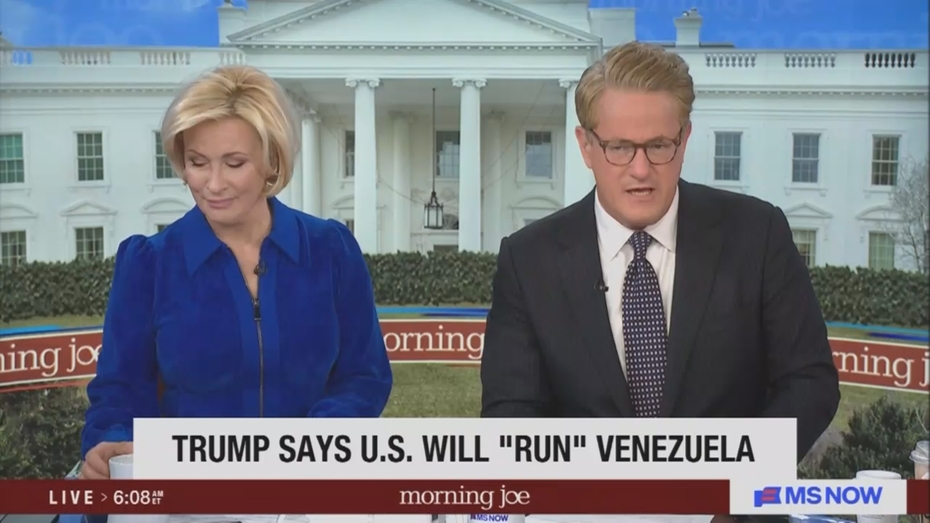
Joe Scarborough gave a perfect illustration of Snow's dictum on today's Morning Joe:
"We're certainly not hoping that things [in Venezuela] unravel, but that's what recent history has taught us."
The success of the operation that resulted in the extraction of Maduro and his wife without the loss of a single life among the thousands of US military members involved has been a bitter pill for Scarborough and the rest of the liberal media to swallow.
Scarborough acknowledged that success as the beginning of his statement: "The military operation was executed, from every report I've seen, flawlessly." The first "but" arrived immediately thereafter: "but let's talk about what we've learned over the past 20 years and the concerns that I think most Americans share with me."
Given the initial success, you just know that Scarborough and the rest of the liberal media are all the more hoping and praying, waiting to pounce at the slightest indication that things are not going according to plan.
And that's how Scarborough's second, telling, "but" popped up:
"There's very little a president can do when you try to occupy a foreign country as things unravel. It's certainly not what we're hoping for here, but it is what history, recent history, has taught us over the past 20 years."
Not what you're hoping, Joe. Riight.
Scarborough based his argument on analogizing the Venezuelan operation to the US invasions of Afghanistan and Iraq, which both ended badly. But there are good reasons to reject those analogies. As the spokesman for Venezuela's opposition has noted:
- Venezuela has legitimate democratic leadership—twice over. María Corina Machado was elected as the leader of the democratic movement with 93% of the votes in the opposition primaries, and Edmundo González Urrutia was elected president with 70% of the votes,. This double democratic legitimacy does not exist in the aforementioned countries.
- Venezuela has a strong democratic legacy. During the second half of the 20th century, Venezuela was one of the most prosperous and stable democracies in Latin America. This historical background contrasts sharply with countries such as Libya, Somalia, or Afghanistan, which lacked consolidated democratic traditions before their crises.
- Venezuela does not face deep religious or ethnic divisions. Unlike Iraq, where sectarian and ethnic conflicts have played a central role in political instability, Venezuela does not suffer from deep-rooted religious or ethnic clashes that could fracture society during a transition process. This significantly reduces the risk of internal conflict and state fragmentation.
There is a persuasive argument that, instead of Afghanistan and Iraq, the US operations in Grenada and Panama are the more apt analogies to the Venezuela operation.
The 1983 invasion of Grenada ordered by President Reagan overthrew the Marxist military junta that had seized power. Just one year later, Grenada held a competitive election, and since that time, Grenada has remained a stable and reasonably prosperous democracy.
Even more analogous was the US operation in Panama at the end of 1989, ordered by President George H.W. Bush. Much like the situation in Venezuela, the operation was aimed at the capture and arrest of Manuel Noriega, the military dictator and a drug kingpin who transformed Panama into a hub for cocaine trafficking. He was captured and put on trial in Miami, convicted of multiple drug-related offenses, and served a long prison term. He was eventually extradited to Panama and sentenced to multiple 20-year sentences for the murder of political opponents. He remained a prisoner at the time of his death in 2017 at the age of 83. The parallel to the capture of Maduro to face multiple drug-trafficking charges in the US is striking.
After Noriega was deposed, Panama established a constitutional democracy and has since maintained stable democratic institutions. And Panama has a flourishing economy, with per capita income comparable to that of some Eastern European countries.
No analogies are perfect. And there are bound to be challenges and setbacks along the way in Venezuela. Success is not guaranteed. But Scarborough's "buts," and the wishin' and hopin' they represent for American failure in Venezuela, say much more about Scarborough's partisanship than they do about the reality of the situation.
Here's the transcript.
MS NOW
Morning Joe
1/5/26
6:06 am ETJOE SCARBOROUGH: The military operation was executed, from every report I've seen, flawlessly, but let's, let's talk about what we've learned over the past 20 years and the concerns that I think most Americans share with me. Not that Maduro's been taken out, but what happens next?
DAVID IGNATIUS: So that what-next problem is the part that haunts anybody who was present, as I was, as US troops rolled into Baghdad in 2003. You could hear in President Trump's voice last night as he spoke on Air Force One the exhilaration that presidents feel when they use military power successfully. Just, there was a lion's roar as he talked about, you know, watch out, Colombia. It's a sick leader. They're next. Watch out, Mexico. Mexico's run by cartels. Cuba's about to fall apart. This was a president who was just feeling what military power can do.
And the problem is, you don't look over the next hill to all the problems you're going to encounter. It was within a week of that arrival in Baghdad that the U.S. began struggling with the reality. Who's going to govern this country now tha Saddam Hussein has been deposed, and you have all the different factions competing for influence.
It's obvious that the strategy, better outlined, really, by Marco Rubio, the Washington Post, cleverly, is calling the viceroy of Venezuela, that his approach is is to leave President Delcy Rodriguez in place, to try to work with the military rather than fire it wholesale, the way it was done in Baghdad. And hope that through coerced cooperation, the Venezuelans will maintain sufficient order that this process of U.S., I want to say, reappropriation of Venezuelan oil can take place and the country will be modernized.
But, boy, I can't imagine, Joe, a more slippery slope ahead than what they're describing as the process for putting this country back together. It is a mess. Trump is right in saying that. But I haven't heard anything yet that tells me how they're going to transform the mess into a viable, stable country. Nothing.
SCARBOROUGH: Again, we, we look back and see what happened with Iraq, and even Afghanistan, which for a while people were saying, well, that was a good war. Well, no, no. Afghanistan and Iraq both ended in tragedy.
Jon Meacham, I, I just keep going back to the early days, as David Ignatius talks about exhilaration, the early days of, of Iraq after the March invasion. We had, you know, generals fist bumping me, saying, can you believe how great things are going? Retired generals. Can you believe how great things are going over there? I had people in the media saying Bush is going to be president forever, et cetera, et cetera, et cetera.
I even remember Jon Stewart, who just unmercifully grilled George W. Bush. At one point, when things were going so well in Iraq in those first few months, he threw his hands up and said, I guess my children are going to be going to middle schools named after George W. Bush.
Of course, that didn't happen. Things turned south badly, and there's very little a president can do when you try to occupy a foreign country as things unravel. It's certainly not what we're hoping for here, but It is what history, recent history, has taught us over the past 20 years.