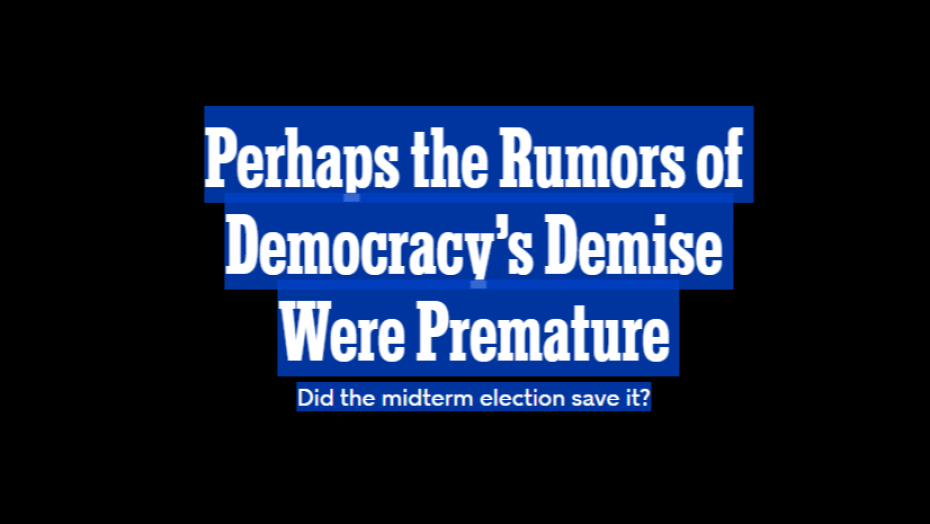
The New York Times Magazine posted this headline for Sunday: “Perhaps the Rumors of Democracy’s Demise Were Premature: Did the midterm election save it?” The answer was yes, according to Times Magazine writer Emily Bazelon:
The November election became not just a referendum on President Trump, but also a crucial test of American democracy. In the end, the country passed. Turnout was the second highest for a midterm in more than a century, and Republicans, including Trump, have accepted the results.
This framing wasn't subtle. The photograph next to the headline was exuberant James Talarico supporters enjoying their victory.
Accepting the results is good and orderly. Even if The New York Times had serious trouble accepting Trump's first election in 2016, spending most of his first term pushing investigations into the conspiracy theory that suggesting Russians stole the election. Bazelon began:
Before the midterms this month, experts who measure the health of democracies saw the United States experiencing “the most dramatic decline in American history,” in the words of one global index.
They linked to the "V-Dem Institute" in Europe, which regularly bangs the can that Trump is an authoritarian. Their 2025 report threw shade at the 2024 election: "The level of democracy for the average citizen in Western Europe and North America is at its lowest level in over 50 years, primarily due to ongoing autocratization in the USA."
This spin makes it crystal clear: Democracy dies in darkness when Republicans win, and suddenly thrives when Democrats win. Bazelon tried to claim otherwise, but it’s self-evident,as the Democrat victory is "healing" us:
Does one free and fair election mean the concerns that preceded it were overblown? There’s little question that Trump’s hyperaggressive use of presidential power and his family’s self-enrichment have served as a shock to the county’s democratic traditions. But the election suggests that American democracy has the resources to heal. The point is not that Democrats were the victors. It’s that the popular will won and reflected a wholesale turn against the administration in power.
There was no “popular will” in 2024, they imply, just “ongoing autocratization." Bazelon made it clear that democracy is upheld when the Left offers a "countervailing force" to Trump, but elitist media never labels them ideologically, they're "civil society":
Maybe Trump will be remembered for trying to distort American democracy but ultimately proving that it was stronger than him. The United States has an advantage over more vulnerable democracies — its wealth and the capacity of civil society. The private sector, universities, unions, foundations and nonprofit groups, along with state and local governments, create a countervailing force. Consider the threats that petered out. The chairman of the Federal Communications Commission, Brendan Carr, urged ABC’s affiliates to drop Jimmy Kimmel, a move that Trump applauded. But Kimmel was back on the air days later after widespread protest. Law firms bowed to the Trump administration’s demands, but lost lawyers and clients. Elon Musk spent hundreds of millions of dollars on Republican candidates and came up empty.
Bazelon also celebrated that "The courts also checked presidential overreach, as the Constitution provides," especially when Democrat states refused to grant the federal government any access to their voter rolls to check for fraud by non-citizen voters. A few paragraphs later, she lectured: "The health of a democracy ultimately depends on the commitment of all the major parties to play by the rules." Once again, the bias is obvious: voting by non-citizens isn't "playing by the rules," but apparently democracy is most vibrant when Democrat states won't offer any transparency into who is voting.