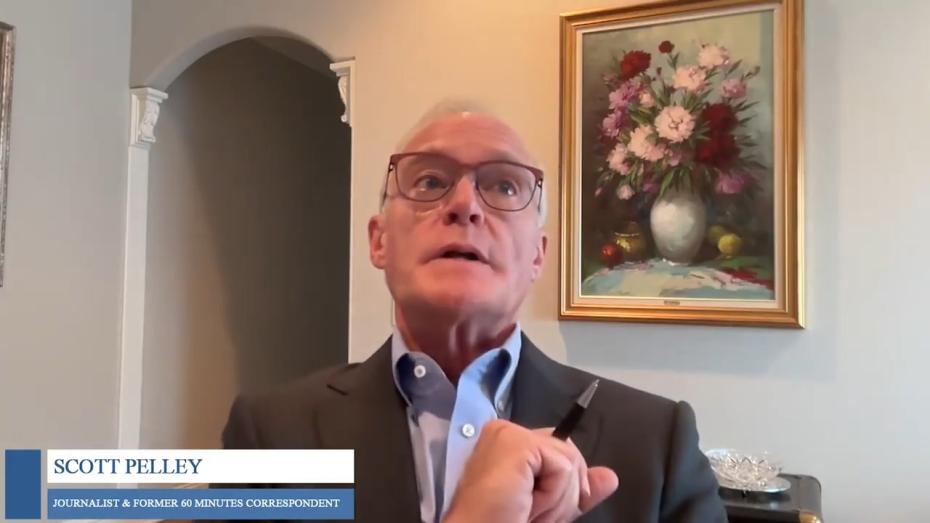
On Wednesday, former 60 Minutes correspondent Scott Pelley, who was fired after yelling at the show’s new editor-in-chief at his introductory meeting, appeared on another random panel event to complain about the current state fo CBS News under Bari Weiss. In the long panel session, Pelley stated he faced “intimidation” in his last months at CBS and claimed he was told to report stories with a “particular bent,” which he called an “anathema to all of us who’d worked at 60 Minutes for so many years.”
Pelly was on a panel from a group called “Speak Up for Justice,” which claims to be a "nonpartisan movement” dedicated to "defending judicial independence.” Notably, the panel Pelly was a part of featured the co-founder of MediaTouch, a liberal media group, who claimed the Trump Administration was a “oligarchic, Putin-style regime.”
At the start of the discussion, the organization’s leader, Paul Keisel, turned to Pelly to discuss his waning months at CBS News. Pelley first claimed, “There was an imperative to move our coverage in the direction of the president to put a thumb on the scale, if you will, in terms of the president's viewpoint.”
He continued, claiming “corporate influence” impacted the news division as he claimed they said, “We want you to report stories with that particular bent in terms of politics.” Pelley added, “It was anathema to all of us who'd worked at 60 Minutes for so many years.”
On an online panel for the group “Speak Up for Justice," former 60 Minutes correspondent Scott Pelley once again appeared at a random panel event and recalled his firing. He claimed new CBS leadership wanted stories reported with a “particular bent” in terms of politics.
Pelley… pic.twitter.com/z8oQb4LDQY— Nick (@nspin310) October 28, 2026
Notably, 60 Minutes stories contained a liberal political bent in the past six seasons of the show, which Pelly was a big part of before his firing, with the show airing five times more liberal stories than conservative ones.
After the MediaTouch panelist went on an anti-Trump rant, Pelly worried about CBS News and CNN having the same ownership after the Slydance-Warner Brothers merger. He once again worried for CNN and claimed Weiss wanted to CBS "to tune its stories to the liking of the White House," which he claimed was what he and his fired colleagues were fired for "standing up to."
Still going, Pelley claimed Bari Weiss wanted to make CBS “more like opinion television" and wanted "to tune its stories to the liking of the White House,” before he claimed he was fired for “standing up to that problem.”
He also later added he would have quit CBS over the Saudi… https://t.co/URstL2UKEI pic.twitter.com/E2QLMf6K9t— Nick (@nspin310) October 28, 2026
Pelly then moved to worry about the new investment partner Skydance had in the merger and called Elon Musk’s proposed $1 billion investment “Troublesome,” before Pelly proclaimed he had a bigger issue with funding from Saudi Arabia’s Public Investment Fund.
In his own self-important fashion, Pelly claimed he would have quit over the Saudi funding:
To me, that's just breathtaking. I don't know how anyone still works at either of those organizations. If they hadn't have fired me, I would have quit over that certainly.
He later detailed a story of a pre-Ellison-owned CBS, before turning to claim new ownership wanted to “kill” Trump-related stories:
Pelley later said executives wanted to “kill” Trump-related stories and claimed an executive suggested replacing 60 Minutes with a sports special one weekend to avoid airing one.
(All 60 Minutes episodes this year have featured a Trump-related story.) https://t.co/s9O7LuDehk pic.twitter.com/5qETa3Rme5— Nick (@nspin310) October 28, 2026
With the Skydance acquisition of Paramount Global, that completely flipped on its head. And now we had corporate interests asking us, Why are we running the story about the Trump administration? Can't we kill it? Can't we push it off?
In one of his newer claims, he said a CBS executive suggested replacing the show one weekend with a “sports special” because they did not want a story to air:
At one point there was a story that the corporation was concerned about that dealt the Trump administration. And one of the executives on the West Coast had a brilliant idea, and that was we'll just preempt 60 Minutes completely with a sports special. We're not going to kill a story. We wouldn't want to be accused of killing a story. But we're going to run a sports special instead of 60 Minutes. All kinds of things like that.
Notably, all 60 Minutes episodes this season have contained a Trump-related and bashing story and have not been preempted for “sports specials.”
Additionally, to close the hour-long panel, Pelly, as if he were a First Amendment hero, was asked, “What's the one principle a newsroom should never compromise, even if defending it costs someone their job?”
Pelly pompously responded, “Independence. Independence from politics. Independence from corporate influence. You train journalists to make the right decisions, and you trust them. And so independence over everything. That is what we lost at CBS News.”
Since Pelley seemingly does not watch 60 Minutes anymore, maybe he should be told the newest episode of the magazine show featured two anti-Trump stories, with one of the stories receiving backlash for its defense of an illegal immigrant.
The transcript from the panel is below. Click "expand":
Speak Up for Justice on YouTube
Trust Truth to Power: Journalism, Corporate Power & the First Amendment
October 28, 2026
Timestamp: 02:04-08:52
PAUL KEISEL: So let's begin the discussion this morning with you, Scott. I'm interested, you spent 37 years at CBS News, before being fired following dispute with new management. You said that management wanted you to introduce falsehoods and bias into politically sensitive stories, and that you refused. CBS has offered a different account of your dismissal. But I want to go beyond the dispute and see what's really happening within the newsrooms today.
So, Scott, what exactly did management want change in the story, and who asked that of you?
SCOTT PELLEY: Well, in my experience, and having talked to my colleagues as well, there was an imperative to move our coverage in the direction of the president to put a thumb on the scale, if you will, in terms of the president's viewpoint. Stories were getting pulled because there was no administration voice in the story this after many weeks, even months of trying to get someone in the administration to talk to us and being told flatly, "No, there's no way you're going to talk to you." Those stories ended up for the most part getting back on the air, again, without the administration speaking, because pulling them didn't do any good either.
So, what we had was a situation that I'd never seen. I was at CBS News almost 40 years, and at 60 Minutes almost 30 years. And I had never seen anything like this.
This was corporate influence coming into the news division saying, "We want you to report stories with this particular bent in terms of politics."
It was anathema to all of us who'd worked at 60 Minutes for so many years. And we fought the battle against it, we pushed back against it. And that led to last year the complete gutting of 60 Minutes, in one morning, without warning or still today, without explanation, the entire senior staff, including the executive producer, Tanya Simon, were all wiped out and replaced by new people that I have to assume the corporation decided would be more amenable to their kind of reporting of the news.
KEISEL: So, that raises an interesting point. And I'm going to ask you, Gretchen, who has the power to influence what journals report?
GRETCHEN CARLSON: Well, when I was listening to Scott talk, I was also a former colleague of his at CBS News before going to Fox, but I was thinking to myself, "Wow, what he's describing, sounds like Fox News.” I mean, that's the way opinion TV works, which is part of the problem as we're going to have this discussion for the next hour or so, is that I believe opinion TV was smart when it first started because people were getting their news at work during the day with the proliferation of just the internet and everything else. And so, it was smart when they came home at night. It's like, "Oh, I wonder what people think about the news, because I already know the headlines." But then it just grew into this monster, where now people are just so hyper-political and separated and only watch what they want to see and what they agree with. And that's how you get down to that 33 percent, I think.
So, Paul, sorry, I wanted to say that first. What was your actual question to me?
KEISEL: Well, I wanted to know, so who has the power to decide what we're seeing, hearing, and what?
CARLSON: Well, you know, from the Fox News point of view, the people at the top, I guess that would be true at any entity. But certainly what Scott was describing was my experience at Fox News. And I can't really speak to, you know, the other entity now, but one would think that the journalists would have a lot of power as well to know how to report stories. But I'm sure there's some directive coming down from the top at every place.
KEISEL: Look, newsrooms obviously face pressure from two directions. They face pressure from the government who wants to have a voice in whatever stories are being told. And they now have more pressure from their ownership.
Just the other day, I read that Elon Musk invested $1 billion in Skydance. And so, you've got Musk, it's got his platform at X. He now has a billion dollars just a rounding error on his balance sheet with Paramount and Skydance. But, you know, Ben that brings me to you and new media and sort of your own ability to have a voice. And who controls you have to say about that?
BEN MEISELAS: Well, exactly. Well, that's where, you know, power ultimately resides in people. And the question is, which people? Is it, "We the people" or is it, "They the oligarchs?" Because what you're seeing is a concerted effort by the oligarchs that didn't just come out of nowhere. In our book, "WTF America," we trace this to the Roger Ailes memo in 1970 about creating a right-wing propaganda network, how that led to talk radio in the '80s, how that led to Fox, once you had the mixture of the Ailes memo with a well-moneyed class of people who were going to put money behind it.
And then the kind of final implementation of it we're seeing in the hands of an oligarchical Putin-style regime, which is what we call this Trump administration. We call it a Trump regime. And so, just like in a Russia, a Putin-Russia where you have oligarchs running it, that's the model that these oligarchs want to see here. It is international in scope, what took place here. It's not just uniquely an American thing. It's an international network. And so, the question that becomes is, "Well, what do we do to fight back?"
And I think, you know, the Trump regime, they said, "Look, if we destroy the institutions, the people will collapse, and the people will fall in line. I think what they didn't expect is that what you're seeing right now is this transformation of we, the people saying, "No, we don't want to accept that level of control." So, you're seeing the rise of independent media, independent news, and then it is developing a relationship of trust with the audience in a environment where there still is not a lot of trustworthy people.
So, it is just establishing these relationships of trust and expanding and rebuilding. And that's what we're trying to do.
(...)
Timestamp: 22:14 - 25:13
KEISEL: Scott, what are your thoughts about this level of concentration of power in the media?
PELLEY: Well, after what's happened at CBS News, it certainly a worry that Skydance has acquired CNN as well. First of all, there's going to be huge consolidation there. I mean, do you need two Washington bureaus? Do you need two London bureaus?
That kind of thing. So, they're with 80 billion dollars in debt. Those two news organizations are going to get conflated into one. I'm quite certain.
So, what happens then? We have seen, under the direction of CBS editor-in-chief Bari Weiss, this push to CBS News to make it more like opinion television and to tune its stories to the liking of the White House. Happened to me, happened several of my colleagues before we were all fired for standing up to that problem.
So, they have promised CNN that they're going to be independent and that nothing of the kind is going to happen and that Bari Weiss isn't going to have oversight over CNN. But David Ellison told me all of those same things while shaking my hand about CBS News that it was going to remain independent and it was going to operate in the way that it had in the past.
So, I think you have to take that with a grain of salt. And there's another point I want to make. And maybe I make too much of this. But I'm a little bit of an absolutist. Paul, you talk about the billion dollars that Elon Musk invested in Skydance to help make these acquisitions. Troublesome, certainly.
But another entity that put billions of dollars into this is the Saudi Arabian Public Investment Fund. The Saudi Public Investment Fund, of course, is controlled entirely by Mohammed bin Salman, who U.S. intelligence would tell you ordered the murder of Washington Post columnist. Not just the murder, but the murder and dismemberment of a Washington Post columnist. So, now, some significant portion of CBS News and CNN are owned by someone who ordered the murder of a journalist because he did not like what the journalist had to say.
To me, that's just breathtaking. I don't know how anyone still works at either of those organizations. If they hadn't have fired me, I would have quit over that certainly. So, this consolidation with all of these players coming in from dubious directions is enormously worrying.
(...)
Timestamp: 29:43-33:12
KIESEL: Well, I think optimism is important, and I'm incredibly optimistic. Though I'm cautiously optimistic as I see things happening. Look, we know how power can control the media. Scott, you're a perfect example of how power controls the media. What threats, Ben, if you know of any, I know he had an enemies list of YouTube channels that he disagreed with. Have you had any direct threats that you can talk about?
PELLEY: Direct threats in terms of what exactly, Paul, physical threats?
KEISEL: No, just the sort of intimidation that's coming from the powerful forces against us.
PELLEY: Well, that describes my whole last 18 months, I would say. When Skydance took over Paramount Global, there was a sudden and dramatic change. There was 100 percent interference in what we were doing at 60 Minutes. Something that none of us had ever seen before. We had a corporate structure that guaranteed the independence of 60 Minutes.
If we did something wrong, we would hear about it, and maybe somebody would get fired, and that was quite reasonable. But otherwise, the people at CBS Corporation didn't know what we were doing and didn't know what was going to be on 60 Minutes before seven o'clock Eastern time on a Sunday night.
I'll tell you a few years ago, I was the anchor of the CBS evening news, and I was called out to LA to the headquarters to meet with the then president of the CBS television network. And I couldn't imagine what it was he wanted to tell me that required me to fly all the way over to Los Angeles and lose a couple of days to speak with it. But his ultimate message was essentially this. He said, look, I'll take care of the politics and I'll take care of the business. You need to look out for the viewers. You understand what I'm saying? And that's the way it was.
Of course, the corporate owners have to deal with politics. Of course, they do. Of course, they have to pay attention to business interests. But the then CEO of CBS flew me out there to make sure, face-to-face, that I understood that my allegiance was to the viewers and the corporation would handle all those other outside pressures and I would not hear about them. Ever.
With the Skydance acquisition of Paramount Global, that completely flipped on its head. And now we had corporate interests asking us, “Why are we running the story about the Trump administration?” Can't we kill it? Can't we push it off?
At one point there was a story that the corporation was concerned about that dealt the Trump administration. And one of the executives on the West Coast had a brilliant idea, and that was we'll just preempt 60 Minutes completely with a sports special. We're not going to kill a story. We wouldn't want to be accused of killing a story. But we're going to run a sports special instead of 60 Minutes. All kinds of things like that.
So I don't know if I came within a thousand miles of your question, Paul. But –
KIESEL: But it was great answer. The answer is more important than the question. So it was a good answer. Thank you.
PELLEY: I always thought so
(...)
Timestamp 01:00:53-01:21
KIESEL: So what's the one principle a newsroom should never compromise, even if defending it costs someone their job?
PELLEY: Independence. Independence from politics. Independence from corporate influence. You train journalists to make the right decisions, and you trust them. And so independence over everything. That is what we lost at CBS News.
(...)