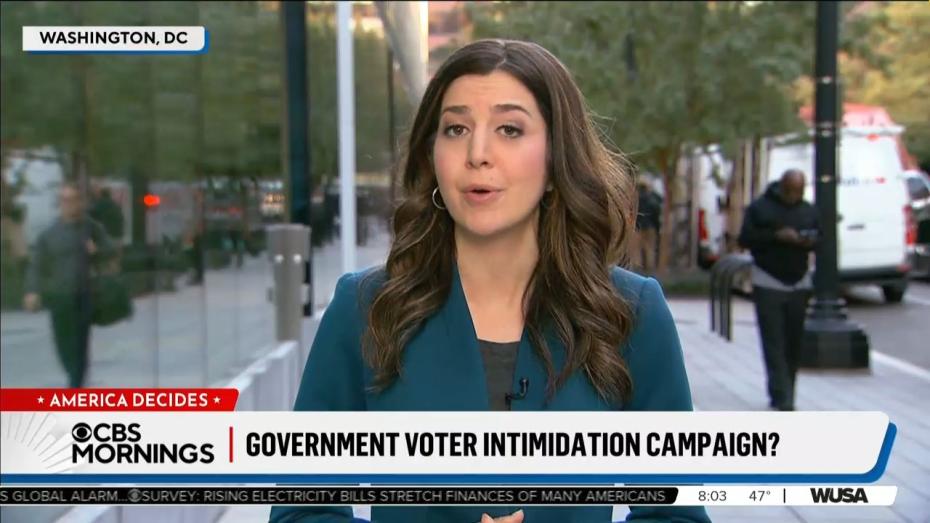
On Thursday, CBS Mornings sounded the alarm over the Trump administration's attempt to investigate potential illegal voting, framing door to door visits by Department of Homeland Security agents as a threat to democracy.
Correspondent Nicole Sganga highlighted concerns about voter intimidation with emphasis on the lack of evidence that noncitizen voting is widespread. In her rush to spotlight the dangers of Trump’s efforts, Sganga gave viewers little reason to consider why officials are investigating election integrity in the first place.
Sganga explained that the visits were “part of a surge initiative to crackdown on so-called criminal voter fraud focused on nine states,” before noting that a federal judge had ordered the operations to stop.
The report then turned to Hayden Johnson, a lawyer of Protective Democracy, the left-wing group suing the federal government. Johnson complained that the effort violated longstanding policy and questioned the government’s ability to identify citizens:
Federal government doesn’t have good information to show who is in fact a U.S. citizen, if they’re naturalized citizens, when they naturalized, and at what point they have participated in elections by registering or voting.
The report offered little comparable scrutiny of the arguments supporting election enforcement. Instead, viewers were left to consider how the visits might frighten eligible voters.
Sganga further emphasized the rarity of voter fraud-related charges, reporting that only 156 people had been charged with related offenses since the beginning of Trump’s second term, out of 227 million active registered voters.
The segment went on to even raise the question of whether or not the operations could cause psychological intimidation, with former HSI supervisory agent Eric Balliet asking “How does it not impact your psyche from an intimidation stance that you are on the federal government's radar when it comes to where and how you vote?”
The question assumed that being questioned by federal agents would necessarily have an intimidating effect on noncitizens, rather than examining the circumstances of the visits or the distinction between investigating suspected violations and prevention of noncitizen voting.
Sganga noted that DHS was “laser focused on prosecuting and removing people who voted illegally,” adding that those who had not broken the law had “nothing to fear.” Sganga ended her story with DHS having 48 hours to appeal the judge’s temporary pause on the operations in nine states.
Sganga’s argument held little pretense, and was insulting to what real voter intimidation and election suppression historically looked like under Jim Crow. Black Americans were systematically denied their right to vote through discriminatory poll taxes, literacy tests, and other barriers to keep them from the ballot box. These were not only intimidations, but documented efforts to disenfranchise voters because of their race.
CBS failed to underscore the importance of distinguishing between genuine voter suppression and legitimate efforts to enforce election laws.
The transcript is below. Click "expand" to read:
CBS Mornings
October 22, 2026
08:01:19 a.m. Eastern(...)
[CUT TO VIDEO]
SGANGA: Armed federal agents are scouring for noncitizens who may have illegally voted or registered to vote in U.S. elections, promoting those efforts in flashy social media videos and photos. This one shows a woman holding her daughter's hand with four officers on her porch with the caption “American elections are for Americans.”
The agents from the Department of Homeland Security are being tasked with knocking on doors asking residents about their immigration status and whether they voted. It's part of a surge initiative to crackdown on so-called criminal voter fraud focused on nine states. But last night, a federal judge gave them a Friday deadline to stop.
LAWYER HAYDEN JOHNSON: It is violating decades of practice in policy.
SGANGA: Hayden Johnson is a lawyer for Protect Democracy, a left-leaning group suing the federal government over these visits.
They allege the target lists compiled by agents are inaccurate and littered with U.S. citizens.
JOHNSON: Federal government doesn’t have good information to show who is in fact a U.S. citizen, if they’re naturalized citizens, when they naturalized, and at what point they have participated in elections by registering or voting.
SGANGA: Since the start of the Trump administration's second term, only 156 people have been charged for voter fraud related offenses out of 227 million active registered voters in the U.S. The searches have raised concerns about voter suppression in the lead up to the midterm elections.
[to Eric Balliet]: Is there a risk of voter intimidation mixed into these operations?
FORMER HIS SUPERVISORY AGENT ERIC BALLIET: How does it not impact your psyche from an intimidation stance that you are on the federal government's radar when it comes to where and how you vote?
[END OF PACKAGE]
SGANGA: DHS told us in a statement it is laser focused on prosecuting and removing people who voted illegally, adding those not breaking the law have “nothing to fear.” The department now has 48 hours to appeal that federal judge's temporary pause on these door to door operations in 9 states.
(...)