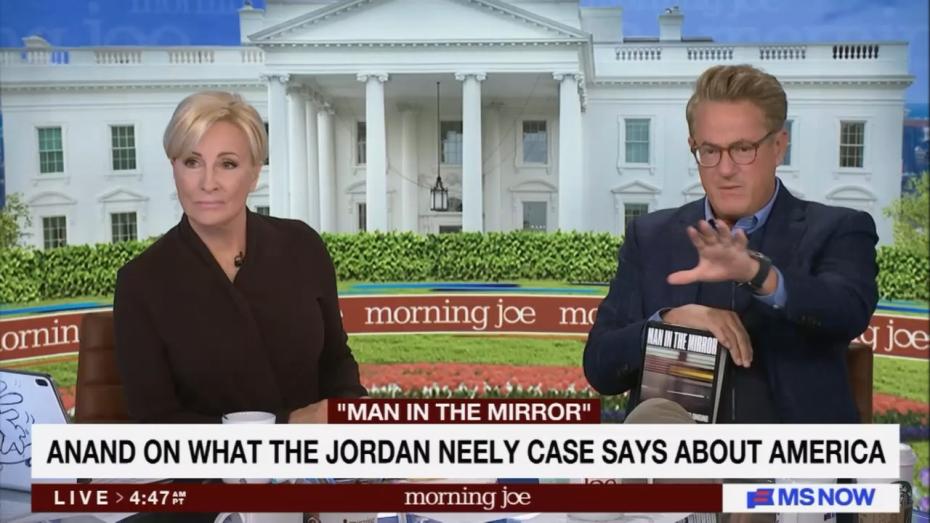
Monday’s Morning Joe led off its week with the revival of Daniel Penny’s New York 2024 subway case in promotion of a new book, Man in the Mirror, by guest Anand Giridharadas, who will apparently be on the liberal morning show multiple times this week to discuss his book on the Penny and Jordan Neely case. In the prolonged segment, Giridharadas decried the “clickbait” of the case, before he then decried Penny’s “dehumanizing language” and blamed his Marine mentality for Neely’s death.
Later, in a Joe Scarborough special at the end of the segment, the ever-present host connected the story of Neely's and “dehumanization coming from the White House” to immigration enforcement and “concentration camps.”
Back in the 2024 trial, a 911 call played where a caller said Neely was “trying to attack everybody” before Penny’s chokehold. Penny was later acquitted by a jury in December of 2024.
On Monday’s Morning Joe, in the year 2026, Anand Giridharadas and Joe Scarborough revived the Daniel Penny-Jordan Neely case from 2023/24 in promotion of Giridharadas new book ‘Man in the Mirror.'
In part of a longer discussion, Giridharadas decried “dehumanizing language” from… pic.twitter.com/bsmiha4uPS— Nick (@nspin310) September 28, 2026
In his introductory background refresher on the story, he gave background for both Neely and Penny before he described the case an “American Rorschach test”:
And everybody immediately knew from that moment it was kind of an American Rorschach test, right? Daniel Penny is either a hero stepping up against anarchy in the cities, or he's a white supremacist vigilante in the Trump era. You know, Jordan Neely was either a kind of thug, hobo, vagrant, career criminal in one telling, or he was someone who embodies the failure of so many of our systems to care for those on the edge of the edge.
He added, “And I really tried to live inside the minds and recreate the minds of lots of different people, almost like in a novel, because at some deep level, I think America is in the crisis we are talking about.”
Later, after Scarborough and Giridharadas admitted Neely’s actions on the subway was “dangerous” and “beyond a Tuesday,” Giridharadas went after Penny and his “language”:
The government's allegation was that he dehumanized Jordan Neely, and they based that on two videos, one taken right after, on the scene where you have a bunch of cops trying to save Jordan Neely's life.
And Daniel Penny quite visibly has a very different attitude than anyone else in that shot. And then in the interrogation room where he repeatedly used dehumanizing language, saying he was just a crackhead. He was just a crackhead. You know, these crackheads pushing people in front of trains. He was squirming. A lot of that kind of language.
He continued to say the interrogation felt like a “manosphere podcast,” before he continued to connect Penny’s Marine mentality to the chokehold of Neely.
And, of course, Joe Scarborough connected the Daniel Penny case to the “dehumanization coming from the White House and politicians” and said it was “what allows our fathers, our mothers, our workers, our church members to be beaten, to be battered, to be thrown in concentration… https://t.co/8zVfrRkC1y pic.twitter.com/NXzrDItAgv
— Nick (@nspin310) September 28, 2026
After frequent panelist Mara Gay asked if the case was a “New York story or an American story,” Giridharadas blamed “the failures of our systems” and “all of our racial enmities and hostilities that have been pumped up from the highest levels of government.”
When Scarborough heard Giridharadas make a connection to current politics, he used it as an opportunity to talk about so-called "dehumanization coming from the White House.” He stated that the “dehumanization” is “what allows our fathers, our mothers, our workers, our church members to be beaten, to be battered, to be thrown in concentration camps.” He later corrected his label and said, “I'm sorry, not concentration camps. Internment centers.”
Scarborough could not help himself from making comparisons to Nazis, World War II, and other historically bad things, which he often does with ICE, which is all “too predictable and boring.”
The transcript is below. Click "expand":
MS NOW’s Morning Joe
September 28, 2026
7:32:24 AM Eastern
MIKA BRZEZINSKI: Okay. So here, the author of the new book out tomorrow titled Man in the Mirror: Hope, Struggle, and Belonging in an American City. And we're going to have you here for a few days to talk about this book.
ANAND GIRIDHARADAS: Very grateful.
BRZEZINSKI: It reports on the case of Jordan Neely from death to trial. And today you want to look at what we thought we knew about the case versus what you report and tell us about it.
GIRIDHARADAS: I was thinking about that ad. You know, sometimes you have to zoom all the way in to individual human lives to kind of see the truth of the country. It's hard to see a country as a country.
And so the story of Jordan Neely and Daniel Penny, for, you know, the brief refresher, three years ago, a subway car in New York, a black, mentally ill homeless man enters a subway car, starts, throws his jacket down, starts screaming, asking for food for water, saying he's hungry, thirsty, ready to go to jail, ready to die, in obvious psychiatric distress.
A white former Marine comes up behind him, puts him in a chokehold, drops him to the ground. Train gets to the station within a few seconds. Most people leave and the chokehold goes on for another five-plus minutes. That's Jordan Neely. He was once a beloved Michael Jackson impersonator right around here, 42nd street in the subway system had fallen on much harder times.
And from the moment that case kind of came up above ground and the news came up above ground, everybody you all remember the Rev. The Rev. was there from the beginning. Making meaning of this case. Delivered Jordan Neely's eulogy. Everybody in America instantly knew what they thought about it.
JOE SCARBOROUGH: Well, give us Daniel Penny background.
GIRIDHARADAS: Daniel Penny from West Islip, Long Island. Went to the Marines, sort of was, you know, like a lot of folks - I actually spent time with his Marine Corps unit for the reporting for this book. Like a lot of the guys in that unit, kind of not sure what they wanted to do with their life, found purpose and structure in the Marines. And he came from this very kind of bland town where most people stay, and things are kind of the same. And he wanted out. And this is also part of the tragedy of this case. He wanted to come to New York and live at this, live in the East Village. He got a nose ring. He was trying to bartend, and these guys collide.
And everybody immediately knew from that moment it was kind of an American Rorschach test, right? Daniel Penny is either a hero stepping up against anarchy in the cities, or he's a white supremacist vigilante in the Trump era. You know, Jordan Neely was either a kind of thug, hobo, vagrant, career criminal in one telling, or he was someone who embodies the failure of so many of our systems to care for those on the edge of the edge.
And I decided I wanted to spend three years not doing the clickbait thing that the country was doing with this story, the kind of chewing up and spitting out. I chose to live inside the story for three years because I believed it would tell us something about who we are, what has allowed, what we've allowed to happen to this country because I think of so many failures to see each other fully and properly as people. And I decided I was going to do the opposite of clickbait. I reported on everybody's perspective. I spent time in Daniel Penny's suburb, and with his Marine Corps unit. I spent time with Jordan Neely's Michael Jackson impersonator community, which is an incredible group of people in New York.
I spent time in City Hall with officials trying to figure out, when you have distressed folks on the street, do you do you grab them and force them to a hospital against their will? Is that the humane thing to do? Is leaving them to their choice the humane thing to do? I spent time with homeless outreach workers, Penn Station and other subway stations doing midnight to 8 A.M. Shifts, going to one homeless person at a time saying, ‘Can I offer you services? Can I help you?’ I watched them do this work.
And I - the last thing I'll say is, you know, for me, having sat around this table for a long time, I realized that I had also fallen prey to a culture sometimes of that hyper-reactivity and the quick, you know, provocative viral take. And this book took me back to my own roots in reporting to say, let's tell the stories of all kinds of people who are colliding in this moment. Let's tell the stories of all kinds of ways of looking at this country, the fighting fates of this country. And I really tried to live inside the minds and recreate the minds of lots of different people, almost like in a novel, because at some deep level, I think America is in the crisis we are talking about.
You're talking about that ad we talk about with Trump, not just because of one guy or four senators. There is a sickness among us, in us that, to me, at its root, is about a failure to see each other and a failure to understand each other.
(...)
7:40:16 AM Eastern
SCARBOROUGH: So let me ask you this, this question. So, I think when we had conversation, a lot of people following this. When the subway train was moving, there were people around. It seemed like everybody might be in danger. At that point, they look at a guy intervening to subdue this guy. I would guess maybe 90 percent of the people say, “Okay, good. It's good keeping everybody safe.” Then they went off the train and he continued holding this, this man for another -
GIRIDHARADAS: Another five-plus minutes.
SCABROUGH: - five-plus minutes.
So, here's a tough question. What did you find in his background? What did you find with his Marine buddies? What did you find like that in sort of the mindset that had developed with him that led maybe not to the five minutes, but led to him being in that position?
GIRIDHARADAS: Yeah, it's such a good question. So, you know, I think it's smart to separate the 30 seconds and the five minutes. I think the 30 seconds, you know, based on what was presented at the trial, you know, a lot of people at the beginning who were defenders of Jordan Neely said. This just happens on the subway every day. This guy couldn't handle it. I think that is not true. This was not every day on the subway. There were a lot of witnesses. You know, there was a 75 year old black woman who said, I've ridden the subway for 50 years. I've been sexually assaulted on -
SCARBOROUGH: It was dangerous.
GIRIDHARADAS: It was beyond a Tuesday.
SCARBOROUGH: Yeah. And so I think his assumption and the Marines I spoke to all kind of spoke to this to a T. They're aware of always being the person in the room who has.
SCARBOROUGH: The protector.
GIRIDHARADAS: Right.
And it's this kind of male hyper-vigilant culture that, you know, can be a very generative thing in some circumstances and can also not be. But in that circumstance, even the prosecution, when they eventually tried Penny, the prosecution began by saying he started trying to do the right thing in that 30 second. The question then became, why did he hold on?
And, you know, I think the Marine Corps - I mean, there's a sort of notion of momentum, first of all, right? You start something and you just want to keep doing that. The government made an argument, which I think is important, it didn't convince a jury, but that his holding for five minutes, right. When the Marine Corps says, you can't do a chokehold like that for more than five seconds, so 60 times longer than the Marine Corps training allows.
The government's allegation was that he dehumanized Jordan Neely, and they based that on two videos, one taken right after, on the scene where you have a bunch of cops trying to save Jordan Neely's life.
SCARBOROUGH: Right?
GIRIDHARADAS: And Daniel Penny, quite visibly has a very different attitude than anyone else in that shot. And then in the interrogation room where he repeatedly used dehumanizing language, saying he was just a crackhead, he was just a crackhead. You know, these crackheads pushing people in front of trains. He was squirming. A lot of that kind of language.
SCARBOROUGH: And the cops, and you told me the cops reaction at some point was -
GIRIDHARADAS: It was racist.
SCARBOROUGH: - to kind of it was really suddenly started to back away like, ‘Whoa, wait a second.’
GIRIDHARADAS: I mean, obviously this is what detectives do, but it's a really striking video that I spent a lot of time with in the book.
In this interrogation, it starts. I said at the beginning it felt like a manosphere podcast, right? It was like they were throwing out What Marine Corps unit were you in? What Marine Corps unit were you in? Comparing tattoos. And when he starts to use this kind of what the government would say is dehumanizing language, it's really interesting. These two NYPD detectives pull back.
SCARBOROUGH: Yeah.
GIRIDHARADAS: They started to realize, no, no, we actually - at least those two guys. We actually don't call those people crackheads. We actually don't. And then he realized he was losing him, and he kept saying, you know what I mean, am I right, you know what I mean? And it was like they didn't know what he means.
But I also want to say, you know, the Marine Corps base time was really interesting because those guys kept using the word care and even love for stepping up violently to protect other people. So there's a kind of association of violence with care that I think is core. And a lot of his guys in his unit, his former unit said to me, it's hard for us to go to restaurants now. It's hard for us to go to movie theaters, right, when we come out. If someone just jumps up in a movie theater and I'm immediately thinking, do I need to protect someone? When I'm in a restaurant, I'm always thinking about what entrances could people come in from? It's hard for us to tolerate disorder.
SCARBOROUGH: After being trained and taught -
GIRIDHARADAS: Yes.
SCARBOROUGH: - you have to protect everybody.
SCARBOROUGH: And the Marine Corps training, unlike, I think, the other branches of service. I didn't know this until I did the reporting. It really has a theory that it needs to almost purge everything about you and your culture and American culture. It's built on a critique of American individualism and kind of living in the moment ism and says, you know, we you can't even say, I in training, you have to say this recruit. So he very much had that culture the way they all have that culture.
MARA GAY: The thing that struck me about this story when it first happened, this was so tragic. You know, when you are a cub reporter and you're reporting on crime in small towns and people in small towns say, I can't believe this could happen here. It may shock people, but growing up in New York, living and taking the subway every day, seeing wonderful kinds of people taking care of each other, strangers, this was shocking to me.
And I just wonder if you could just give us a sense of iis this a New York story or an American story?
GIRIDHARADAS: I love that, I mean, in some ways it is a New York story in a very narrow sense. It's a subway car. But all of America and all of America's crises and failures and blindnesses were in that subway car that day.
BRZEZINSKI: Mmh, hmm.
GIRIDHARAS: All of the failures of our systems, all of our failures to see each other/ All of our racial enmities and hostilities that have been pumped up from the highest levels of government. When the door’sclosed, America was in that car. And I think the dehumanization that became kind of litigated in this case.
I decided I wanted to do a book in the opposite spirit of dehumanization. What if I humanize everybody? Doesn't mean I like everybody, embrace everybody. But what if I humanize everybody?
SCARBOROUGH: But Anand, let's take it to where we are right now as a country.
GIRIDHARADAS: Yes.
SCARBOROUGH: I've got to say, those doors close, Im not surprised when something goes wrong that somebody steps up to help. Because what I found is, you know, we all Republicans, Democrats, Washington fights. What I've always found across America is Americans help Americans. I know that sounds Pollyannaish. It's just what I've seen over all of my years. You're in a room and somebody is in distress. Americans step up and help each other.
But now you talk about the dehumanization, and that dehumanization coming from the White House, -
GIRIDHARADAS: Yes.
SCARBOROUGH: - coming from politicians is what allows our fathers, our mothers, our workers, our, church members to be beaten, to be battered, to be thrown in concentration camps.
BRZEZINSKI: Children!
SCARBOROUGH: I'm sorry, not concentration camps, internment centers. To have children thrown in internment centers.
GIRIDHARADAS: Yes.
SCARBOROUGH: People need to understand this. This applies to what they see on TV. How could that happen in America? It happens in America, in a great land, but a great land where too many have been, the others, have been dehumanized by the people from the top.
BRZEZINSKI: Exactly
GIRIDHARADAS: And dehumanization is a long word, maybe not normally suitable for morning television. I think it is the skeleton key to understand this age.
(...)