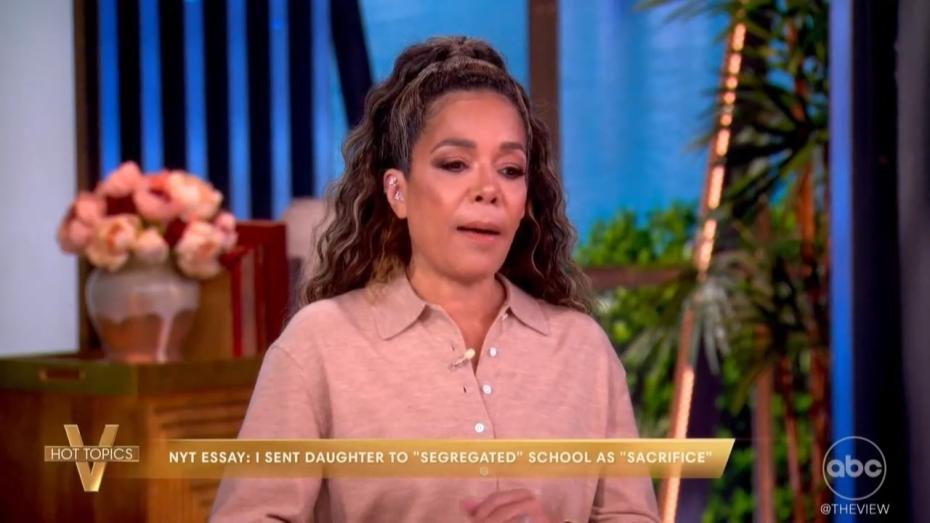
On Monday, four days after getting threatened with a defamation suit for erroneously suggesting a group of Mississippi teenagers engaged in a race-motivated murder of their black friend, ABC News co-host Sunny Hostin proclaimed she had sent her kids to a racist private school. Hostin’s claims came during a conversation about race baiter Nikole Hannah Jones regretting sending her daughter to a public school because of the poor education she received.
Hostin began by defending Jones’s decision to send her daughter to public school because “We should help the collective.”
“This is a very difficult decision for black parents in particular because I made a very different decision, I sent my children to private schools, a predominantly white private school,” Hostin lamented.
Hostin went on to claim that her son and daughter suffered “psychological trauma” and “racism” at the private school they attended:
And so, while they didn't suffer academically, they excelled, but it was a well-funded school, a private school, well-resourced school, they suffered a different type of pain. There was psychological trauma, there was racism that they experienced. They were bullied. There was -- there was, you know, trauma around their identity.
My daughter wears a big afro, kids were trying to stick pencils in her hair. Men - boys were calling her “butter face,” meaning she looked good, but her face, and she is a beautiful girl. She struggled. My kids struggled in a predominantly white environment, but they did not struggle academically.
After getting threatened with a defamation suit for suggesting a group of white teenagers were racist murderers, race baiting Sunny Hostin claims the white kids at the private schools she sent her kids were racist to them. pic.twitter.com/JEkk3TXEnF
— Nicholas Fondacaro (@NickFondacaro) September 21, 2026
The examples of the bullying Hostin shared didn’t specifically pertain to race, but were indicative of the kind of general nastiness kids were known for.
At no point was Hostin asked nor did she explain why she didn’t pull her kids from that school and put them in another.
Hostin sent her kids to Ethical Culture Fieldston School, where the 2026-2027 tuition fee was $70,890, according to their website. The school appeared to be very liberal, boasting a “progressive education” for students. “The exploration of being an ethical and responsible member of society forms the core of our curriculum and community,” they say. “We value inclusion and belonging, honoring all students for their unique contributions, cultural backgrounds, and beliefs.”
ECFS did not respond to NewsBusters’ request for comment.
Nearly a year ago, Hostin made headlines when she asserted that she feared for her son, Gabriel’s safety in the “all white neighborhood” she had just moved into. She was afraid they would call the cops on him if they saw him jogging around the neighborhood.
You might be asking yourself, ‘how is it that Hostin finds herself besieged on all sides by racists so often and seemingly putting herself in such positions?’
Well, it’s likely that those situations never actually happened and she just enjoyed the virtue and clout that came with perpetually playing a victim on TV. It’s why she continued to demand reparations while refusing to find and pay the descendants of those her family enslaved.
Sunny Hostin apparently thinks all her white neighbors are racists. She says she fears them calling the police on on her son if they see him training for the Junior Olympics:
"As a mother of black children, I know that black boys are not given the presumption of innocence...I… pic.twitter.com/3Q1sfc1c5c— Nicholas Fondacaro (@NickFondacaro) October 22, 2025
Hostin liked to harp about her “lived experience” during these kinds of conversations. Well, paranoid schizophrenics also have a lot of “lived experiences” that didn’t actually happen.
The transcript is below. Click "expand" to read:
ABC’s The View
September 21, 2026
11:16:40 a.m. EasternWHOOPI GOLDBERG Welcome back. In a new essay New York Times writer Nikole Hannah Jones wrote that she's second guessing her decision to send her daughter to a neighborhood public school rather than a private one. She writes that she did it to help improve the education quality for other students, but years later her daughter asked her why she didn't send her to a better school, since she struggled academically when she went to a more elite high school.
So the question is, you know, I guess, what do you do when your ideals say we should be supporting these schools here.
SUNNY HOSTIN: We should help the collective.
GOLDBERG: We should help the collective. What are your thoughts?
HOSTIN: I think it’s a brilliantly - I think everyone should read this. I think it's brilliantly written. You know, Nicole is a friend of mine, she writes about the black experience in America and specifically also writes about education in America.
And I think that this is a decision broadly that all parents make when it comes to educating their kids, but black parents make a very - This is a very difficult decision for black parents in particular because I made a very different decision, I sent my children to private schools, a predominantly white private school.
And so, while they didn't suffer academically, they excelled, but it was a well-funded school, a private school, well-resourced school, they suffered a different type of pain. There was psychological trauma, there was racism that they experienced. They were bullied. There was -- there was, you know, trauma around their identity.
My daughter wears a big afro, kids were trying to stick pencils in her hair. Men - boys were calling her “butter face,” meaning she looked good, but her face, and she is a beautiful girl.
WHOOPI GOLDBERG: She’s beautiful.
HOSTIN: She struggled. My kids struggled in a predominantly white environment, but they did not struggle academically.
So, I think the real question here is nationally schools in predominantly non-white districts receive $23 billion less in annual funding than their white counterparts. Underfunded schools versus well-funded schools. So, public schools are funded from property taxes. So we need to look at the systemic problem that's happening in this country around public education because education is the great equalizer.
ANA NAVARRO: We're living this in Florida right now. So, where I live in Florida they passed a voucher program that gives parents up to $8,000 to go towards private schools, and it is decimating public schools.
Killian High School in south Florida went from 3,700 students to 430-something students. So, I do think it is an ethical dilemma and sometimes you advocate for things and then when it comes to your own personal choices, you make choices that are different than what you advocate for, and that puts you in a place where you're feeling hypocritical.
(…)