CNN commentator Scott Jennings has a particular skill in short-circuiting the brains of the left-wing rabble on his own network, even when it comes to run-of-the-mill banter on taxes.
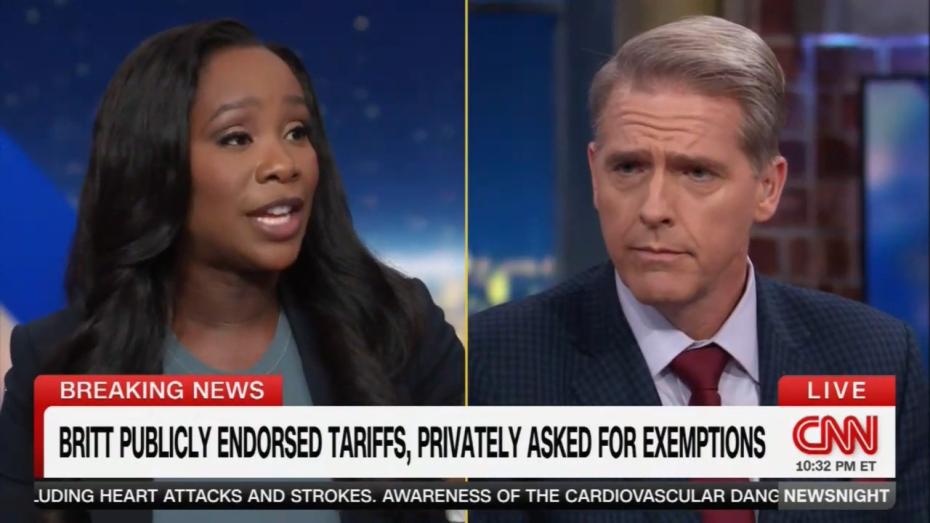
Jennings sent the roundtable during the September 16 edition of NewsNight into a tailspin after questioning snobby Abby Phillip & Co. for their double standard -- their repudiation of tariffs, while being indifferent about the burden of taxes anywhere else.
“I have a sincere question for you,” Jennings asked the panel. “[Y]ou all are very concerned about the tariffs as taxes. If Donald Trump tomorrow said, ‘I'll trade you elimination of all tariffs for elimination of all corporate income taxes,’ would you take the deal?”
And that’s all it took for Phillip, race-baiting Bakari Sellers, pseudo-Republican Ana Navarro and former New York City Mayor Bill De Blasio to launch a cacophony of confused hyena-laughter and disbelief that Jennings would dare try to bring parity to what are clearly both punitive taxes that corporations eventually pass off to consumers.
Once the confusion died down, Jennings restated his line of questioning, “My question to you all is very simple: If you’re so upset about tariffs as taxes being depressive of economic activity, would you trade all the tariffs for a zeroing out of corporate income taxes.” Cue the confused cacophony again! “You don’t have to do that,” cried Phillip. “I want my tariff rebate check damn it,” Navarro seethed. “It’s patently absurd,” Sellers snorted. Jennings cut through the real issue at hand: “Why are certain taxes good and certain taxes bad? Because Trump did one and you want to do the other!”
Watching @ScottJenningsKY completely break the brains of the lefty peanut gallery on @CNN on the issue of taxes is must-see TV. pic.twitter.com/kiQvRtkgMS
— Joe Vazquez (@JV3MRC) September 17, 2026
A miffed Phillip later retorted that she didn’t “think that they’re both the same. They are not both the same, okay?” But for all the weight of her pompous persona, Phillip wound up committing a massive gaffe, much to Jennings’ astonishment: “Tariffs have the effect of raising prices … income taxes do not raise prices on goods.” What in the economic ineptitude are you talking about, Phillip?
Mercatus Center Gibbs Scholar Jack Salmon summarized research from the National Bureau of Economic Research in a September 2025 policy brief, which he analyzed had revealed “a substantial pass-through of corporate taxes to consumers, suggesting that a significant portion of the tax burden is ultimately borne by those who purchase goods and services.” In their base case, noted Salmon, “consumers shoulder approximately 52 percent of the tax burden, while workers and shareholders bear 28 percent and 20 percent, respectively.” Then came the killer passage that put Phillip’s stupidity to sleep:
These findings suggest that the bulk of corporate taxes are passed through to consumers in the form of higher prices and to workers in the form of lower wages.
To quote Jennings’ retort to Phillip, “What do you think corporate income [taxes] do? Where do you think it goes?” Apparently she doesn’t even really know.
On another note, Phillip couldn’t even get the facts straight on tariffs in their own right. After conceding Jennings' point that manufacturing jobs had increased last month under the current tariff regime, she smirked that “it did not for 2025! So it has not been a clear story of a manufacturing boom as a result of these tariffs.” Jennings quipped back, “It’s going up now.” Phillip is in effect acting as if jobs could just get reshored overnight just because Trump slapped a tariff on certain imports.
While tariff revenues did double and the trade deficit was narrowed, “much of the ‘reshoring boom’ exists in planning documents. Some sites are breaking ground, but construction will take years,” according to the Supply Chain Management Review in November 2025. Tariffs can have the immediate effect of shifting incentives for companies, “even when facilities open, the deeper supplier networks that make local production sustainable take far longer to mature.” In essence, it takes time to reshore companies from overseas stateside! Who knew the economy doesn’t function like a cartoon!
But for argument’s sake, let’s consider some of the manufacturing data Phillip conveniently chose to pretend didn’t exist. According to the National Association of Manufacturers, “Manufacturing value-added output increased from $2.961 trillion at an annual rate in Q4 2025 to $3.000 trillion in Q1 2026.” In addition, U.S. exports of manufactured goods hit a “new record level” at more than $1.7 trillion in 2025, “with durable goods exports hitting an all-time high” at approximately $1.2 trillion. Lastly, “Employment in the sector has been in decline over the past few years but is above the pre-pandemic levels, with 12,638,000 manufacturing employees in August. The sector averaged 12,613,000 employees pre-pandemic (2017–2019).”
Doesn’t exactly sound like the tariff regime is nuking the manufacturing sector to smithereens now, does it?