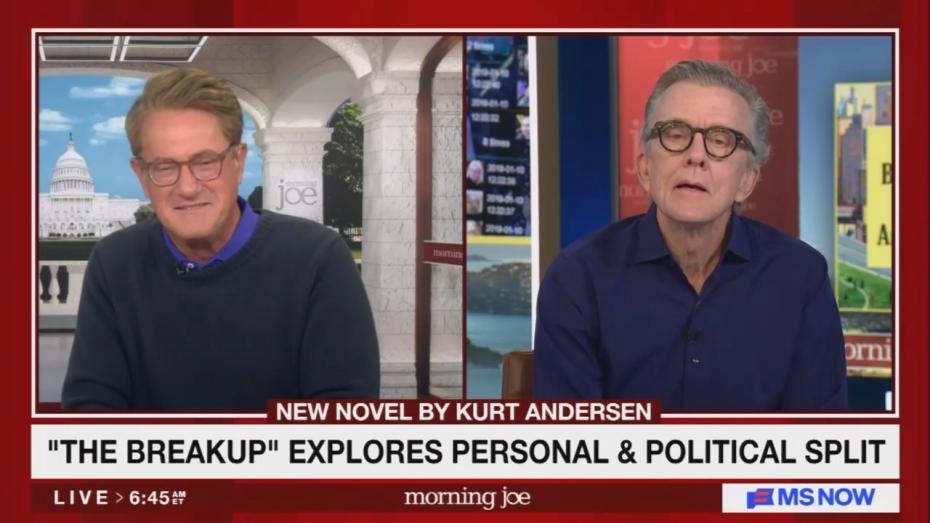
On Tuesday’s Morning Joe, the MS NOW morning program spread doom and gloom on the state of the country as it promoted a new book by author Kurt Andersen titled The Breakup, which focused on a fictional future of America 20 years in the future in the aftermath of a civil war. Andersen constantly seemed pessimistic about the future of America throughout the interview and even said the country was possibly “being softened for such a real-life, full-on breakup.”
Joe Scarborough introduced Andersen and described the book as a novel that “imagines America about 20 years into the future as a country that's reshaped by civil war, political division, and rapidly advancing technology.”
Andersen said he wanted to first write his new book as “nonfiction,” but decided to write a novel on “a Gen Z couple who are now middle-aged, who have lived through this civil war, this seven years of disunion, the United States of America finally negotiated breakup. And from their point of view, their eyes view, and, as you say, as they travel around the eastern half of America, looking at colleges in the old-fashioned way with their kid.”
Tuesday’s Morning Joe promoted a new Kurt Andersen book titled ‘The Breakup,’ which was described as a book set 20 years in the future in a “country reshaped by civil war, political division, and rapidly advancing technology.” Throughout the interview, Andersen seemed to predict… pic.twitter.com/i55IMXSLnr
— Nick (@nspin310) August 18, 2026
Co-host Willie Geist then asked, “You've talked, Kurt, about in real life, this country kind of maybe going through a soft breakup at the moment. I'm curious how that outlook and that view of where we are as a country and where we may be headed informed this book?”
Andersen then started to predict a civil war, and stated how a “soft breakup” might have already occurred. He used an example of “Second Amendment sanctuary states and counties” as his example of a breakup.
Andersen continued and feared a “full-on breakup”:
“So, this is already existing. And I realize that as I created my story of the future and what happens in - the 2020s and 2030s, and everything is, is the ground arguably possibly could happen being softened for such a real-life, full-on breakup.”
Frequent Morning Joe guest Mike Barnicle framed his question to Andersen on the “fracturing” of the country around the removal of Temporary Protected Status (TPS) for Haitians in the U.S. Barnicle stated, “And yet the fracturing today, it's not occurred in the 2040s, it's just occurring right in front of our eyes with very few people with official power saying, ‘Hey, wait a minute, wait a minute. We're ruining this country by fracturing what the country is all about.’”
Mike Barnicle then connected the idea of a “breakup” to the removal of Temporary Protected Status for Haitians in the U.S.
Author Kurt Andersen responded with agreement and said, “It’s suicidal of us as a nation to do such a thing.”
Andersen ended with more doom and gloom and… https://t.co/CTvypjVOBM pic.twitter.com/BHbe1LO9jR— Nick (@nspin310) August 18, 2026
Andersen responded and called it an example of “unforced errors” and said, “You could even argue, maybe it’s a little hyperbolic, but it’s suicidal of us as a nation to do such a thing.”
He continued to spread doom and worried, “As I was thinking about this book and figuring out the story I wanted to tell about these people in this situation in the future, it became harder and harder for me to think, How do we get how does this end? How does this end well? How does how do we all return to happy days of America again? And I see it less and less.”
Joe Scarborough tried to close the fictional Civil War book promotion with optimism and said, “I just want to let everybody know this actually is a hopeful novel.” He then noted how Americans have more in common than it would seem with media depictions of division (ironic).… pic.twitter.com/2djiYBS5di
— Nick (@nspin310) August 18, 2026
Scarborough closed and tried to end on a less gloomy look on the future, as he said, “I just want to let everybody know this actually is a hopeful novel.” He then noted how Americans have more in common than it would seem with media depictions of division, which was ironic for a show like Morning Joe where a recent guest said Republican voters want a “Blood and Soil” party. MS NOW divides the country constantly.
Andersen did not seem to agree with Scarborough’s assessment and said, “Well, I'm not at this moment as hopeful as you about that, but it's a chance.”
Later on Morning Joe, after the civil war book promotion, the show promoted a different book from California Democrat Rep. Jared Huffman titled ‘No Prophets’, which talked about “the fight to save America from Christian Nationalism." https://t.co/CTvypjVOBM pic.twitter.com/Hi7QeP0dhe
— Nick (@nspin310) August 18, 2026
Later on Morning Joe, the show promoted a different book from California Democrat Rep. Jared Huffman titled No Prophets, which was described as a book about “the fight to save America from Christian Nationalism." In the book's promotional materials, Huffman's pitched as "the only member of Congress to admit he does not believe in gods."
The congressman, who was described as a “humanist” in a New York Times feature on the book, called it a “threat to Democracy” and defined Christian nationalism as “the fusion” of “conservative Christian identity with right-wing politics.”
Two books that fear division and the end of democracy were apparently what Morning Joe wanted to feed their viewers on a Tuesday morning.
The transcript is below. Click "expand":
MS NOW’s Morning Joe
August 18, 2026
6:42:27 AM Eastern
(...)
JOE SCARBOROUGH: A great new novel is out today, and it imagines America about 20 years into the future as a country that's reshaped by civil war, political division, and rapidly advancing technology. Titled The Breakup, the book follows a married couple that spent years apart, reuniting for a tour of colleges with her teenage child that takes them on a road trip through a fractured new American landscape while they confront the divide between themselves.
The author, Kurt Anderson, joins us now. Kurt's last two books, Fantasyland and Evil Geniuses, are both New York Times best-selling works of nonfiction that explore the roots of American dysfunction, and The Breakup is a fictional follow-up to those investigations, and he uses the novel to examine the forces that have sharpened the division of this country.
MS NOW contributor Mike Barnicle is with us as well. And Kurt, thank you for being here. I love this book. We've talked about it offline. Tell us, why don't you go ahead, because I'm sure a lot of people are asking why you decided, after having two extraordinarily important nonfiction books, why did you decide writing a novel about the current state of disunion in America, and why it may be in the future, was the best way forward for you as an artist, as an author?
KURT ANDERSEN: Thank you for having me, Joe. I started thinking about it as a potential nonfiction book because, you know, a lot of happy readers for the two big histories. And I realized I don't have a basis for saying, ‘Oh, this is what will happen,’ or ‘This is what might happen,’ or ‘Where are we going?’ And so I returned to novel writing.
I, you know, it's my fifth novel, so I knew how to do it. And I decided that focusing on a couple and a family who have lived through this. A Gen Z couple who are now middle-aged, who have lived through this civil war, this seven years of disunion, the United States of America, finally negotiated breakup. And from their point of view, their eyes view, and, as you say, as they travel around the eastern half of America, looking at colleges in the old-fashioned way with their kid.
SCARBOROUGH: It was so realistic. I - at one point I commented to you. I read - so you have Nat and Ash. Natalie, the wife, Asher, the liberal husband. And it - listening to them talk, listening to the differences in their outlook on not only politics, but on the future.
There are several times I would read passages out loud to Mika and laugh because you have the lefty catastrophizing all the time and you have the righty going, will you please just relax?
And of course, what happens, as is the nature of Mika and my relationship, sometimes she's overly pessimistic, and sometimes I'm overly optimistic.
(...)
6:47:30 AM Eastern
WILLIE GEIST: You've talked Kurt, about in real life, this country kind of maybe going through a soft breakup at the moment. I'm curious how that outlook and that view of where we are as a country and where we may be headed informed this book?
ANDERSEN: Well, I did a lot of research because, you know, I used to be a journalist and I pretended to be an historian. So, I was researching this soft breakup idea, which I wasn't aware of until I started doing the research that law professors and others have been talking about this since for the last dozen years. These coalitions and these kind of emergent quasi-government entities among states to, to be against the federal government.
The Second Amendment, sanctuary states and counties, for instance, where they do not enforce federal gun regulation laws. Who knew? But there's all kinds of these things left and right, about climate, about health, all kinds of things. And certainly in the last year and a half, even more than ever.
So, this is already existing. And I realize that as I created my story of the future and what happens in the 21st of the 2020s and 2030s, and everything is, is the ground arguably possibly could happen being softened for such a real-life, full-on breakup? You know.
MIKE BARNICLE: What you were just talking about just now reminds me that the fracturing might also be taking place right here, right now, in front of our eyes. And I'm talking specifically about Haitian people who are here. They once were under TPS, temporary protected status. That's gone for them. They are among the hardest-working young people who have come to America over the last - you can't go into a hospital without finding Haitians, helping people, working for people.
And yet the fracturing today, it's not occurred in the 2040s, it's just occurring right in front of our eyes with very few people with official power saying, ‘Hey, wait a minute, wait a minute. We're ruining this country by fracturing what the country is all about.’
ANDERSEN: Well, precisely. I mean, we're doing so many kind of unforced errors, to use your baseball fans terminology. And really, I wouldn't, you know, you could even argue, maybe it's a little hyperbolic, but it's suicidal of us as a nation to do such a thing.
And I - and again, as I was thinking about this book and figuring out the story I wanted to tell about these people in this in this situation in the future, it became harder and harder for me to think, How do we get how does this end? How does this end well? How does how do we all return to happy days of America again? And I see it less and less.
And I started writing, you know, three, three years ago, three and a half years ago, when it's when this premise seemed a little, a little far-fetched to me. And the last year and a half, it seems less far-fetched to me.
BARNICLE: Yeah.
(...)
6:50:52 AM Eastern
SCARBOROUGH: Kurt, before we let you go, I just want to let everybody know this actually is a hopeful novel. And what makes this novel so hopeful, and what makes it so fascinating, is that in the midst of this chaos, we find what I know you find when you travel across the country.
When we were talking several years ago about a trip to West Virginia. What I find wherever I am, and I know a lot of people watching probably don't want to hear this on any podcast or any cable news show, but people, for the most part, are the same man. They really are. You sit down, and you talk to them. Whether you're in Demopolis, Alabama, or whether you're on the upper west side and, they're Americans. I mean, below all of this chaos, they're Americans. And you see that. You always see that in your characters and you're thinking, yeah, things look bad. But at their core, I've got a feeling they're going to find their way through this. Talk about that.
ANDERSEN: Well, I'm not at this moment as hopeful as you about that, but it's a chance. And my characters, Asher and Natalie, are in a certain way., illustrative models of how, maybe with luck, people can get back together if they recognize their basic human connections.
(...)7:16:27 AM Eastern
SCARBOROUGH: A new book out today by a member of Congress warns that religious nationalism is taking hold in our nation's capital. With us now, Democratic Congressman Jared Huffman of California. He's the author of the new book titled No Profits: The Fight to Save Democracy from Christian Nationalism.
Thank you so much for being with us. We greatly appreciate it.
You know, what you're talking about is actually, interestingly enough, this is very timely because the Presbyterian church of America actually just passed a resolution condemning Christian Nationalism. And - the Wall Street Journal published an op-ed by actually a professor at Hillsdale College, a very conservative college, who wrote this:
“This affirmation aligns with American beliefs about limited government. And it differs dramatically from Christian Nationalism, whose advocates have called for Christian lawmakers to write laws that constrain the free exercise of religion. Such big government arguments clearly place Christian nationalists along the post liberalism that churns on the left and the right.”
And they go on to say that this is really, again, getting in the way of the First Amendment. So, it's interesting. Wall Street Journal publishes very conservative professor from Hillsdale College, who aligns with the Presbyterian Church, who's actually aligning with your position. Talk about why you wrote this book.
REP. JARED HUFFMAN (D-CA): Yeah, thank you, Joe, for having me. And I'm glad that more religious voices are calling out Christian Nationalism, often from a faith perspective. But all of us need to be in this fight. I have watched this Christian nationalist movement grow in strength and militancy throughout my time in Congress. It erupted for all of us to see in the January 6th insurrection, and I had really hoped that would be the wake-up call our country needed to hold this movement to account and confront it. But unfortunately, the country and my own colleagues who the mob targeted and wanted to kill really went back to sleep.
So, I wanted to write this book to expose what I consider America's most dangerous political movement, and to take folks behind the scenes of the Capitol, show them what I see every day, and why I'm so concerned about this threat to our democracy, and to do it in a way that has never been done before.
(...)