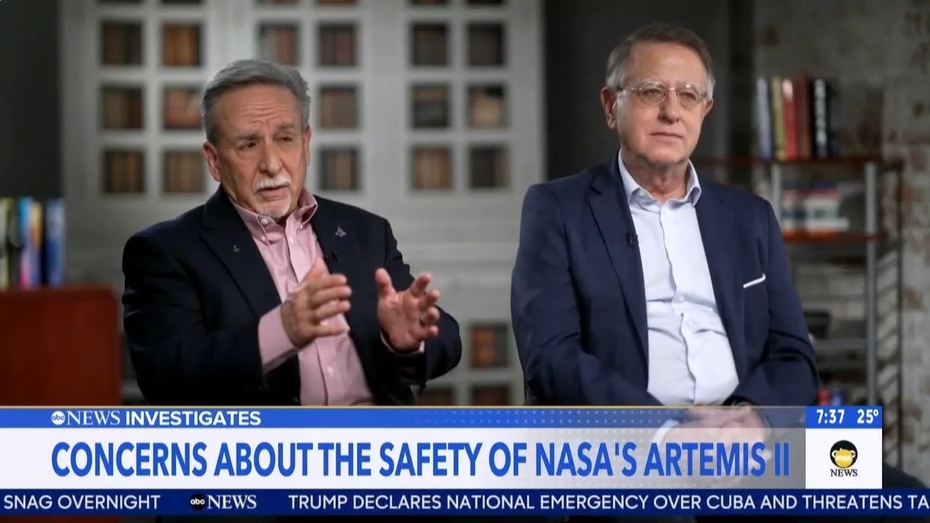
Of course, the claims have been weighed in complete disproportion to the pushback from NASA officials (including Administrator Jared Isaacman), years of testing, and both internal and external reviews of the capsule.
ABC’s Good Morning America predictably spent both the most time (five minutes and four seconds) promoting Camarda and Rasky and coming off like a tabloid, fully leaning into the sensationalism.
In the first of two teases (not included in the time count), co-host George Stephanopoulos boasted: “ABC News investigates. NASA going back to the moon. Why two former scientists at the space agency are sounding the alarm.”
Stephanopoulos promised in the second of a look at “that concern about NASA's first crewed mission around the moon in more than 50 years” with “[t]wo former scientists at the space agency...raising a red flag” and “say the mission is tempting fate.”
Washington-based correspondent Elizabeth Schulze had the story poisoning the public’s well of trust in NASA ahead of this mission and ignored the fact that Camarda has a brand new memoir out accusing the agency of, in essence, not letting him run the show.
“A lot of anticipation for this mission that will send astronauts to the moon’s orbit...We spoke with two former longtime NASA engineers who are worried about the safety of the spacecraft, saying that it could put the astronauts’ lives at risk,” she began.
Last week, ABC’s ‘Good Morning America’ really did @NASA dirty ahead of the #ArtemisII launch, holding up two former, disgruntled engineers (and one who has a book to sell, but they left that out) as canaries in the coalmine warning the mission will be a deadly failure because of… pic.twitter.com/P4rodQtn1x
— Curtis Houck (@CurtisHouck) February 5, 2026
After reminding viewers this mission will bring astronauts “around the moon for the first time in 54 years, she ominously said “[b]ut this morning, two veteran NASA scientists say they believe there are serious safety risks ahead of the mission’s planned launch as soon as next month.”
Camarda and Rasky couldn’t have dreamt of better PR in the softballs to allow them to construct a strawman and never consider the fact that, while they certainly could be right, there’s risk in everything NASA does (click “expand”):
SCHULZE [TO CAMARDA]: In your view right now, is it safe for astronauts, humans to go on this mission on Artemis 2?
CAMARDA: I would say no.
SCHULZE: Charlie Camarda is a former director of engineering at NASA and a retired. Astronaut who flew on the space shuttle, Daniel Rasky retired in December from the space agency after working as an engineer specializing in thermal heat systems for more than 30 years. [TO RASKY] Is this what you both expected to be doing, speaking out about in retirement?
RASKY: No.
KAMARDA: No, no, no.
SCHULZE: Their key concern centers on the Orion spacecraft’s heat shield. A system designed to protect astronauts from the extreme heat when they reenter the atmosphere. They say the heat shield uses a material from the 1960s that cracked during the uncrewed Artemis I test flight in 2022, a finding highlighted in a 2024 publicly released report by NASA’s Inspector General that was reviewed by Rasky.
RASKY: I have to say from the data I’ve seen with regard to this heat shield. If I had to rate it A, B, C, D, I’d rate it an F.
SCHULZE [TO RASKY]: You’d rate it an F?
RASKY: It’s an F. It’s a clear F, clear, and there’s no way you put crew on an F heat shield. You are just tempting fate.
Even in providing NASA’s view, she made it seem suspect: “During a pre-launch press conference, NASA acknowledged that the Artemis II heat shield has what they called limitations.”
Following a single-sentence soundbite from Artemis II flight Director Jeff Radigan, Schulze provided those lonely two sentences explaining why the concerns have been addressed. In addition, she did that bit so many Americans probably loathe about journalists in cosplaying as experts in literally everything (click “expand”):
SCHULZE: We asked the man in charge of the spacecraft at NASA, Howard Hu, about those limitations and the engineers’ concerns.
HOWARD HU: Crew safety is paramount, and our ability to fly our crew safely and ensure their mission success is what we do every day. And I think about it every night, every day, every waking hour.
SCHULZE: Hu told us NASA conducted an extensive 18-month investigation on the heat shield and identified the root cause of the problem. He said NASA then changed Orion’s return path so the astronauts spend less time in high heat zones.
HU: As part of that investigation, they were able to determine that there was limitations that we could take on this current heat shield on Artemis II that would be safe.
SCHULZE: In a statement to ABC News, NASA administrator Jared Isaacman said he has full confidence in the heat shield, adding “NASA’s engineers and safety experts followed the evidence, challenged every assumption, and applied disciplined engineering judgment to understand the anomaly and mitigate remaining risk.”
She closed with more sound from Hu after an emotional appeal from Camarda (click “expand”):
CAMARDA: I lost three classmates, seven friends on Columbia. And so, you know, I get very emotional. You know, I understand we take risks, but we don’t have to take unnecessary risks. And I’m praying for the crew because I don’t wanna see that happen.
SCHULZE [TO HU]: The engineers told us they don’t want to see a tragedy like we saw with Columbia or Challenger. Can NASA confidently say it’s done everything in its power at this point, given those risks to avoid a tragedy like that?
HU: He confidently would say that. I think to a person that was part of the investigation, the technical team, I would say, would definitely say that.
SCHULZE: So, both of the former NASA engineers suggest sending robots on the spacecraft instead of humans. They say that the U.S. was already first to put astronauts on the moon so that there is no rush here. We asked NASA’s Howard Hu about that. He said there is no pressure on the timeline of this mission, and if it was not ready to go, NASA would not hesitate to say so.
STEPHANOPOULOS: There are such diametrically opposed positions there.
SCHULZE: Such differences, and the reality is there are risks. How much risk do you take? That’s the debate here.
To give support to this robots farce, weatherman Sam Champion jokingly said, “I don’t know. It seems like a good time for robots.”
Schulze’s piece received three extended airings Friday on ABC’s free, 24/7 news channel ABC News Live in the 9:00 a.m., 3:00 p.m., and 7:00 p.m. Eastern hours.
In that second example, afternoon host Kyra Phillips had the courtesy to bring on former astronaut Butch Willmore — who was famously stranded in space by the Biden administration and brought home thanks to President Trump — to completely reject Camarda and Rasky. But on the last airing, ABC News Live gave Schulze an exhaustive nine minutes and 38 seconds.
But on the last airing, ABC News Live gave Schulze an exhaustive nine minutes and 38 seconds, including a portion in which the two insisted they weren’t doing this for partisan purposes.
NBC’s Today gave Camarda his time to promote himself but, like ABC, never mentioned his book. Senior correspondent Tom Costello spent the last 97 seconds of his story on Camarda after leading with the pushback launch window.
How you know a PR campaign is in full effect – NBC’s ‘Today’ joined ABC’s ‘Good Morning America’ in promoting claims from two former @NASA engineers who claim the agency is willfully sending the #ArtemisII crew on a death mission to space.
— Curtis Houck (@CurtisHouck) February 5, 2026
Only at the end of the 92-second… pic.twitter.com/eD3oWUv0oN
“But [a delayed launch] may not be the only problem. A former astronaut and thermal protection engineer is warning, the heat shield on the crew's Orion spaceship could fail as it hits 5,000 degrees on re-entry,” he ominously warned.
Costello then went to Camarda, wondering aloud whether he “fear[s] this crew could lose their lives.” Unsurprisingly, Camarda said “absolutely.”
This went on (click “expand”):
COSTELLO: Charlie Camarda flew on the first mission following the space shuttle Columbia disaster that killed all seven astronauts after the heat shield was damaged on liftoff. Now Camarda is pointing to the heat shield on the Orion capsule, which showed burn marks, cracks, and pieces missing after the uncrewed Artemis I flight in 2022. This time, four astronauts will be on board Artemis II.
CAMARDA: I don't think NASA should be flying a crew on this vehicle. It is a deviant heat shield. We know it’s a deviant heat shield. We do not know how it’s going to fail or how we can predict it’s going to fail.
COSTELLO: But NASA says it is changing Orion's return angle to ensure the crew is protected.
JEFF RADIGAN: We’ve changed the entry profile so that we're flying a profile that the heat shield can handle.
COSTELLO: Commander Reed Wiseman on 60 Minutes.
REED WISEMAN [on CBS’s 60 Minutes, 02/01/26]: We're going to come in hotter, a little bit faster than Artemis I and based on the issues that we have with the heat shield, that will keep us safe.
COSTELLO: So, NASA chief Jared Isaacman says internal and external engineering teams have reviewed the heat shield analysis and they agree with NASA. But everybody knows this is one of the most dangerous moments of the mission, as we saw when the space shuttle Columbia came apart on reentry.
What made Costello’s Today piece so disappointing was the fact that, on the 3rd Hour of Today, he was given more space to expound upon this and, with more than twice the amount of time, he admitted it’s “[r]eally important to note here that former astronaut Camarata is really in the minority on this issue.”
Costello further undercut his entire piece with the admission NASA has had “internal and external engineering teams” review “all of the data on the heat shield and that they agree with NASA’s plan for reentry.”
How convenient — in NBC’s ‘3rd Hour of Today’ on Monday, Tom Costello used the extra time to point out that the claims from two former, disgruntled astronauts is a “really...minority” view that, while there’s always risk, NASA believes they’ve done everything to address… pic.twitter.com/b7UYMUBowL
— Curtis Houck (@CurtisHouck) February 5, 2026
“When they come back, they’re actually going to come in a little bit more of a nose up kind of position. So that, they think, is going to help them on reentry, guys,” he added.
With a set-up from co-host Craig Melvin, Costello explained how a delay in the launch window will give the astronauts even more repetitions to the point of “rote memory” and safety officials time to go over any and all scenarios (click “expand”):
MELVIN: So, Tom, you mentioned that the astronauts there at NASA, they’ve gathered engineers in and outside of the agency.
COSTELLO: Yeah.
MELVIN: Are they going to do a final review before launch?
COSTELLO: Yeah, absolutely. Just before the countdown actually begins, mission managers will conduct a final flight readiness review. That’s a final chance for engineers and mission managers to give their go or no-go for this mission. And again, now that we’re postponed for another month, they’ll look at all the data again, look at all the engineering again, give people like Charlie Camarata the chance to speak up yet again. Guys, I’ve covered Charlie for 20 years. He is not a shrinking violet. He always speaks his mind rather aggressively.
ROKER: Yeah, and you got to spend time with the Artemis crew, I did too, as they entered the home stretch. And, with this delay, the safety concerns, Tom, to the best of your knowledge, does this change how they prepare?
COSTELLO: No. In fact, what they will do is go back and double down and do it again and again and again. They’ll take advantage of this period to retrain again, go back into the simulator, again. Go through all the steps again and again and again. You know, as you saw firsthand, as I’ve seen it over the years, they think that there’s nothing better than committing it all to rote memory so that God forbid something happens, they automatically know how to react to that.
ROKER: Muscle memory.
What none of these segments did was provide extensive comments from Isaacman. Thankfully, the local NBC affiliate WESH did in mid-January with Isaacman given the chance to emphasize the importance of safety (click “expand”):
“The heat shield has to do its job. There’s no Plan B capability,” Isaacman said. “On Artemis I, our heat shield did not perform as expected. That’s normal in human spaceflight — that we’re going to engineer a solution and not get an outcome directly in line with our prediction. That’s why we do test flights.”
With astronauts aboard Artemis II, safety is critical.
“We have modified our reentry profile. We have regained margin to safety, and I feel very good about that with Artemis II,” Isaacman said. “Now with Artemis III, we’re rolling in different improvements. We will never stop doing that — never stop listening to the data and rolling it into subsequent designs.”
Along with the ABC and NBC segments, Agence French-Presse (AFP), Boy Genuis Report (BGR), CNN.com, The Economist, and Futurism all fluffed Camarda up as the only voice of reason in the entire space industry.
The AFP article joined ABC in going for the dramatic, calling it a “risky bid.” Over at BGR, they irresponsibly focused in a January 29 piece on this narrative with a headline that read: “NASA's Orion Spacecraft Has A Potentially Dangerous Flaw That Has Experts Worried.”
The second sentence offered loaded language: “[T]here’s one glaring issue with Artemis II's Orion spacecraft that most experts are worried about. As it turns out, the heat shield on the craft — a special coating on the bottom of the craft to help protect inhabitants from extreme temperatures — may be faulty if the prior mission is any indication.”
Futurism was similarly sensationalist in a January 23 item cross-posted at Yahoo! News: “Experts Warn That There’s Something Wrong With the Moon Rocket NASA Is About to Launch With Astronauts Aboard; ‘What they’re talking about doing is crazy.’
However, the February 1 CNN.com piece from Jackie Wattles showed plenty of nuance and far less reliance on Camarda.
Thanks to its nearly 4,000-word length, Wattles was able to deliver the expound upon the years of emphasizing safety, charting alternative reentry, and a history lesson to explain that, simply put, the current NASA has been locked into this Orion capsule thanks to decisions made and technology from decades prior.
Most notably, Wattles stated the seemingly-obvious reality of anything related to space travel: There’s always risk and, if NASA shirked from doing bold, dangerous things, humans would have never gone to space in the first place.
And, when they did reference Camarda, they acknowledged he’s out with a memoir (and thus has a story to tell). However, if Camarda were to pop up on CNN’s coverage of the launch, one could infer they’re looking for the possibility of a disaster from Mr. I-Told-You-So.
To see the relevant transcripts from ABC and NBC, click here (for ABC’s Good Morning America), here (for NBC’s Today), and here (for NBC’s 3rd Hour of Today).