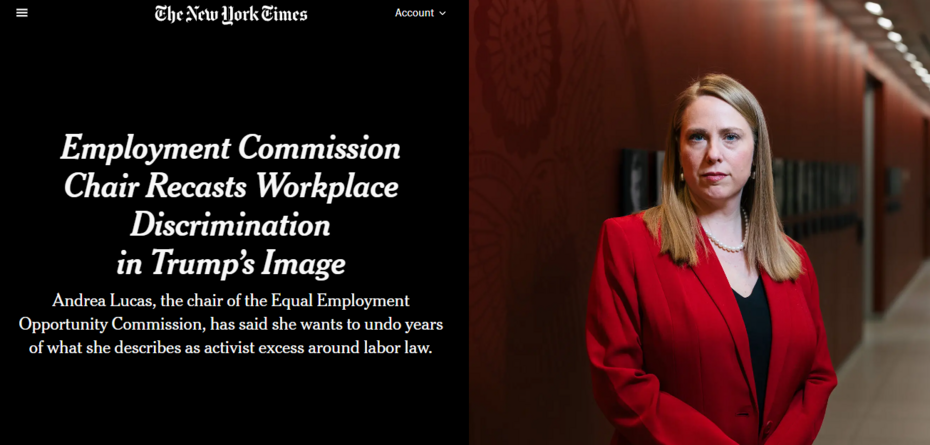
The online subhead provided the flavor: “Employment Commission Chair Recasts Workplace Discrimination in Trump’s Image -- Andrea Lucas, the chair of the Equal Employment Opportunity Commission, has said she wants to undo years of what she describes as activist excess around labor law.”
The opening paragraphs perfectly encapsulated the insufferable tone of the elitist media when the Left is on the losing end of policy:
In December, a 9,000-word essay about white male millennials shot across the internet.
The author, a ticket scalper and frustrated screenwriter, marshaled interviews and data to describe how the professional trajectories of members of his generation had been crushed by what he called the institutionalization of diversity, equity and inclusion mandates, a “profound shift in how power and prestige were distributed.”
Vice President JD Vance reposted the piece, saying it “describes the evil of DEI and its consequences.” Elon Musk responded, calling D.E.I. “a great wrong.”
The essay also caught the attention of Andrea Lucas, the chair of the Equal Employment Opportunity Commission, the agency, born of the Civil Rights Act, that enforces laws against employment discrimination.
O’Brien’s piece was initially published with no link to that thoroughly researched and influential 9,000-word act of journalism published at Compact magazine, and no mention of either the magazine or author’s name, Jacob Savage, only a risible description in the lead aimed to discredit him as “ticket scalper and frustrated screenwriter,” details Savage himself led with in his essay.
After Compact editor Matthew Schmitz pointed out the omissions on X, O’Brien issued a personal apology on her paper’s behalf (“It was an oversight, lost in edits.”) and a link was added – but the snobby, dismissive tone remained unaltered.
The story hardly improved from there:
Critics of Ms. Lucas, including former commissioners of the E.E.O.C., say she is distorting the intent of the Civil Rights Act, paying lip service to equal treatment while using her position to write MAGA grievances into federal law. They noted that as she has solicited complaints from white men — historically a small share of complainants to the E.E.O.C. — the commission has dismissed cases that would defend transgender employees and job applicants with criminal records.
Charlotte Burrows, Ms. Lucas’s predecessor as chair, who was fired by Mr. Trump last January, said, “Federal civil rights laws protect everyone, and the E.E.O.C. has a duty to engage in fair and evenhanded law enforcement.”
She and others said Ms. Lucas’s message in the December video was that white Americans would receive preferential consideration under the Trump administration. “That’s the opposite of equal opportunity,” Ms. Burrows said.
"Critics" aren't "Democrats" or "leftists." Any ideological labels for the several liberal groups O’Brien cited were also presumably “lost in edits.” Josh Boxerman was an Obama aide who gets quoted in Jerry Nadler press releases.
“She has closed the door of the E.E.O.C. to groups that are disfavored by the president,” said Josh Boxerman, who handles civil rights work at the National Employment Law Project, a workers rights group. “That is extraordinary. And it is radical and harmful.”
O’Brien brought up the liberal concept of “disparate-impact liability,” which she called “a pillar of civil rights law,” when a seemingly neutral policy is deemed discriminatory toward a certain group of people, even if the policy itself seems neutral. In less sympathetic terms, a potential Diversity, Equity, and Inclusion (DEC) boondoggle.
Times readers were supposed to be aghast over the example she gave, though the implication of group criminality were certainly not flattering to “applicants of color”:
The move, denounced by civil rights and employment groups, had swift consequences at the commission. Within weeks, it moved to dismiss a civil rights lawsuit it had brought a year earlier against Sheetz, the convenience store chain, over its practice of screening out applicants with criminal convictions. The commission had previously found that the practice disproportionately affected applicants of color and violated the Civil Rights Act.
Compelling a company to consider hiring you despite your criminal record is a protected civil right?