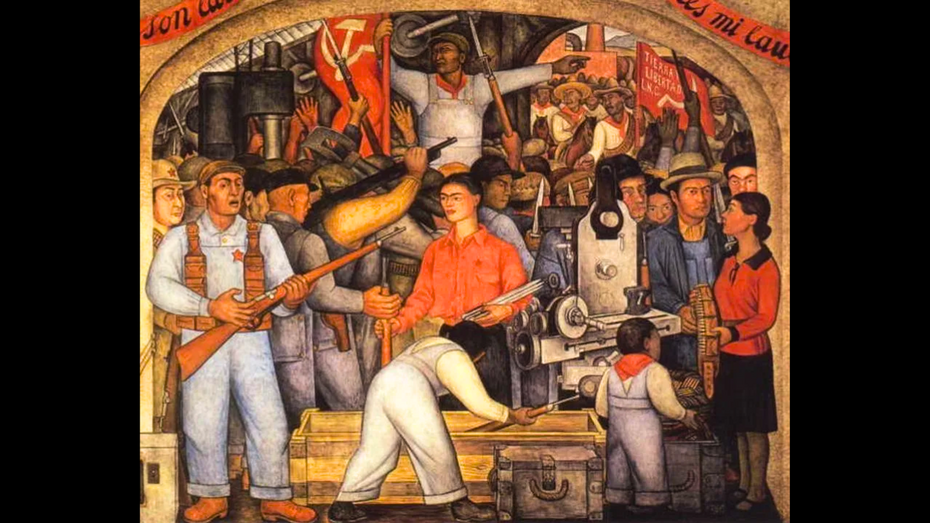
Of course not, but that is how Mexican muralist Diego Rivera is often depicted in the media. As for his sometime wife and lover, Frida Kahlo, she was even more fanatic in her devotion to communism. She was not only a party member, but a staunch Stalinist as well. And yet it appears that the their communist connection which was at the core of their beings as well as their art, as the Diego Rivera painting on this page reveals, could be whitewashed out of their media portrayals yet again. The evidence for this comes from a Variety story on Thursday by Anna Marie De La Fuente, "Frida Kahlo, Diego Rivera Netflix Series in the Works."
The closest Variety comes to mentioning their communism comes in this brief observation in passing: "The still untitled show will delve into their lives and explore how shifting political, social, and artistic upheavals shaped their relationship and oeuvre."
Blink and you would have missed the vague reference to communism. Actually, if you don't blink you also miss the communism reference, because it doesn't exist.
It would be interesting if the Netflix series about Rivera and Kahlo dares to at least touch upon the devout communism of both those artists. However, judging from past media attempts to cover the pair, one should not expect too much. A good example was the 2002 big budget film Frida starring Salma Hayek that absurdly treated her (and Diego Rivera's) communism only very lightly. The leftist Current Affairs wrote in April 2025 about the absurdity of ditching the communism at the core of of Kahlo and Rivera in "How Frida Kahlo Went From Communist to Kitsch."
...The definitive biography of Kahlo is Hayden Herrera’s Frida, from 1983, and it covers her politics in considerable detail—from her childhood fascination with the ongoing Mexican Revolution, to her reading of Marx and Hegel as a teenager, to her later engagements with both Trotskyism and Stalinism. But sadly, a lot more people get their history from big-budget movies than from 400-page hardcover books, especially in the United States. There are two major films about Kahlo’s life: one a dramatization from 2002 with Salma Hayek in the lead role and the other a documentary released on Amazon Prime in 2024. Like Herrera’s book, both are simply called Frida, and both have their strengths. But they also distort their subject in important ways and, above all, downplay Kahlo’s devotion to the communist cause.
The 2002 Frida, directed by Julie Taymor, really ought to be called Frida and Diego, the title it reportedly had at one point during its long and troubled development. Ostensibly, it’s an adaptation of Herrera’s book. At the time, Harper Perennial even released a new edition of the biography with the movie poster as the cover. But really, the film is less a straightforward biopic and more a romantic drama. It frames Kahlo’s life mainly through her romantic and sexual relationships—primarily with fellow artist Diego Rivera, but also with Leon Trotsky when he was exiled to Mexico in the late 1930s, and occasionally with a variety of female side characters. The tagline on one of the cinema posters reads “prepare to be seduced,” and that sums up the film’s approach.
When communism comes up, it’s usually because Rivera (played with aplomb by Alfred Molina) or Trotsky (a slightly underwhelming Geoffrey Rush) are expounding about it. Kahlo takes part in their arguments and their protests; she helps Rivera crank out communist pamphlets on a clunky printing press and supports him when he feuds with Nelson Rockefeller over his decision to paint Lenin into his latest mural. But she seems to have little political initiative of her own. The implication is that she’s a communist mainly because the men in her life are. Instead of a portrait of her as a serious political thinker, we get a lot of prurient stuff about her sex life, whether she’s seducing the same woman Rivera has just slept with (out of jealousy, it’s implied) or having a fling with the much-older Trotsky. The performances save this version of Frida from being truly bad—both Hayek and Molina inhabit their roles perfectly—and Taymor’s use of color, plus the occasional stop-motion skeleton, bring Kahlo’s art to vibrant life. The film looks like one of her paintings, but as a portrait of the painter, it’s incomplete.
It remains to be seen if the Netflix series will reflect at least a semblance of reality and cover in proper detail the very strong association with communism of both Diego Rivera and Frida Kahlo instead of pretending that it was a mere sideshow for both.