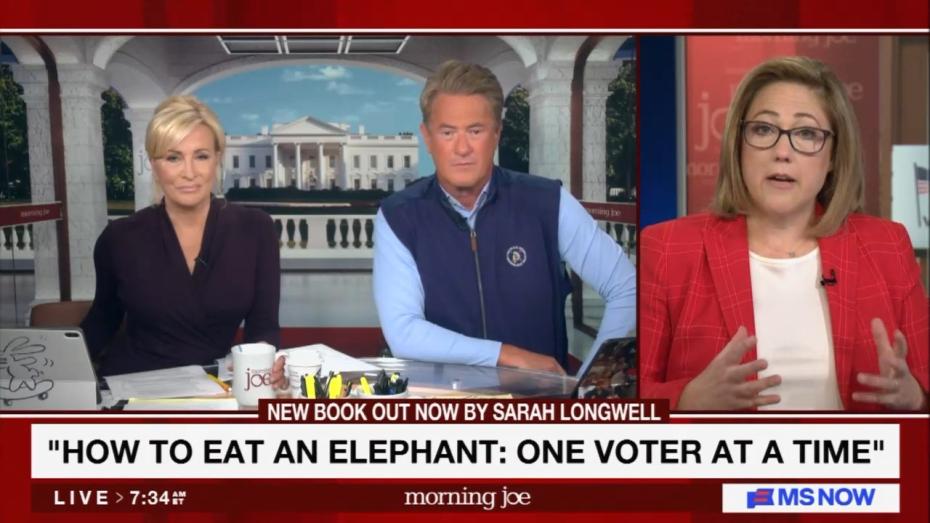
On Tuesday’s Morning Joe, the MS NOW program promoted a new book by The Bulwark’s Sarah Longwell that called for an end to the Trump era, as Longwell clamored for an end to the Trump movement and hoped it would go to the ‘Ash Heap of History.”
Frequent co-host Willie Geist, who is also host of NBC’s Sunday Today, gave praise to Longwell and the rest of The Bulwark. Geist began, “Let's talk about the book and the Trump era, really, because you are to be commended, along with a list of others who, I don't want to leave anybody off, but there are a group of them who have remained true to your principles in this Trump era.”
The other “true to your principles” conservatives Geist is referring to include Bulwark podcaster Tim Miller, who said GOP voters resonate with the idea of a “Blood and Soil” party, which was a Nazi slogan.
Tuesday’s Morning Joe featured an interview with The Bulwark’s Sarah Longwell, described by Willie Geist as part of a group that “remained true to your principles in this Trump era,” on her book, which she described as being about “How to solve a big intractable problem, which is… pic.twitter.com/XvRoJmNuOs
— Nick (@nspin310) September 8, 2026
Geist then asked, “So, part of what you write in this book and you say, how to eat an elephant, not just how to win elections, to unseat Republicans who you think deserve to be unseated, but how, in the bigger picture, kind of to pull America back from this era of MAGA politics and personality cult and all those things? So, where do you begin whenever this day ends?”
Longwell responded and claimed the “problem” that needed to be solved to end “this era of MAGA politics” was Trump voters: “Well, the reason I call it How to Eat an Elephant: One Voter at a Time is it's about how to solve a big intractable problem, which is not just Trump, but also Trump voters.”
She then stated that many people she spoke to after Trump’s 2024 victory “thought America is gone,” before later describing how she had worked on Republican attempts to primary Trump in past years. Longwell then said she pitched the voters who felt doom about Trump's victory about how the movement would be buried:
And my pitch to people is to say, America is not lost. And in fact, we have a generational opportunity to take MAGA and sort of bury it in the ash heap of history where it belongs.
Joe Scarborough then mentioned to Longwell how some voters simply view Democrats as crazy for their views on immigration and transgender athletes, and how Republicans seem poised to successfully use the DSA as its next line of attack.
Longwell then said Democrats need to say… https://t.co/lWvUCdpMwp pic.twitter.com/Gt1jyOMDHK— Nick (@nspin310) September 8, 2026
Co-host Joe Scarborough, back from a brief late August absence from the show, later asked how Democrats could be seen as less crazy by voters, as he stated, “That said, I still hear, and I'm curious what you hear in focus groups, I still hear people in conversations: Yeah, Trump's crazy. Yeah. I wish we had a sane person in the White House, but at least he's better than the other side.”
Scarborough continued, with more worry over Republican midterm messaging against the Democratic Socialists of America’s rise, and said the Republican Party’s messaging in recent years has moved from “immigrants” to “trans issues” and “now it’s DSA.” He worried it was effective:
You know, they always pick something, Republicans do, and they always use it effectively. So people go, ‘Yeah, these people, they, they, they work against our economic interests. Yeah, they're crazy, but at least they're not Democrats.’ So, how do Democrats handle that?
As Scarborough showed his worries over Republicans connecting Democrats to the DSA, Longwell's hope of burying the Trump era might be difficult to materialize if her own side was seen as crazy.
The transcript is below. Click "expand":
MS NOW’s Morning Joe
September 8, 2026
7:26:54 AM Eastern
(...)
WILLIE GEIST: Sarah. Let's talk about the book and the Trump era, really, because you are to be commended, along with a list of others who, I don't want to leave anybody off, but there are a group of them who have remained true to your principles in this Trump era. You are conservative, and you stayed that way as conservatism, the definition has changed and kind of just become Trumpism. You worked on Republican campaigns, and you've stayed right there as it's drifted away from you.
So, part of what you write in this book and you say, how to eat an elephant, not just how to win elections, to unseat Republicans who you think deserve to be unseated, but how, in the bigger picture, kind of to pull America back from this era of MAGA politics and personality cult and all those things? So, where do you begin whenever this day ends?
SARAH LONGWELL: Yeah. Well, the reason I call it “How to eat an elephant, one voter at a time” is it's about how to solve a big intractable problem, which is not just Trump, but also Trump voters.
And I think right after the 2024 election, which is when I decided to write the book, I was hearing from so many people. They thought America is gone. We're never going to come back from this. Like the idea that we could elect a president who had done an insurrection, who had, you know, had lied about the election being stolen. How was it possible that America could reelect this person? But I knew the answer because I had been listening to voters in focus groups day in and day out ever since I started them, because I was trying to primary Trump back in 2018, 2019. I was trying to figure out: how do you beat this guy?
And in listening to voters all of these years, there's a bunch of things that have become really clear. But one of them is that they're ever-changing. And also that Donald Trump is a super specific person. There's not a lot of people who can come along and do what he's done, and he has hollowed out the Republican Party to such a degree that in a post-Donald Trump world, this party has no idea how to function. And my pitch to people is to say, America is not lost. And in fact, we have a generational opportunity to take MAGA and sort of bury it in the ash heap of history where it belongs.
(...)
7:29:37 AM Eastern
JONATHAN LEMIRE: It is going to take some real effort and time, though, to unwind. It's just striking, just the ecosystem that's been created around Trump. You're right about the Republican Party. Think of how the Republicans in Congress. That makeup has changed since 2016 to now. These are loyalists. These are Trumpists far more than Republicans, with only a handful of exceptions.
There's a whole media ecosphere around him: influencers, podcasts, the list goes on and goes on and on. How is that going to - do you think that just disappears? Like, how does that - what's the work that requires to undo that?
(...)
7:31:17 AM Eastern
JOE SCARBOROUGH: So, Sarah, help help me out here because I agree with you, Donald Trump, like Reagan, like Barack Obama, one of a kind for his time. Just as there was no follow-up with Reaganism or Barack Obama's success, it won't be for Trump.
That said, I still hear, and I'm curious what you hear in focus groups, I still hear people in conversations. ‘Yeah, Trump's crazy.’ ‘Yeah. I wish we had a sane person in the White House, but at least he's better than the other side.’
And, you know, back in 2004, it was gay marriage. And then, you know, they moved on to immigration, even though when Trump was talking about building his wall, you know, border crossings from Mexico were at a 50-year low. Of course, that changed very quickly. Then it was after immigrants, it was trans issues. Now it's DSA.
You know, they always pick something, Republicans do, and they always use it effectively. So people go, ‘Yeah, these people, they, they, they work against our economic interests. Yeah, they're crazy, but at least they're not Democrats.’
So, how do Democrats handle that?
LONGWELL: I do hear that all the time, especially from swing voters. And there are a few places where Democrats are really out of step with the vast majority of sort of the swingier electorate. And obviously, look, you mentioned immigration. Donald Trump is interesting because the wall, he never built the wall, and voters didn't hold him responsible for not building the wall. Why? Because talking about the wall was a stand-in for Donald Trump saying, ‘I'm going to take immigration seriously at a time when voters are really frustrated that nobody is taking immigration seriously.’ And so he never had to build the wall. He just had to focus on things that voters were frustrated about.
I would say Mamdani in New York is sort of similar - he does a similar thing where it's a lot of his individual policies around groceries and, you know, transportation. They're not particularly good policies. But voters didn't care about those policies. What they cared about was he was talking about affordability. He was talking about the things that were bothering them.
And so I just I do think that Donald Trump does not have - while Democrats are struggling to figure a few things out, they've got to they've got to say, look, the borders got to be closed.
They've got to understand that Republicans are going to try to move the conversation on trans issues, not to whether or not trans people should be treated with dignity and respect and not discriminated against, because the vast majority of Americans agree with that.
Where they don't agree with them is on sports, and Democrats are going to have to figure out how to talk about this issue in a way that both, I think, acknowledges people's humanity in the way that Republicans don't, acknowledges people's dignity. But also, on some of those 70/30 issues, aren't forced into such extreme positions.
I'll just say very quickly, look, I came up during the gay marriage debate. And one thing that we understood as advocates for gay marriage on the Republican side was that, you know, we're going to have to give politicians some space on that. Barack Obama wasn't for gay marriage in 2008, and the advocacy community understood they had to persuade people of that before they asked politicians to take a tough position on something that voters didn't agree with. And I think that the advocacy community is going to have to give some Democratic politicians some space on this, because Democrats would obviously be better for trans people in the long run.
So, there's just a few places where Democrats do have to sort of get in a better position with the American public. But then they've also really got to think about building a bench of better communicators. Democrats cannot rely on, you know, generational politicians every single time. They have to build a much bigger bench of people who are out there communicating with voters. Donald Trump and Republicans have practiced a kind of narrative dominance for so long that Democrats live on defense. They've got to find a way to get on offense on these issues.
(...)