n Monday, MS NOW’s Morning Joe led off its week in a familiar place as it fearmongered to its audience over Trump Administration policies and it worried over possible changes to the U.S. Census system, including a question about citizenship. After the Census conversation, host Joe Scarborough worried about other government agencies “being torn down brick by brick” and feared, “Are we going to survive? Are we going to be able to rebuild this two years from now?”
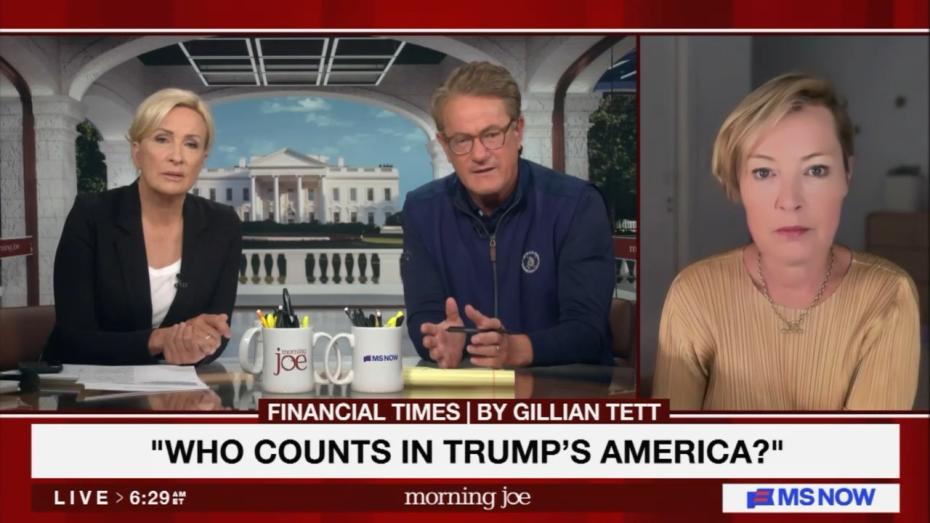
The start of the segment focused on a Gillian Tett column in the Financial Times with a title, “Who Counts in Trump’s America,” that clearly gave away the article’s slant.
After co-host Mika Brzezinski read the column, Tett herself barged in and said, “And what's fascinating is that, although 99.9 percent of voters just ignore it, Republicans have noticed that it's potentially got a lot of importance, and they are essentially mounting a very quiet campaign to reshape how the census is done in two ways.”
Monday’s Morning Joe feared possible changes to the US Census, most notably the addition of a question about citizenship.
Financial Times columnist Gillian Tett argued the citizenship question would be “unconstitutional,” and continued to say more possible changes would make it… pic.twitter.com/8HKtdtKrDo— Nick (@nspin310) August 24, 2026
Tett then feared the possibility of adding a citizenship question to the 2030 Census, akin to the Trump Administration’s attempt to add the question in his first term, which was called racist back then on MSNBC. She said, “Firstly, to knock out the – sorry – to add a question about citizenship to the 2030 census, which many people would argue is unconstitutional because the Constitution says you have to count everybody, irrespective of status.”
Tett continued to worry, “They're trying to change some of the technical ways that privacy protections are put into the census that effectively mean it's going to be almost impossible to publish detailed data on race or gender, or even much detailed data on minorities in small communities at all.”
Scarborough’s main concern from Tett’s piece was the impact on congressional redistricting, as he seemed to fear changes to the census, like a citizenship question, would lessen the amount of Democratic seats, as he stated it would “obviously…impact the congressional redistricting over the next decade.”
Scarborough built off the census discussion and argued the Trump Administration had “torn down” institutions:
Joe Scarborough then continued to worry about overall Trump government policies and stated, “...the question people have is, are we going to survive? Are we going to be able to rebuild this two years from now?”
French responded in a long-winded answer that, in short, labeled the… https://t.co/ZZRIuq0qXl pic.twitter.com/uonvxiIuxq— Nick (@nspin310) August 24, 2026
You see what's happened at the DOD. You see what's happened at the Justice Department. You see what's happened at the National Institutes of Health. All of these institutions that have been built up to protect Americans and to extend American power and safety across the globe, are being torn down brick by brick, piece by piece, by this Trump Administration.
He added, “And the question people have is, Are we going to survive? Are we going to be able to rebuild this two years from now?”
New York Times “conservative” columnist David French used his airtime to label the Trump Administration as authoritarian:
You know, I wouldn't call it tearing down the state so much as personalizing the state. All elements of the state are being put in the service of the person Donald Trump. Being pulled from their primary purposes, being pulled from their primary areas of competence, being remade from the inside out to serve Donald Trump. And this is core to his authoritarian project.
Another week meant just more comparisons of Trump to authoritarians on Morning Joe.
The transcript is below. Click "expand":
MS NOW’s Morning Joe
August 24, 2026
6:28:52 AM Eastern
(...)
MIKA BRZEZINSKI: Gillian Tett, your latest piece for The Financial Times is titled “Who counts in Trump's America?” And you write in part this: “On the afternoon of August 2nd, the Trump team delivered a bombshell that is highly political ahead of this year's midterm elections and amid wider fights about gerrymandering and Trump's insistence that the 2020 election was rigged.
They explained that when America holds its next census in 2030, technical reforms will make it hard to publish the data about race and gender. The statisticians were shocked, since they, not politicians, usually handle technical reforms. Worrying about the state of America's statistics might not seem that urgent, given all the other explosive political rows swirling in Washington. But voters should pay attention, for at the heart of this story, there are three key questions: Can anyone paint an accurate portrait of what America is today? If so, how should this shape voting processes, and can this data be trusted in an era of manipulation, cyber hacks, and artificial intelligence?”
JOE SCARBOROUGH: So, Gillian, tell us how the Trump administration right now is making it harder in 2030 to figure out exactly who is an American, what the racial makeup of America is, and tell us how this may impact future elections.
GILLIAN TETT: Well, thank you. I mean, the census is a classic example of something linked to infrastructure, which seemed incredibly boring. Everyone ignores it most of the time because it's basically geeky and a bit nerdy. But in reality, it's crucial because it doesn't just shape how we measure the economy, which businesses and investors rely on. It also has a huge impact on the political system because it shapes how House seats are essentially allocated.
And what's fascinating is that, although 99.9 percent of voters just ignore it, Republicans have noticed that it's potentially got a lot of importance, and they are essentially mounting a very quiet campaign to reshape how the census is done in two ways.
Firstly, to knock out the – sorry – to add a question about citizenship to the 2030 census, which many people would argue is unconstitutional because the Constitution says you have to count everybody, irrespective of status. And secondly, they're trying to change some of the technical ways that privacy protections are put into the census that effectively mean it's going to be almost impossible to publish detailed data on race or gender, or even much detailed data on minorities in small communities at all.
Now they are saying they're doing that to protect people's privacy. But many of the community activist groups are really upset because they argue, essentially, what's happening is you're blurring a picture of what America is. And that's got all kinds of implications for how we imagine politics going forward. Most notably, that it will be harder to measure impacts of policies around things like race and gender.
SCARBOROUGH: Yeah, no doubt about it. And obviously will impact the congressional redistricting over the next decade. Columnist at The Financial Times, Gillian Tett, as always, thank you so much.
BRZEZINSKI: Thank you, Gillian.
SCARBOROUGH: You know, David French, years ago, Steve Bannon said he was a Leninist, and he and Trump were going to go in, and they were going to tear down the state, take it to the ground.
You look at what Gillian said they're doing with the census. One of the most basic should be noncontroversial things ever. They're trying to rig that, it seems. What they're doing with the post office, using the post office to do unconstitutional things with the midterm elections. Taking it from the states' power and giving it to the executive branch, which is not in the Constitution. It's unconstitutional.
You see what's happened at the DOD. You see what's happened at the Justice Department. You see what's happened at the National Institutes of Health. All of these institutions that have been built up to protect Americans and to extend American power and safety across the globe, are being torn down brick by brick, piece by piece, by this Trump Administration. And the question people have is, Are we going to survive? Are we going to be able to rebuild this two years from now?’
DAVID FRENCH: You know, I wouldn't call it tearing down the state so much as personalizing the state. All elements of the state are being put in the service of the person Donald Trump. Being pulled from their primary purposes, being pulled from their primary areas of competence, being remade from the inside out to serve Donald Trump. And this is core to his authoritarian project.
I mean, look, we have to understand that he looks at XI Jinping out there, he looks at Vladimir Putin out there, and he sees peers with whom he envies in some ways. He envies their autonomy. He envies their authority. And as we've seen with the Canadian trade wars, he envies their spheres of influence. And so he is directing everything in on himself. And this is inherently corrupt. People can see that it's inherently corrupt. And when they're struggling economically, or they're dissatisfied economically, or they see all of these self-inflicted wounds that are focused in on Trump and not for their benefit, they get angry. And you're beginning to see rumblings here in this country that remind me a bit of the popular revulsion, ultimately, at Viktor Orban in Hungary. Authoritarianism does not sell, especially when people feel insecure financially.
(...)