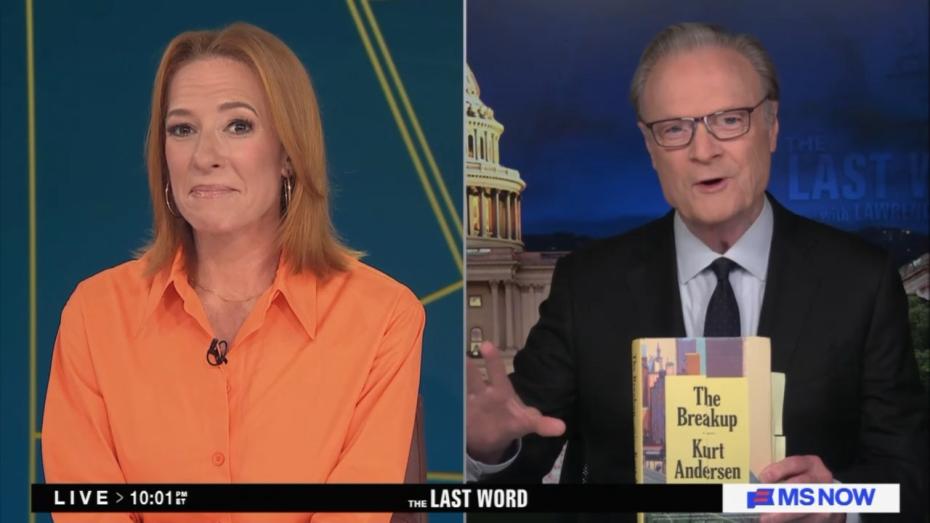
On Wednesday night, MS NOW’s The Last Word host Lawrence O’Donnell continued the network's promotion of the novel The Breakup, a futuristic book set 20 years into the future after a civil war and “national divorce.” O’Donnell called the book his “favorite new book” as he told fellow MS NOW host Jen Psaki details of the novel, including former Transportation Secretary Pete Buttigieg’s role of “negotiating the disunion.”
At the start of the show, amid the handoff with Psaki’s The Briefing, O’Donnell exclaimed, “Hey, Jen. We have some predictions for you in this book, my favorite new book. It is a futuristic novel about our world 20 years from now. Includes a lot of stuff. Our life with robots, all sorts of stuff, but also our politics.”
O’Donnell later dove into the idea of the national split in the novel, as he stated, “And Pete Buttigieg has a very important role in government 20 years from now, negotiating what they call the disunion, because the President of the United States is the president of only 39 states, the rest having separated in what works out to be kind of a divorce. It's all so fascinating.”
Earlier, in the show handoff with Jen Psaki, O'Donnell called the novel “my favorite new book.”
Psaki seemed a little uncomfortable when O’Donnell noted Pete Buttigieg “has a very important role in government 20 years from now, negotiating what they call the disunion..." pic.twitter.com/xfeBRfeQ1A— Nick (@nspin310) August 20, 2026
It should be noted, Psaki’s face seemed to change during O’Donnell’s mention of “disunion,” almost as if she noticed a bit of a crazy person.
He then exclaimed, “This one is the best beach read of the rest of the summer, that's for sure."
What exactly was in the “best beach read of the rest of the summer?” A futuristic fiction novel about an upcoming civil war and national divorce that left the United States with 39 states.
Wednesday’s The Last Word with Lawrence O’Donnell promoted a futuristic novel set 20 years in the future amid a national “disunion.”
The novel, ‘The Breakup’ by Kurt Andersen, was really just a book of liberal dreams for the future, including a national breakup that left the… pic.twitter.com/MkNXiaIhc3— Nick (@nspin310) August 20, 2026
While the book’s author, Kurt Andersen, mentioned the idea of a civil war in an interview on Tuesday’s Morning Joe and had a gloomy tone on the future of America, O’Donnell instead declared, “A national divorce occurs in the breakup instead of an all-out 19th-century-style civil war. Like many divorces, it begins angrily and in the later negotiations becomes more practical and understanding and not so bad.”
O’Donnell then described Andersen’s post-divorce government. First came Senator Chris Murphy (D-CT), who was Senate majority leader in the novel set in 2046. Current Virginia governor Abigail Spanberger (D) “is the chair of the Senate Foreign Relations Committee, now dealing with the USA's closest neighboring country, the Free American Republic.”
Back after O’Donnell’s brief mention to Psaki, the book declares “Pete Buttigieg is the Disunion Commission chair, the national divorce mediator of sorts.” O’Donnell then read, “Elissa Slotkin is the vice president of the United States, and Alexandria Ocasio-Cortez is president.”
Lawrence O’Donnell also made sure to note the details in the novel about Donald Trump and Elon Musk’s fate:
O’DONNELL: In the future, 20 years from now, rendered in the breakup, Donald Trump is no longer with us, and although we have a collection of trillionaires, not all of… https://t.co/fWDOfY7opC pic.twitter.com/fT9CkccqpW— Nick (@nspin310) August 20, 2026
Additionally, O’Donnell gleefully read the predictions of fate for President Trump and SpaceX founder Elon Musk:
In the future, 20 years from now, rendered in the breakup, Donald Trump is no longer with us, and although we have a collection of trillionaires, not all of them completely bad, Elon Musk is no longer among them. Having, quote, “overdosed en route to Mars.”
Andersen then expressed some desire for a real national divorce and ended by saying, “But as you say, in the end, you know, many divorced couples find, among other things, it's better for the kids in the long run. And so I, I think that could well be the case in, in our national instance.”
O’Donnell closed the segment with his own last word: “This has been a delight for me. It's just been the summer read, and I'm urging it on everyone.”
Of course, a divisive man like O’Donnell, who seemed giddy about a possible Iranian assassination attempt against Trump, would call a book that predicted a national war and the overdose of Elon Musk a “delight.”
The transcript is below. Click "expand":
MS NOW’s The Last Word
August 19, 2026
10:00:26 PM Eastern
JEN PSAKI: That does it for me tonight. Thanks for being here with us. The Last Word with Lawrence O'Donnell starts right now. Hey, Lawrence.
LAWRENCE O’DONNELL: Hey, Jen. We have some predictions for you in this book, my favorite new book. It is a futuristic novel about our world 20 years from now. Includes a lot of stuff. Our life with robots, all sorts of stuff, but also our politics.
And I'm not going to tell you who the President of the United States is going to be 20 years from now. In this book –
PSAKI: Please tell me. Is it somehow we know?
O’DONNELL: In this book – I will only say, she is a Democrat.
PSAKI: Oh. You had me at she. You had me at she.
O’DONNELL: Right. And the vice president. The only thing I'll say about her is she is also a Democrat.
And Pete Buttigieg has a very important role in government 20 years from now, negotiating what they call the disunion, because the President of the United States is the president of only 39 states, the rest having separated in what works out to be kind of a divorce. It's all so fascinating. We're going to discuss it with Kurt Anderson when he joins us at the end of the hour tonight.
PSAKI: I can't wait. I always tell you, you need a book club because I always want to read every book you're excited about. So, I'll look forward to watching that too.
O’DONNELL: This one is the best beach read of the rest of the summer, that's for sure.
PSAKI: Beach read for nerds. We love it.
O’DONNELL: Right. Thanks, Jen.
(...)
10:47:12 PM Eastern
O’DONNELL: A one-of-a-kind book that only this writer could produce. That's what the Chicago Tribune is calling Kurt Andersen's brilliant new novel, The Breakup. The book takes us 20 years into the future to see how a politically divided country has decided to break up.
“Americans have been strange bedfellows in a mixed marriage for a long time. We grew apart. We stayed together, but finally came to find each other impossible. We fought. We had irreconcilable differences. We finally split. In a world where half the marriages unravel or rot or die of thirst or blow up,
A cliched question about America since I was a kid concerned our national political “fever,” if and when it would ever break. The fever broke. Along with our beautiful, uncomfortable, brittle, breakable, antique national governing arrangements now being rebuilt and refurbished. It could be worse.
A national divorce occurs in the breakup instead of an all-out 19th-century-style civil war. Like many divorces, it begins angrily and in the later negotiations becomes more practical and understanding and not so bad.
In this imagined American future. Chris Murphy is the Senate majority leader. Abigail Spanberger is the chair of the Senate Foreign Relations Committee, now dealing with the USA's closest neighboring country, the Free American Republic, which includes half the land of the United States but only about one-fourth of the people.
Pete Buttigieg is the Disunion Commission chair, the national divorce mediator of sorts trying to sort out the future of Social Security and Medicare and Medicaid in the breakaway states.
Elissa Slotkin is the vice president of the United States, and Alexandria Ocasio-Cortez is president. Purely fictional characters populate the leadership of the free American republic, where, according to news reports, 20 years from now, some secession remorse is taking hold among people who are watching their hospitals close and are now living in a country with an economy one-seventh the size of the remaining United States of America, which includes all of the biggest and richest blue states. Some states, like Montana, go back and forth about leaving the union, but in the end, 39 states vote to stay.
In the novel, we tour the disconnected landscape with the parents of a high school student doing what has become, by that time, an old-fashioned college tour, visiting campuses in both countries, and we learn much of the new etiquette of the mid-21st century, including where to stand on an elevator with robots.
“We had training sessions last month to practice what will happen when the robots start riding along with the rest of us, instead of in robot-only elevators. The main lesson was about their default positions: at the front of cars, because some people feel uncomfortable with robots behind them and on the left side, particularly the tall walkers, since robots communicate with the elevator via ultra-wideband and don't need to push buttons.
In the future, 20 years from now, rendered in the breakup, Donald Trump is no longer with us, and although we have a collection of trillionaires, not all of them completely bad, Elon Musk is no longer among them. Having, quote, “overdosed en route to Mars.”
Joining us now is Kurt Andersen, the author of the New York Times best-selling nonfiction books, Fantasyland and Evil Geniuses, and now the author of a movie-worthy work of fiction titled The Breakup, which is now available online and in stores.
Kurt, thank you very much for joining us tonight. And thank you so much for this book. I told Jen Psaki the other night, this is what I've been reading to feel, actually, among other things, the import of these election nights that we're having right now, that so much is at stake in the present as we imagine what the future might be.
You've taken this imagination all the way, all the way up to 2046, and it is just beautifully told and told in the shape of a divorce. The kind of story we've seen people go through, fearing the worst at the beginning, finding ways that turn out maybe to be practical ways of coexisting. What got you on this path?
KURT ANDERSEN: Well, I started with this idea that I wanted to write really a book about the future America. You know, I'd written these two nonfiction histories that you mentioned, and I decided that the way to do that future is what I've done for previous times, which is to say fictionally with a novel, because thinking about it, I realized I could write a book saying, ‘Oh, this could happen, this could happen, this happened in Yugoslavia’ or whatever.
But to me, the future of the United States of America, and anywhere, is fiction. You know, it's all speculative. And until it happens, it's fiction. So, that was the way to go.
Plus, I decided I wanted to see how this went down and how life exists in the aftermath of the breakup and the civil war through the eyes of two people. Two people, I hope, are sympathetic characters, living through it and having their own issues with their 23-year-old marriage. That is part - has political issues in their conflict, but other, also, incredible conflicts over technology, which has, as you suggest, progressed as it will in 19 years.
And she grew up in Tennessee, Natalie. He grew up in Los Angeles, suburbs of Los Angeles. She was working class, he's not. So, they began with differences, as in that passage you read, so did America. So does America, nd that's part of its, of course, magnificence.
O’DONNELL: I love – just Futurists alone should have an interest in this. Whether they - even without caring about the politics. You don't have to care about the politics to be just swept away with this book. You're holding a great movie in your hands, and the pages turn themselves.
But on the framing of it, in terms of divorce, what I found so fascinating about it was that what people discover in divorce, as painful as an idea as it might sound at the beginning and they discover it might be years down the road, it's very common for them to discover, ’Oh, it wasn't so bad.’ And/or in many cases, ‘Oh, it was definitely the right thing to do. And everyone is better off.’ And so we're only about ten years into the workings of the divorce in this book at 2046. Do you imagine that in this in the next volume of this story, in 2066, that people would be feeling, you know, it was probably the right thing to do under the circumstances?
ANDERSEN: Well, I left it, as, you know, ambiguous about what happened. And it seems as though that possibility is very much there. And certainly the husband in this marriage is, ‘Hey, this is great.’ And when there was a civil war, and then when there was this movement to break up the United States, unlike in the Civil War 170 years ago, there was not the pushback to save the union at all costs, which was Lincoln and the Union's desire back then.
This is like, ’Okay, good riddance.’ And so - and it is painful, and it would be horrible, peaceful or violent. But as you say, in the end, you know, many divorced couples find, among other things, it's better for the kids in the long run. And so I, I think that could well be the case in, in our national instance.
O’DONNEL It is a great read. And it doesn't matter whether you think it is likely or possible. That isn't the point of a novel like this. It is a wonderful work of the imagination. Kurt, thank you very much for joining us tonight. This has been a delight for me. It's just been the summer read, and I'm urging it on everyone.
ANDERSEN: Thank you so much.
(...)