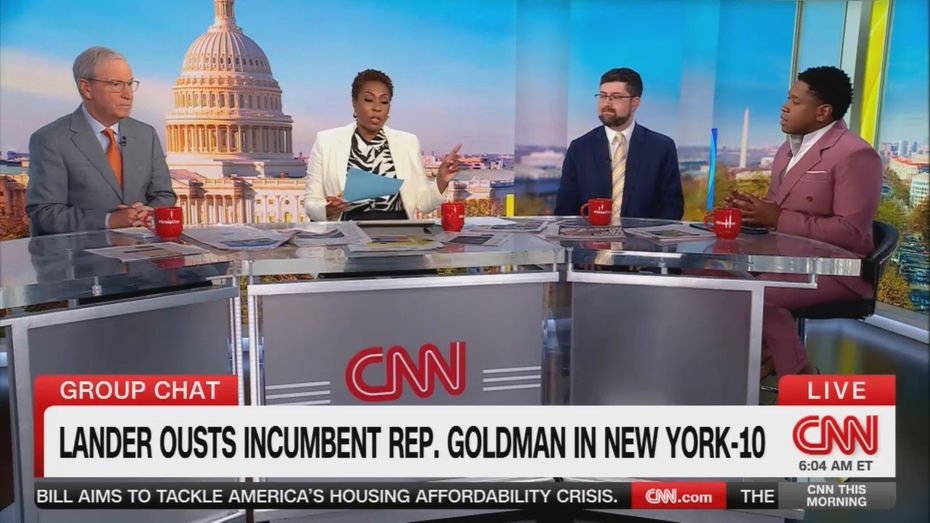
Cornish started with Democratic House Leader Hakeem Jeffries’ denial of the Democratic socialist candidates and their recent victories, alike with cases of victories of Senator Bernie Sanders (I-VT) endorsed candidates.
She asked Seawright if Jeffries was “denying the reality of where voters are headed.”
On CNN This Morning, two panelists downplayed the victories of DSA-backed candidates in Democratic primaries.
— Nick (@nspin310) June 24, 2026
First, strategist Antjuan Seawright claimed the big takeaway of the night was the "turnout," and said the Democratic party was like a buffet, "adding some items." pic.twitter.com/T79q4asciy
Seawright’s response minimized the DSA-backed candidate's wins, and instead said the “big takeaway from last night was the robust, healthy turnout. We saw expanding our traditional base in these primaries, which means that we have room to grow,” before he referred to the Democratic Party as a “buffet” that was “adding some items.”
After Cornish read a tweet from former DNC head Jamie Harrison, which seemed to be confrontational to the rise of socialist candidates who disliked party leadership, Seawright said the party was “experiencing growing pains. That happens on both sides of the aisle.”
He then continued to claim moderate victories were the big takeaway from the New York primaries: “progressives winning in Democratic safe seats is not some narrative that we should just be flashing the lights about. I mean, that's healthy debate. That's healthy within the party.”
Brownstein jumped into the conversation and agreed with Seawright that the focus should be on the wins of moderate candidates:
It is really a two-track story. I think that it is not as simple as being portrayed.
Ron Brownstein then continued the "nothing to see here" approach and focused on moderates over the DSA:
— Nick (@nspin310) June 24, 2026
"But if you look at the districts that are going to decide which party has the majority, with a few exceptions, Democrats are still relying primarily on moderate nominees." pic.twitter.com/3TMrrXgYeA
The CNN analyst said there is “no question” the “party is moving to the left” in safe Democratic districts, and said, “a mainstream Democrat in a solidly blue district” has to be, “looking over your left shoulder after what we are watching this year.”
But, Brownstein ultimately concluded, like Seawright, moderate victories represent the party better:
But if you look at the districts that are going to decide which party has the majority with a few exceptions, Democrats are still relying primarily on moderate nominees.
After listing a couple “moderate” victories in primaries, Brownstein then worried that Republicans would tie moderate Democrat candidates to the far-left: “Now, it is not without consequence that these left candidates are winning in, even in safe places, because A, Republicans are going to try to tie all Democrats to them.”
Conservative panelist Jarrett Stepman insisted you can't deny that Mamdani & Co. are adding more socialists to the party and changing the party's dynamic.
In his final minimization, Brownstein added, “And if Democrats do get the majority, it's going to affect the internal dynamics of the caucus.(...) But in terms of who gets the majority, it's not critical.”
The minimization from CNN hid the true nature of the rise of Mamdani-like socialist candidates across the country, and, as Cornish mentioned in the beginning, seemed to be a denial about the rise of socialists.
CNN This Morning
June 24, 2026
6:03:10 AM Eastern(...)
AUDIE CORNISH: Antjuan, I'm going to start with you because this is all about Democrats last night and the Democratic Party, except it kind of was about the Democratic Socialists instead.
You had someone like Hakeem Jeffries on Wednesday, sort of implying like, ‘Hey, settle down, everyone trying to turn these into tea leaves.’
(...)
6:03:45 AM Easter
CORNISH: Is this denying the reality of where voters are headed?
ANTJUAN SEAWRIGHT: A few takeaways from last night. One, I think that these New York primaries are not some big, bold print or summary of where the totality of the Democratic Party is heading.
Number two, I would argue that the big takeaway from last night was the robust, healthy turnout. We saw expanding our traditional base in these primaries, which means that we have room to grow. I think that means that the buffet, known as the Democratic Party, are adding some items. And so that means more people will stand in line to eat from the buffet in November.
CORNISH: It sounds like a parallel buffet. Hold on, no, no no, before you go.
Jamie Harrison, Democrat, he was saying - I think this was - 23rd, almost midnight when he’s tweeting this. “Political parties aren't perfect, but they're built by millions of people who knock doors, make calls, fight for the values they believe in.” And then he says this because a lot of people are criticizing the party. “If you don't believe in the party, then don't ask its members to carry you across the finish line.”
Chris Murphy responds, Chris Murphy of Connecticut. And he goes, “I don't know, man. Who is the Democratic Party, if not the voters? Democratic voters choose candidates, not party leaders. And party leaders need to listen to what voters are telling us. And right now, they're demanding our party be bolder.”
SEAWRIGHT: Sure. We are experiencing growing pains. That happens on both sides of the aisle.
But what I will tell you is that the big takeaway from the New York primaries last night was New York 17, a moderate candidate who will take on Mike Lawler, a swing district in New York that will help us get the majority.
Democrats - progressives winning in Democratic safe seats is not some narrative that we should just be flashing the lights about. I mean, that's healthy debate. That's healthy within the party
I'm more focused on how do we get to 218? And New York 17 primary is a direct result of that.
RON BROWNSTEIN: It is really a two-track story. I think that it is not as simple as being portrayed.
Antjuan was right. I mean, in safe Democratic seats, in blue places, there is no question the party is moving to the left. If you are an incumbent, kind of a mainstream Democrat in a solidly blue district, especially in an urban setting, you have to be looking over your left shoulder after what we are watching this year.
But if you look at the districts that are going to decide which party has the majority with a few exceptions, Democrats are still relying primarily on moderate nominees.
I mean, New York 17, South Carolina 1, and Utah 1 last night. We didn't say Ben McAdams. We didn't say Nancy Lacore. We didn't say Kate Connelly. But ultimately, those are the candidates that are going to decide which party is in the majority.
Now, it is not without consequence that these left candidates are winning in, even in safe places, because A, Republicans are going to try to tie all Democrats to them.
And if Democrats do get the majority, it's going to affect the internal dynamics of the caucus.
CORNISH: Well, Let me make sure -
BROWNSTEIN: But in terms of who gets the majority, it's not critical.
CORNISH: Let me make sure Jarrett has a moment to step in here. Because this is the argument that I've heard over and over and over again with each one of these special elections. There's a moderate doing well. There's someone over here making noise. Why? Who are they?
But you have Republicans using those voices to be like, look, they're all communists. And does that work against some of these moderate candidates?
JARRETT STEPMAN: Sure. But you can't deny the fact that Mamdani and folks like him are trying to reshape the Democrat Party.
I thought a lot of the issues were actually less just directed toward Donald Trump. What you see a lot of in the Democrat Party is opposition to Trump. This is about internal debates within the party.
I mean, it's very clear now that Israel is becoming a litmus test for many, especially in these deep-blue districts. That clearly came to pass in these elections.
So, yes, I understand that the larger political picture, the national picture, is being shaped by a few more moderate swing districts. But this does shape the party, long-term. If you're sending more socialist members to Congress that changes the dynamic.