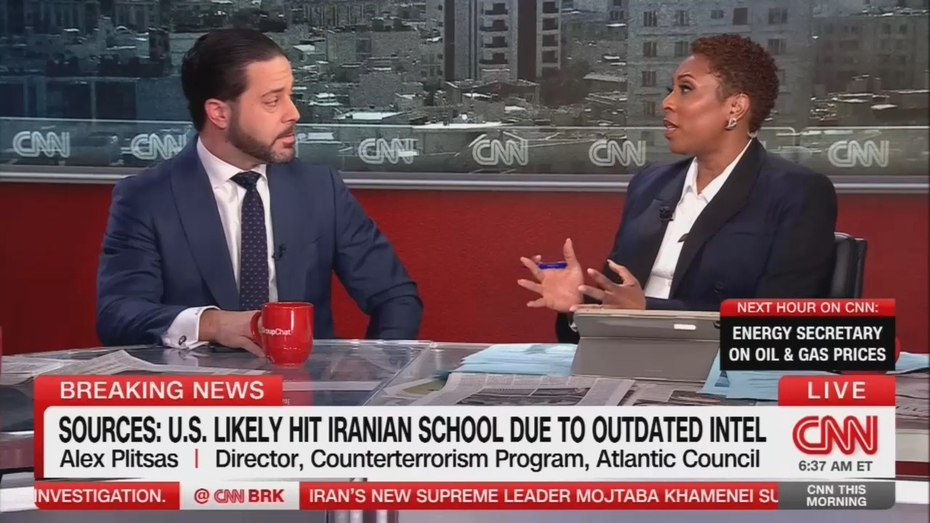
The bombing at an Iranian school close to IRGC facilities has been a top topic among media outlets. Cornish opened with, “But one of the reasons why I think people are interested is if there was an imminent threat, if we've modeled going into Iran for years, why out of the gate would there be an error in a strike?”
On Thursday's CNN This Morning, Audie Cornish implied the Department of War under Hegseth has no oversight and took issue with the idea of a "more lethal" military.
— Nick (@nspin310) March 12, 2026
As Alex Plitsas tried to explain the measures taken to prevent civilian death, Cornish repeatedly interrupted. pic.twitter.com/j1qbfAIkJg
Plitsas tried to point out the isolated nature of the alleged incident, but Cornish repeatedly interrupted as he tried to discuss the safeguards that were in place:
PLITSAS: So. I mean, at this point, we've struck something like 5,000 targets, and this is the only time we've heard of a target like this being struck by accident.
CORNISH: That’s a pretty big one, right? I mean, to me, this feel, it's not like -
PLITSAS: It's big because of the outcome that happened, and I'm not going to diminish that by any means. There were 168 innocent people that were reportedly killed, and that is a travesty that we can't ignore.
CORNISH: And it was near a base. So, that’s why I’m asking.
PLITSAS: That’s precisely -
CORNISH: That sense of like, wait a second, was it an error? Someone on the panel was talking about the idea of there being somehow an actual error in the intelligence, or is it outdated? Did we launch something and not really have a grasp on where we were aiming those missiles?
Most would agree any strikes that lead to civilian deaths are a tragedy, but it should also be noted the proximity of the school to IRGC targets, specifically naval base targets in a military compounds.
Then, Cornish implied that Secretary Hegseth and his department would strike more civilians because of his mission to make the department “more lethal” while another implication suggested he was removing civilian safeguards:
One of the reasons why I'm also interested in this is under Pete Hegseth and his Defense Department posture, which says we need to be more lethal, we need to streamline the red tape, he has downgraded some attorneys. He has said they shouldn't be clouding or muddying the line of decision-making. Can we expect oversight from a military that is literally downgrading the legal observers, the legal guys?
It’s pretty clear Hegseth’s mission of increased lethality did not mean killing civilians, but more of an actual focus on training soldiers to be better fighters if they need to fight.
Even as Plitsas was trying to explain how DoW lawyers were still involved in approving strike packages, Cornish just wasn’t having it seemingly adamant there was no oversight:
PLITSAS: Sure. So, there's still operations law attorneys who have to review all the strikes that are going on. So, US Central Command, which is our military command that's responsible for the Middle East and Central Asia, is overseeing this at a four-star level, which is Admiral Brad Cooper.
He has lawyers in there as well that review the strike packages when they come in and make sure that they're legal. We're not seeing illegal targets being struck. These all appear to be to conform with the law.
CORNISH: But do you know what I mean, are the watchers there? Are the watchmen doing any watching?
PLITSAS: So, at the command where it's happening, yes, and then I think the question for you is an oversight, right, at the most senior level.
Plitsas responded with the same and correct response that there is oversight and the incident is under investigation.
The media’s derangement over Hegseth has continued since he was first nominated after Trump’s election win and might be headed to its top point during these Iran operations.
The transcript is below. Click "expand":
CNN This Morning
March 12, 2026
6:37:26 AM Eastern
(...)
AUDIE CORNISH: Ok. Alex Plitsas, CNN national security analyst and director of the counterterrorism program for the Atlantic Council, is here in the chat. And man we needed you. So here is the thing I'm hearing from, you know, the White House, the Republican establishment, and it is saying this, the media is making a big deal out of this thing and that that is not fair.
But one of the reasons why I think people are interested is if there was an imminent threat, if we've modeled going into Iran for years, why out of the gate would there be an error in a strike?
ALEX PLITSAS (CNN Analyst and Director of Counterterrorism Program at Atlantic Council): So. I mean, at this point, we've struck something like 5,000 targets, and this is the only time we've heard of a target like this being struck by accident.
CORNISH: That’s a pretty big one, right? I mean, to me, this feel, it's not like -
PLITSAS: It's big because of the outcome that happened, and I'm not going to diminish that by any means. There were 168 innocent people that were reportedly killed, and that is a travesty that we can't ignore.
CORNISH: And it was near a base. So, that’s why I’m asking.
PLITSAS: That’s precisely -
CORNISH: That sense of like, wait a second, was it an error? Someone on the panel was talking about the idea of there being somehow an actual error in the intelligence, or is it outdated? Did we launch something and not really have a grasp on where we were aiming those missiles?
PLITSAS: So, it appears to be outdated intelligence, and here's why. The compound itself, there were about six buildings right adjacent to each other, and then the school was sort of adjacent to the side. It appears that a wall had been built in between somewhere over the last decade or so when the building transitioned to a school. So, it appears it was part of an old target deck.
And the pilots are moving through, we call it an air-tasking order. So, they're moving down a series of targets in order. They're not hitting targets of opportunity. So, it wasn't that a pilot saw something and dropped, you know, a bomb. It was a missile, by all accounts, that came in. So, unfortunately, it appears coordinates were entered for an old building based on outdated intelligence. So, it would have actually been a targeting error.
CORNISH: So, you can see how people would then be like, well, wait a second. I thought we were ready for this. I thought we had all the intelligence. I thought the Israelis were helping us. Like, what happened?
PLITSAS: Sure. I mean, this is - again, it appears to be an isolated incident out of 5,000 strikes. We're not hearing like a lot of these. So, unfortunately, it does appear that one slipped through on this one and led to catastrophic circumstances where 168 innocent people were killed.
CORNISH: One of the reasons why I'm also interested in this is under Pete Hegseth and his Defense Department posture, which says we need to be more lethal, we need to streamline the red tape, he has downgraded some attorneys. He has said they shouldn't be clouding or muddying the line of decision-making. Can we expect oversight from a military that is literally downgrading the legal observers, the legal guys?
PLITSAS: Sure. So, there's still operations law attorneys who have to review all the strikes that are going on. So, US Central Command, which is our military command that's responsible for the Middle East and Central Asia, is overseeing this at a four-star level, which is Admiral Brad Cooper.
He has lawyers in there as well that review the strike packages when they come in and make sure that they're legal. We're not seeing illegal targets being struck. These all appear to be to conform with the law.
CORNISH: But do you know what I mean, are the watchers there? Are the watchmen doing any watching?
PLITSAS: So, at the command where it's happening, yes, and then I think the question for you is an oversight, right, at the most senior level. So, at least it appears now the Pentagon is investigating and they're going to come forth with the report, so I think we'll find out very quickly if the oversight is as robust as it is.
(...)