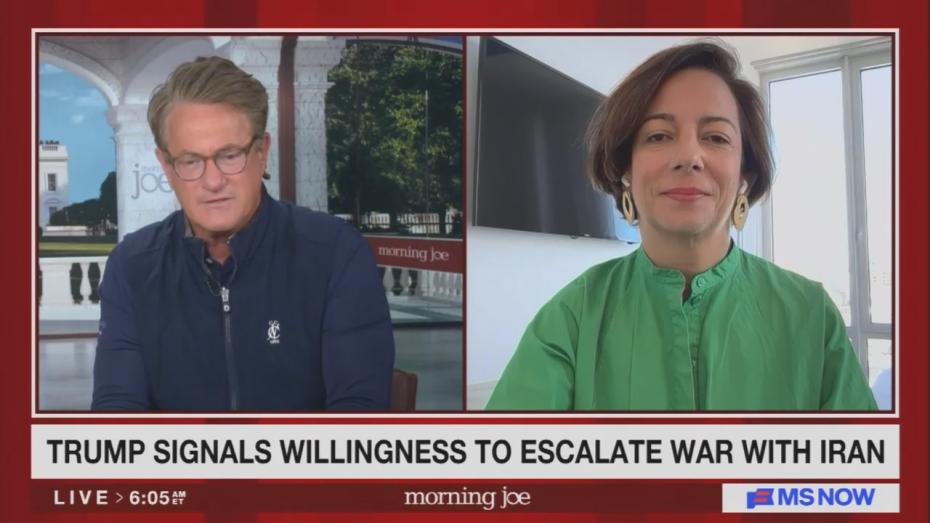
The liberal media consensus has been that Iran has emerged stronger than ever from the conflict with the United States and Israel. Joe Scarborough has been a strident voice in that downbeat choir.
Thus, on Morning Joe's June 18th episode, Scarborough railed that the Memorandum of Understanding leaves the Iranian regime "more powerful than they've ever been."
On Wednesday's Scarborough chat-a-thon, Kim Ghattas, a contributing editor at the Financial Times, acknowledged that while Iran may appear to hold the upper hand with actions like threatening the Strait of Hormuz and inflicting casualties, the reality on the ground tells a different story.
“It's very interesting to hear Richard speak about Israeli overreach and American overreach. Because I also think the Iranians are overreaching at this moment in the conflict . . . They also feel quite stuck,” Ghattas said, reading the tea leaves from Iranian officials including Foreign Minister Araghchi. “It sounds like, from listening to these interviews, the Iranian foreign minister was sounding quite demoralized, almost.”
Rather than sticking to his "Iran-stronger-than-ever" guns, Scarborough exclaimed, "Boy! That's so important," and brought in Washington Post columnist and associate editor David Ignatius to expand on the point.
Ignatius agreed with Ghattas's views:
"We've been talking about how the United States is stuck, and I think that's equally true of Iran . . . Iran has been hit so hard. They're really playing a pretty weak hand. Week by week, their ability to project power declines."
Surprise! @Morning_Joe Guests Admit Iran ‘Stuck, Demoralized, Declining'@KimGhattas @IgnatiusPost pic.twitter.com/l3ckx8jbrD
— Mark Finkelstein (@markfinkelstein) July 22, 2026
Wednesday’s exchange highlighted an Iranian regime that, despite its bluster and continued missile/drone launches, is internally strained, economically battered, and increasingly limited in its capacity to sustain or expand its reach.
While Ghattas and Ignatius still framed aspects of U.S. and Israeli actions as overreach, their candid assessment of Iran’s vulnerabilities undercuts the simplistic “Trump made Iran stronger” storyline that has dominated much of the coverage.
Faced with insights from far better-informed experts, will Scarborough back off his apocalyptic preaching against Trump's handling of Iran? Wouldn't bet the rent.
Here's the transcript.
MS NOW
Morning Joe
7/22/26
6:04 am EDT
JOE SCARBOROUGH: I want to add to the discussion contributing editor at the Financial Times, Kim Ghattas. And Kim, Richard was just talking about how both the United States and Israel find itself greatly challenged. The United States tied down in Iran, and Israel not only tied down across the region, but also more unpopular with United States voters than at any time since 1948.
How is that impacting the direction not only of this war, but also the region?
KIM GHATTAS: Joe, it's very interesting to hear Richard speak about Israeli overreach and American overreach. Because I also think the Iranians are overreaching at this moment in the conflict.
And reading through the tea leaves of what Iranian officials are saying, including the foreign minister, Araghchi, who was speaking just over the weekend in an interview. There's really a sense that, although it may look like they have the upper hand closing the Strait of Hormuz, inflicting damage and casualties on the United States and its forces and troops in the region, they also feel quite stuck.
It sounds like from listening to these interviews, the Iranian foreign minister was sounding quite demoralized, almost.
SCARBOROUGH: Boy, that's so important. Let's bring in a columnist and associate editor at The Washington Post, David Ignatius.
David, let's underline Kim's point right now. Because obviously we're looking at this from a position of how this could be a growing quagmire for the United States.
If you step back and just look over the past year or two, you have an Iranian regime, which you said was ready to fall under its own weight. The fact that Donald Trump may have given them a second life doesn't take away from the fact they still face the same economic challenges.
They still face the same popular discontent there. But it is fascinating when Kim talks about the Iranian foreign minister being down. It reminds me, again, as we talked about earlier this week, David, of the checks and balances in the United States.
He might as well be the Senate majority leader who can't get a bill through because, as we've said time and again, between the Revolutionary Guard and the mullahs and the parliament and the president and the president's cabinet, there are a lot of checks and balances there in Iran.
There always have been. They've just been made more scrambled and Byzantinian since this war began. Talk us through that.
DAVID IGNATIUS: So, we've been talking about how the United States is stuck, and I think that's equally true of Iran.
Iran has been hit so hard. And that comes after years of economic neglect and decline.
. . .
The problem is that the people who have the guns in Iran are just intoxicated with their resistance to the United States and Israel. And you can understand why. They've stood up to bombardment. They're still going. They're still fighting. So they think this conflict is going their way.
It's going their way only in the sense that they're still in the game. They're still able to fire drones and missiles, to hit targets in Bahrain and Jordan, inflict casualties, deaths on the United States.
So that gives them a sense of power. But they're really playing a pretty weak hand. Week by week, their ability to project power declines.