Across the broadcast networks on Tuesday morning, all three chose to apply their anti-Trump drivel and Republican voter suppression efforts through all-too-convenient anecdotes. NBC’s Today did so by blaming Trump’s Iran war for a Yakima, Washington-area school district having to cut bus routes (even though the school year didn’t start all that long ago), strategizing for Texas Democrat James Talarico, and cheering on Mississippi as a possible stop on an inevitable blue tsunami.
Chief White House correspondent Garrett Haake had the lead-off report, boasting to viewers that Democrats are doing so well that the “midterm map of battlegrounds continues to shift in these final days,” because “it now includes the state of Mississippi, which hasn’t elected a Democrat to the Senate since 1982.”
It all started on NBC’s ‘Today’ with Garrett Haake boasting that Mississippi could possibly go blue pic.twitter.com/UwaLFEMbZ5
— Curtis Houck (@CurtisHouck) October 27, 2026
“Republicans are concerned enough about that prospect this year that President Trump dropped into the Magnolia State overnight, and into the middle of a race where rising costs are on the ballot,” Haake added.
Haake then spilled an inordinate amount of time trying to boost the prospects of the Democrat running against Republican incumbent Senator Cindy Hyde-Smith (click “expand”):
HAAKE: It’s another deep-red state where the GOP is unexpectedly on defense, with a competitive Senate race between Republican incumbent Cindy Hyde-Smith and Democrat Scott Colom, a district attorney.
HYDE-SMITH: Is this not the best President in our lifetime?
HAAKE: Mississippi is one of the poorest states in the nation, and with voters worried about high prices, the President defending his policies.
TRUMP: We haven’t raised the costs. We have growth. And, by the way, your incomes are going up much faster.
HAAKE: While costs, including groceries and the price of gas, have risen since the President’s war with Iran, Hyde-Smith has been on the defensive over controversial comments she made earlier this year on the price of beef.
HYDE-SMITH: You know, you have so many proteins to choose from.
VOTER [in Colom ad]: I would rather pick another senator.
HAAKE: The senator later saying she was trying to point out cheaper options. Colom emphasizing rising prices yesterday.
COLOM: We’re all paying more at the grocery store.
HAAKE: And attending the rally, vowing to listen to Trump voters outside.
Haake also closed with a few words to prop up Michigan socialist and senatorial candidate Abdul el-Sayed, boasting he’s sought “to tie [Republican Mike] Rogers to President Trump” with “Rogers accusing El-Sayed of misleading voters about his record.”
Today’s previous big board segments with Steve Kornacki have provided welcome balance to a consistently dark-blue picture, but Tuesday’s was not the case. Instead, it was more gruel for Democrats, offering free, unsolicited campaign strategy for Talarico and former Ohio Democrat Senator Sherrod Brown as he looks to rejoin the upper chamber:
The ‘Today’ show’s previous big board segments with Steve Kornacki have provided welcome balance to a consistently dark-blue picture. Tuesday’s was not the case.
— Curtis Houck (@CurtisHouck) October 27, 2026
Instead, it was more gruel for Democrats, offering free, unsolicited campaign strategy for Talarico and former Ohio… pic.twitter.com/Auq7DZJZPl
Remarkably, the show then had a nearly identical segment fawning over Talarico and Texas Democrats, but instead of Kornacki and co-host Savannah Guthrie, it was co-host Craig Melvin and Meet the Press moderator/el-Sayed superfan Kristen Welker (click “expand”):
Remarkably, the show then had a nearly identical segment fawning over Talarico and Texas Democrats, but instead of Kornacki and co-host Savannah Guthrie, it was co-host Craig Melvin and Meet the Press moderator/el-Sayed superfan Kristen Welker pic.twitter.com/CjhoGXCdH9
— Curtis Houck (@CurtisHouck) October 27, 2026
MELVIN: You would be hard-pressed to find a more reliably red state than Texas. President Trump there today. What’s happening in the Lone Star State?
WELKER: Craig, it’s a great question. A Republican source told me overnight that Republicans are actually more concerned about a state like Texas than they are about some of those states in the Midwest. That’s why they’re seeing that intense focus on Texas. And there are a couple things that we’ll be watching for. Can the Trump coalition stay together? You heard Savannah and Steve talking about Latino voters. They were so critical to his win in 2024. They’ll be watching him very closely. Early voting so far, turnout has exceeded where it was in 2022. Clearly, a lot of enthusiasm. A lot of Latino voters have turned out. Redistricting: could it actually backfire in some of these Texas districts? So, we’re watching that, and then the spending. You have Elon Musk, who’s poured $190 million into it, Craig, making it one of the most expensive races in history. So, it’s just this extraordinary mix. But zooming out, the fact that we are talking about Texas, a reliably red state, it does speak to the quality of the candidate. We know that Ken Paxton does have some political baggage, but it speaks to this broader climate that you just saw Steve lay out with Savannah.
MELVIN: The President is going to be in Texas. He’s going to be in Ohio and Iowa as well again. Other states that historically, in the past cycle or two, have been reliably Republican. Do Democrats actually think they can win in these states?
WELKER: It’s a great question. They do feel bullish about Texas. They’re feeling bullish about some of these Midwest states, like Ohio. Iowa, I think, is going to be tricky. But when it comes to a state like Mississippi, when it comes to states like South Carolina, that’s where Democrats acknowledge, look, this is going to be an uphill battle. They feel as though they’ve chosen strong candidates, but these are states that haven’t gone Democratic in decades. So, it’s going to be really tough to cross that finish line. I did talk to Senator Raphael Warnock who said to me, look this is about a broader, long-term strategy, also as much as it is about 2026. He believes that Democrats haven’t invested in some of these Southern states, and you’re starting to really see that effort pick up right now in 2026. Could that be competitive? We’ll see.
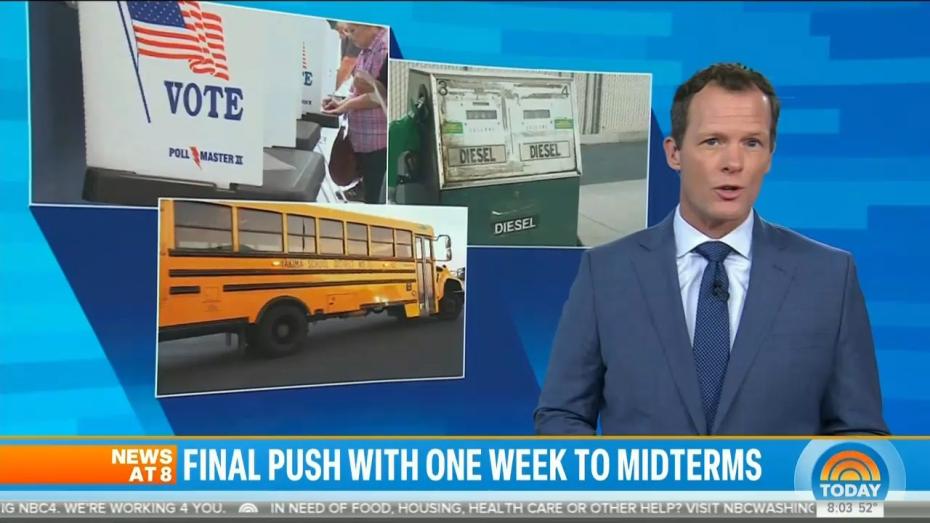
The second hour was when we saw the story about Yakima from chief Capitol Hill correspondent Ryan Nobles.
Melvin set up the piece: “[O]ne of the biggest issues on voters’ minds: the cost of living. Prices are up across the board, including the cost of diesel. And that is causing some major problems in school districts nationwide, some forced to make budget cuts, so they can actually afford to keep the buses running.”
WATCH: NBC’s ‘Today’ flew correspondent Ryan Nobles out to Yakima, Washington to paint a picture of DOOM for the GOP because the local school district has had to cut bus routes because they didn’t budget enough money for rising diesel prices pic.twitter.com/LFq5pZRkRA
— Curtis Houck (@CurtisHouck) October 27, 2026
In contrast to what the networks were doing ahead of the 2022 midterms (i.e., defending Joe Biden and insisting he’s focused on taking on gas prices), Nobles tied it around Trump, lamenting that soaring gas prices have “forc[ed] tough decisions directly impacting kids and voters” (click “expand”):
NOBLES: With just one week to go, rising costs are hitting voters in battlegrounds across America. For instance, the price of diesel fuel has gone up much quicker than many school districts were prepared to handle. In Yakima, Washington, which is about two hours east of Seattle, the increase is equivalent to the cost of two full-time teachers, forcing tough decisions directly impacting kids and voters. With one week to go before the midterm elections, affordability remains the dominant issue on the ballot, from the skyrocketing cost of living, from groceries to housing, and, of course, energy.
WOMAN: I’m very worried. I know the effects of diesel prices. I know how it’s affecting my family personally.
NOBLES: It’s a reality that’s impacting not just families, but school districts from coast to coast. In picturesque Eatonville, in the shadow of Mount Rainier, diesel is among the most expensive in the country. Nationwide, it’s $6.35 per gallon. Washington state is averaging $7.28. Bonny McNickle, the district’s transportation director and bus driver, has been forced to adjust bus routes and stagger pickup times.
BONNY MCNICKLE: I’ve cringed every time someone grabs their fuel card, and I know they’re going to put 100 gallons into a bus, and I know that’s, you know, $700 at least.
NOBLES: In Yakima, Assistant Superintendent Jacob Cooper has already dramatically cut his district’s operating costs. And now, the hike in diesel prices could soon mean classroom resources will be cut.
JACOB COOPER: We are at the whim of global — global politics and the outgrowth of diesel prices worldwide, which, you know, we’re at the mercy of.
NOBLES: Those politics land squarely in the midterm elections, where Washington’s nearby 3rd Congressional District is one of the most competitive in the country. Incumbent Marie Gluesenkamp Perez is laying the blame on the Trump administration.
CONGRESSWOMAN MARIE GLUESENKAMP PEREZ (D-WA): It has been a disaster, this war in Iran. It’s really thrown, obviously, our fuel markets into chaos, but it’s really hurting families.
NOBLES: Her district voted for President Trump, who promised to bring down prices on everything, including gas.
TRUMP [in August 2024]: We will end inflation and make America affordable again.
NOBLES: But inflation has increased since President Trump’s return to office, with fuel costs spiking since the start of his war with Iran, something Gluesenkamp Perez’s Republican challenger, John Braun, is partly blaming.
JOHN BRAUN: We need to wrap up the — the conflict in Iran as quickly as we can. We got to get a good solution, but sooner, not later.
NOBLES: All of it, as drivers are trying to give their kids a reliable routine. [TO BUS DRIVER] What — I mean, what’s your favorite part about being a bus driver?
BUS DRIVER: My favorite part about being a bus driver is seeing a smile on the kids.
Back live to close out the block, Nobles fretted there’s “no relief in sight, and districts are making dramatic changes” with a survey by a national group for superintendents that their clients have “already started or are looking into limiting field trips, delaying maintenance work, and cutting down on extracurricular and athletic programs, and that is such an important part of the school experience for so many kids.”
To see the relevant NBC transcript from October 27, click here.