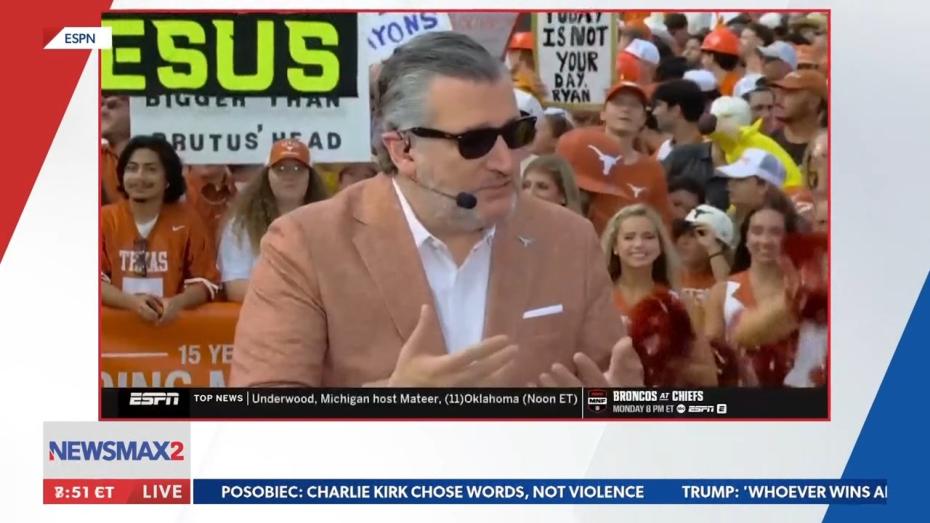
Showing the depths of their far-left derangement, Oliver Darcy’s Status sent out Natalie Korach to partner with a slew of anonymous sources to heap scorn on ESPN for allowing Senator Ted Cruz (R-TX) on Saturday’s College GameDay to discuss the Protect College Sports Act and then not have an interview with someone against it.
In other words, Korach was crowing about some alleged violation of the Federal Communications Commission’s (FCC) “equal time” rules, despite the fact that she herself conceded it wouldn’t apply here as Cruz isn’t currently up for reelection and ESPN is a cable channel, not a broadcast network.
She huffed in the headline and subhead, “ESPN’s Cruz Control; Ted Cruz’s ESPN cameo got him booed off the air, left staffers “embarrassed,” and sparked questions about equal time, in what Status has learned is the latest source of friction inside and outside the network.”
Korach painted late-night ABC host Jimmy Kimmel as the responsible one with his “unusual announcement” of stashing an interview with Texas Democratic senatorial candidate James Talarico on YouTube because they were “spooked by equal-time rules under FCC boss Brendan Carr.”
She then interjected with the Cruz interview, whining he was given “nearly 10 minutes to lobby for a bill currently before Congress” and this “couldn’t have...bothered” FCC Chair Brendan Carr any “less.”
Korach admitted equal time didn’t apply, but still tried to make fetch happen:
Even though Cruz is not currently a candidate—and thus equal-time rules do not apply—the episode made waves because Carr has spent the past 18 months threatening to strip broadcasters of certain equal-time exceptions, with Talarico as a recurring target. After a February interview with Stephen Colbert sparked controversy, Talarico recently sat down with Kimmel for the YouTube-only interview—which, one pointed headline later suggested the FCC “doesn’t want you to see,” had over 8 million views as of Sunday.
But when Cruz sat for his own extended interview Saturday on a cable sports show, to promote his own pending legislation, Carr saw nothing to worry about. The statute represents a “totally different universe,” he told me, noting the law applies to broadcast stations, not cable programming, and covers legally qualified candidates—a category Cruz doesn’t fall into here. He did concede that it could be worth a “debate—whether it’s a legal, policy, or journalistic debate.”
“Let’s look at the data, and if people really think that Republicans are getting outsized coverage across all cable, I’m happy to have a debate as a general matter,” he told me. But whatever the optics, he was clear that there’s limited authority to force a cable network’s hand.
She even admitted it was a waste, using the phrase “in any case” to state the Cruz sit-down (which included plenty of boos in liberal Travis County, Texas) “present[ed] the latest consternation for a network still absorbing high-profile layoffs while increasingly making the controversial personality Pat McAfee its face.”
“Even if the interview won’t land the network in hot water with the FCC, it sparked questions inside and outside Bristol about the segment’s overtly political nature—and more blurring of the line between its premier hosts and political advocacy,” she added, completely ignoring their turn toward issues such as Black Lives Matter, Florida laws, and George Floyd.
She found plenty of anonymous sources, demanding to know “who was that interview for” because it was “really embarrassing” and “I still can’t believe anyone thought that was a good idea.”
Korach framed the opposition as both genuine and the side of facts because far-left quacks like former ESPN host Jemele Hill, NAACP’s Derek Johnson, NBC’s Mike Florio, and Senator Chris Murphy (D-CT) said so.
Only in paragraph 14 did Korach point out that “ESPN hasn’t received an interview request from anyone in the PCSA opposition, I’m told, but said it would honor one if it came” and “a spokesperson for Murphy didn’t respond to a question about whether he plans to make his case on the network.”
As the MRC has pointed out, The View is both (a) a broadcast network and (b) had documented examples of guests seeking to appear on the show but were denied.