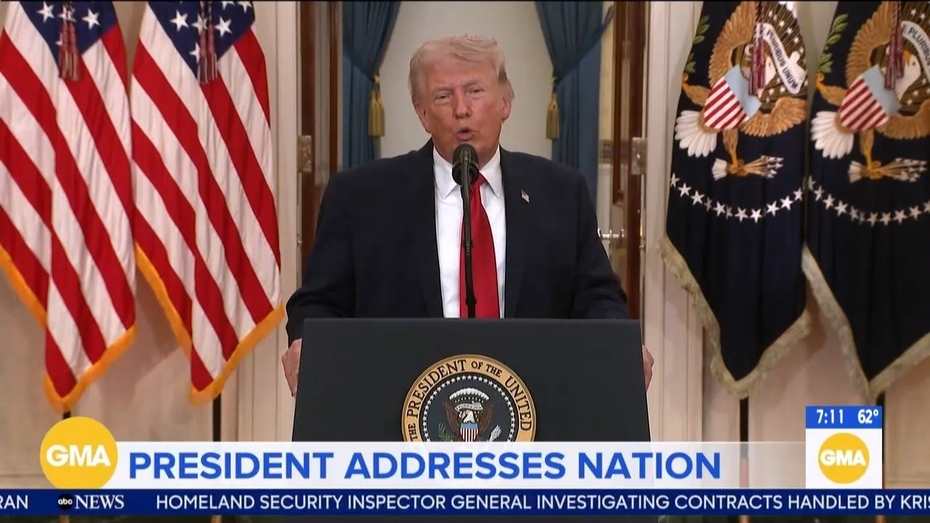
Of course, co-host and former Clinton official George Stephanopoulos set the tone: “Want to turn now to President Trump’s first prime time address to the nation since launching the war against Iran, detailing military progress. The President promised to finish the job soon, but offered no new details on that end of conflict and threatened escalation.”
Condescending White House correspondent Mary Bruce set the tone with the negative:
[T]his speech left more questions than answers. More than a month into this war, the President argued why he feels this fight is necessary. He touted his military successes, even as Iran continued to strike while he was speaking. But the President offered no cut path forward to actually end this conflict.
She continued to pummel the President: “Overnight addressing the nation for the first time since launching this war with Iran, President Trump claiming the U.S. is on track to end the conflict soon, but offering no vision or timeline for what comes next.”
ABC’s ‘Good Morning America’ to offer a wholly negative, condescending story on President Trump’s primetime address, courtesy of former Clinton tool George Stephanopoulos and the Biden regime’s chief apple polisher, Mary Bruce pic.twitter.com/fBD0piYWC4
— Curtis Houck (@CurtisHouck) April 2, 2026
Literally every thought had to have a negative connotation, including simping for the Iranians (click “expand”):
BRUCE: Five weeks into this war, the President still not making clear what conditions have to be met for this conflict to end. He says the operation is nearing completion, but is also vowing to continue attacking Iran and threatening their energy infrastructure if they don’t reach some kind of a deal.
TRUMP: We’re going to hit them extremely hard over the next two to three weeks. We’re going to bring them back to the stone ages where they belong.
BRUCE: The President rehashing why he started this campaign, saying Iran couldn’t have a nuclear weapon, despite claiming he obliterated their program in last year’s strikes. And, in an interview Wednesday, Trump said he’s not concerned about removing Iran’s remaining stockpile of enriched uranium, saying “that’s so far underground, I don’t care about that.” But that statement at odds with why the President says he went to war in the first place: to prevent Iran from being able to make a nuclear weapon. International inspectors estimate Iran has nearly a thousand pounds of near-bomb grade uranium, deep underground at nuclear sites bombed by the U.S. last year.
Bruce also sided with Europe: “[T]he President did not repeat his earlier warning that he could pull the U.S. out of NATO. The President is furious with our NATO allies for not supporting the war effort, even though, guys, he did not give them and he heads up.”
And, because they hate the President so much, ABC brought Bruce back in the second hour to rehash many of these same points.
In contrast, CBS Mornings and NBC’s Today were far more ho-hum or indifferent to the speech.
Taking NBC first, Saturday co-host Laura Jarrett kicked it off by saying Trump “[made] his case for what he says will be several more weeks of this war with Iran, but the lack of specifics rattled markets and oil prices as attacks continue to spread across the Middle East.”
Senior White House correspondent Gabe Gutierrez acknowledged the speech “many points that President had made recently” and provided “no specifics on how the crucial Strait of Hormuz will reopen,” but was the only network correspondent on Thursday to concede “a senior White House official tells me the President’s intended audience was the American people who are not following the war’s developments day-to-day.”
Gutierrez’s piece largely gave space for Trump’s objectives to be laid out before including Iran’s latest ominous response.
He was also the only person on the networks to pivot to Trump’s Easter lunch speech to allies and supporters, which was not supposed to have been made public (but the White House had inadvertently done) (click “expand”):
GUTIERREZ: Overnight, global markets fell sharply rattled by the uncertainty, all of it coming amid rising gas prices here at home and growing skepticism over the conflict. Yesterday, in a speech to faith leaders at the White House, the President saying the federal government needs to focus on the militaries while discussing fraud and funding for domestic programs, which he says states should run.
TRUMP: We’re fighting wars. We can’t take care of daycare. It’s not possible for us to take care of daycare. Medicaid, Medicare, all these individual things, they can do it on a state basis. We can’t do it on a federal. We have to take care of one thing, military protection.
GUTIERREZ: The White House posting then removing the speech, which was closed to the press. The remarks coming as the President is also pressuring Republicans to end the partial government shutdown while TSA officers are now getting paid, easing those long airport lines.
Meet the Press moderator Kristen Welker also had analysis: “[A]ccording to the President’s allies I’ve been speaking with, the President’s goal was to really lay out his rationale in the most fulsome way for the war in Iran to the American people, and to try to calm jitters from Wall Street to Main Street, even though that clearly hasn’t happened yet[.]”
“[H]e did leave a lot of critical questions unanswered, including what his strategy is for exiting, whether he plans to put troops on the ground...and his critics say he didn’t show empathy for the higher prices Americans are dealing with,” she added in part.
Over on CBS, Saturday co-host Kelly O’Grady had a similar phraseology as NBC’s Jarrett:
[W]e’re going to start the news with President Trump’s late-night address to the American people. Now, in his nearly 20-minute speech he made his case for the war against Iran and said the U.S. military would, “finish the job soon.” But he didn’t say what that job is. After the speech, oil prices rose more than seven percent. The national average for a gallon of gas is now $4.08.
CBS senior White House correspondent Weijia Jiang had the story and was more grim by declaring the speech came amid “sagging job approval numbers and soaring gas prices” and delivered no “new details about a time frame, a plan for winding down on what victory would look like.”
That said, she relayed that “Trump delivered a full defense of the Iran war and promised Americans the end to the military operation is in sight, claiming the objectives are ‘nearing completion’” and “vowed to continue the U.S. bombing campaign even as he says negotiations are ongoing.”
Jiang was the only network correspondent to point out that, amid Trump’s disgust with NATO countries for refusing to step up to help ensure safe passage for oil tankers on the Strait of Hormuz, “[t]he United Kingdom is hosting a virtual summit today with 35 countries to talk about reopening the Strait of Hormuz, but the prime minister has made clear they do not want to get tangled up in the conflict.”
Chief correspondent Matt Gutman then brought in CBS News contributor and School of War podcast host Aaron MacLean for measured and welcomed analysis (click “expand”):
[I]f you go back to the matrix of objectives that the President and others of his administration laid out at the start of the campaign a month ago, you can go it and give them grades. The Iranian navy — I think our military is doing pretty well. The Iranian military is largely at the bottom of the sea or has holes in the sides of its boats. The missile program has massively been degraded, but it’s here where you get slightly more moderate grades, right? They retain the capacity to harass their neighbors pretty significantly day to day as a big salvo fired at Israel and other countries just in the last 24 hours. President Trump spoke repeatedly about the nuclear program. Not a lot of action directly connected to the nuclear program thus far and it is unclear what the status of the goal will be going forward. And, of course, I think the biggest thing that’s on everyone’s minds and we just referred to it in that good report there is the Iranians have played the major card available to them which is the closure of the Strait of Hormuz, is having a massive economic impact and at some point is going to have to be dealt with.
(....)
[T]here were a series of comments [about the Strait] through the speech. First, he basically said the Strait of Hormuz is not America’s problem because we don’t buy our oil from there which, while technically true, of course, there’s a global finite supply of the commodity. So, if there’s a lack of supply the price still goes up in America. I think they should in and take it and he said don’t worry, it is naturally going to open up which implies his objective remains a deal at which point the Iranians open it up or perhaps regime change where they no longer harass it. You can see — I think he’s aware of the difficulty of a military campaign to open the Strait. It’s been done before. The United States did it in the 1980s, but it’s potentially protracted as a military operation. The President promised the American people a four-to-six-week war.
In the second hour, chief Washington analyst Robert Costa said the speech illustrated Trump “exerting executive power” and “leav[ing] a lot of options on the table” by, among other things, following recent predecessors in speaking to the public and Congress once the U.S. is in the midst of an armed conflict and not beforehand.
To see the relevant network transcripts from April 2, click here (for ABC), here (for CBS), and here (for NBC).