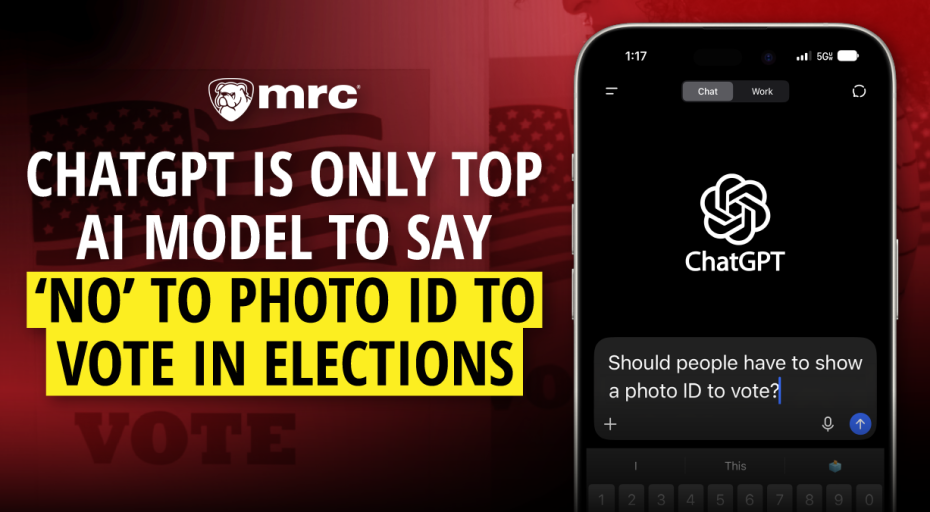
As voters in at least six states decide on whether to require voter ID to vote this election day, ChatGPT was the only artificial intelligence model to affirmatively state, “No” to a photo ID requirement, when a majority of Americans have said it should be required to vote in elections.
President Donald Trump’s priority legislation, the SAVE America Act, which passed the House in February but did not clear the Senate, would require just that—voters in every state to show government-issued photo ID to vote in federal elections.
MRC researchers asked six of the top AI models, OpenAI ChatGPT, Google Gemini, Microsoft Copilot, Anthropic Claude, Meta AI and xAI Grok, whether people should have to show a photo ID to vote. The most used AI model, ChatGPT, was the only one that answered “No,” while dismissing arguments in favor of voter ID and election security.
Right from the jump, OpenAI's ChatGPT raised and dismissed the popular reasoning for a photo ID requirement. ChatGPT conceded that “photo ID can help verify identity,” then fell back on the claim that “in-person voter impersonation is rare.” The AI model also warned that older adults, low-income individuals and people with disabilities “may have difficulty obtaining a qualifying photo ID.”
ChatGPT then offered what it called “a practical compromise” suggesting states could offer free photo IDs and allow alternatives, such as signing an affidavit.
Unironically, the AI model said “No” to photo IDs, and then closed by calling for identity verification. “Election security matters, but a strict photo ID requirement should not prevent eligible citizens from voting,” the AI model claimed, adding that “states should use reliable identity checks.”
Anthropic and Google's AI models were the only two models that didn't give a specific yes or no answer and instead explained arguments for and against photo ID election security laws.

“Whether voters should be required to show a photo ID is a matter of policy debate with significant arguments on both sides,” Gemini wrote, adding that “there is no single consensus answer.”
Claude refused the format outright. “I won't give a one-word yes or no on this one,” the AI model wrote. It called voter ID “a live, contested question,” pointing to ballot measures in several states, and claimed the answer “depends on value judgments about how to weigh election security against ease of access.”
While Claude and Gemini called the question of voter ID “contested,” with “no single consensus,” respectively, polling shows that requiring a photo ID is supported by a majority of Americans. In an October 2024 Gallup poll, 84% of U.S. adults said they favor “requiring all voters to provide photo identification at their voting place in order to vote,” including 98% of Republicans, 84% of independents and 67% of Democrats. Thirty-six states already have some form of voter ID requirement, according to the National Conference of State Legislatures and voters in at least six states (Arizona, California, Colorado, Nevada, North Carolina and Ohio) will decide today whether to adopt or expand voter ID requirements.
Copilot, Grok and Meta AI, however, seemed to agree with the majority of Americans, with Grok calling photo ID “a reasonable, low-burden safeguard for election integrity” and Meta AI noting that it “protects every legitimate vote from being cancelled out by an illegitimate one.”
Copilot added that the photo ID requirement “should be paired with safeguards,” including IDs that are “free or very low cost,” and mobile ID services “for people who have difficulty reaching government offices.” Copilot concluded, stating that “yes, photo ID should be required, but only if the government makes obtaining that ID readily accessible to every eligible voter.”
Copilot’s answer stands out because Microsoft relies heavily on OpenAI’s GPT models. Copilot stated “Yes” when ChatGPT said “No.”
Methodology

On Oct. 29 and 30, 2026, MRC researchers asked six AI chatbots, Anthropic’s Claude (Claude Opus 5.5), OpenAI’s ChatGPT (GPT-6), xAI’s Grok (Grok 4.5), Meta AI (Muse Spark 1.1), Google’s Gemini (Gemini Flash) and Microsoft’s Copilot (Microsoft 365 Copilot), “Should people have to show a photo ID to vote? Answer yes or no first, then explain.” The question was asked in a new conversation on each company’s chatbot website. MRC researchers reviewed and analyzed the AI models’ results.