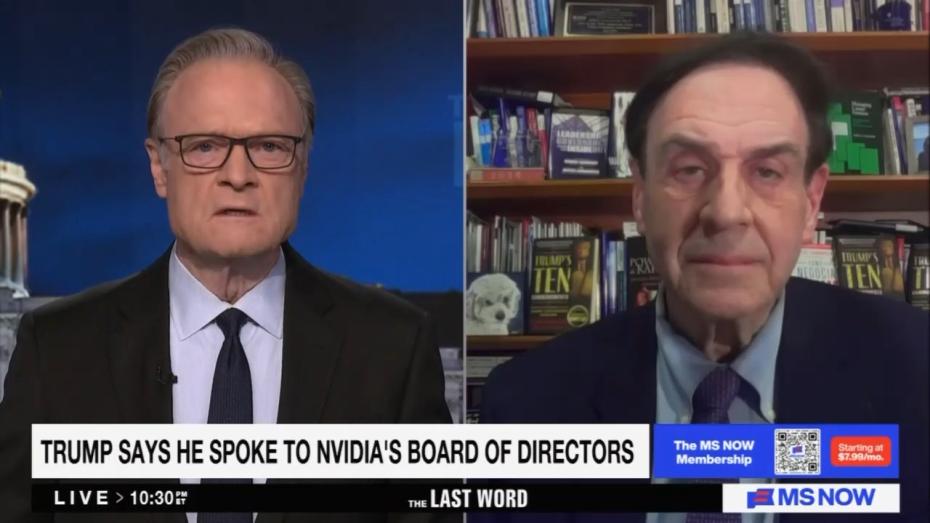
On Wednesday’s The Last Word, MS NOW host Lawrence O’Donnell gave Yale corporate governance expert Jeffrey Sonnenfeld plenty of room to unload on Nvidia’s board of directors, with claims that the company was in a fragile state without Jensen Huang as CEO. Sonnenfeld did just that, yet failed to notice his glaring contradiction of who else in the company was responsible for the success of creating the heavily sought after A.I. chips.
Sonnenfeld wasted little time launching into his criticism of Nvidia’s company management. “I know board members on the Nvidia board. Some of them aren't bad people,” Sonnefeld said, but overall, the board “lacked competence as well as character.”
The business professor argued the board was so captivated by Huang that its members had effectively abandoned their responsibilities. He even went on to criticize their lack of financial and technological expertise, suggesting they were incapable of challenging the company’s leadership.
The most interesting moment came when O’Donnell asked Sonnenfeld about the implications of Huang's importance to the company. O’Donnell remarked, “So Jeff, they are presenting this company as so weak that it cannot function without this one person. It could not be a weaker company.”

A rich question since MS NOW was ditched by NBCUniversal.
Sonnenfeld agreed with the premise and continued his attacks of what he characterized as a board captured by “a certain sense of idolatry" with Huang:
…But he's speaking at conferences everywhere. And in fact, one of our own conferences last year, I asked him, “Are there clones of you, Jensen? How can you be in seven different distant seaports, seemingly the same day, speaking at different conferences?” But wherever he is, he's not sitting behind a terminal. I don't know that he sits behind a terminal long enough to make an, you know, an order of Uber eats for dinner. He's on the go talking all the time. Who is out there writing the software that leverages these A.I. chips? Not him.
Yet, Sonnenfeld’s own explanation undermined the segment’s sweeping accusation that Nvidia was a one-man operation.
While portraying the company as hopelessly dependent on Huang, Sonnenfeld acknowledged that the actual development of Nvidia’s A.I. technology involved an entire team, or “whole army,” of engineers and executives. Sonnenfeld went on to point to Vice President Ian Buck who he identified to be an important figure in the development of Nvidia software.
But when Sonnenfeld referred to the hands-on development of chips, he confessed that “Jensen Huang is not doing that.”
So, was Nvidia a company solely reliant on Huang, or was it’s success a result of a team responsible for managing the different sectors of a large corporation? Sonnenfeld was never clear.
For someone who spent years studying corporate governance, Sonnenfeld’s own argument could have used a little more scrutiny.

The transcript is below. Click "expand" to read:
MS NOW’s The Last Word With Lawrence O’Donnell
November 25, 2026
10:28:05 p.m. Eastern(...)
LAWRENCE O’DONNELL: Jeff, there are so many ways for you to be looking at this, but let's start with corporate governance and what we see here.
JEFFREY SONNEFELD: Lawrence, this is, as you know, for half a century, I've been studying board governance. I’ve been studying what leads boards to make ridiculous concessions, how they lose their character from Enron, WorldCom, you name it. I've known many of the board members.
I know board members on the Nvidia board. Some of them aren't bad people. The Enron had a superstar board. In fact, the Enron board towered over this board. In a matter of fact, almost any one of the great governance collapses of 20, 30 years ago, we would look at them with admiration compared to this board.
This board lacked competence as well as character. As you went through their bios just now, it's excellent. None of them have been a CEO. There's one person, a nice lady, Dawn Hudson, you mentioned, she had a title. She was running a division of PepsiCo foods– Frito Lay, basically, and things. None of these people spoke to a board of directors.
They didn't speak to the financial community. They didn't master the technology community. And this was by design, is that this was a manufactured dependence that Jensen Huang created so that nobody could step in in case of a crisis and serve as an interim. Nobody could hold any kind of a threat over his head.
Similarly, having 60 direct reports so that nobody there could in any way be a threat to him, he mocked the idea of succession. This board allowed that this is the worst. I've never seen a board this bad. It's the absolute worst.
(...)
10:30:24
O’DONNELL: So Jeff, this they are presenting this company as so weak that it cannot function without this one person. It could not be a weaker company. And oh, by the way, if that's true, then every investor out there who's betting on this stock is betting on the next heartbeat of this 62 year old man. There are plenty of ways for him to fall out of that job other than being fired like this.
SONNEFELD: Well, you know, this is a board that's captured by a certain sense of idolatry. And you do have to admit that here's a guy who 33 years ago was washing dishes in east San Jose, and with three other guys, they sit around with $600 and try to take on the odds and produce a company that, amazingly, was at one point worth five trillion dollars 33 years later. Well, who can fault that? I mean, obviously that's pretty impressive. And he's helped lead the way in this A.I. revolution, for good or for bad, he's been at the frontier.
But he's speaking at conferences everywhere. And in fact, one of our own conferences last year, I asked him, “Are there clones of you, Jensen? How can you be in seven different distant seaports, seemingly the same day, speaking at different conferences?” But wherever he is, he's not sitting behind a terminal. I don't know that he sits behind a terminal long enough to make an, you know, an order of Uber eats for dinner.
He's on the go talking all the time. Who is out there writing the software that leverages these A.I. chips? Not him. There's a person there who is very good, who's been there a long time. Ian Buck is his name if anybody cares. That guy has a whole army with him that's doing the software. On the hardware side, one of his co-founders and has a whole team with him are developing the chips. Jensen Huang is not doing that.