On Tuesday night, a supposed polling firm cited by the likes of The New York Times and MS NOW, Wedgewood Polls, put out a statement admitting to faking its polls. In the statement, posted on X, Wedgewood claimed it was a social experiment.
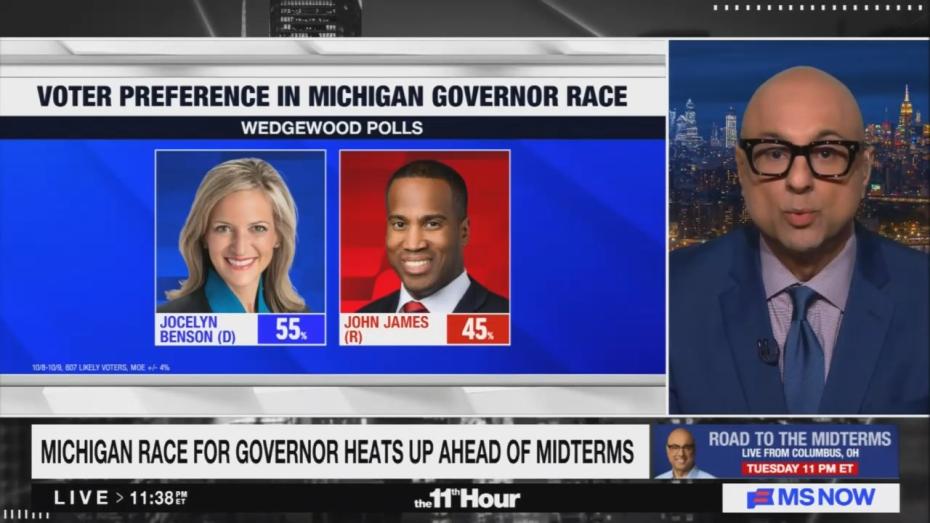
Just last Monday, one of the group’s polls was cited on MS NOW by The 11th Hour host Ali Velshi. The presumably fake poll showcased a double-digit lead in the Michigan gubernatorial race for Democratic candidate Jocelyn Benson over Republican nominee John James.
On his October 12 show, Velshi used the Wedgewood poll as part of an introduction to an interview with Benson:
MS NOW’s new election big-board guy, Ali Velshi, cited a presumably fake Wedgewood poll on Michigan’s governor’s race on his show last Monday. https://t.co/azKWTXNWpI pic.twitter.com/H5EwS5QGCc
— Nick (@nspin310) October 21, 2026
The latest polling from Wedgewood Polls shows Benson with a ten-point lead, which is outside the margin of error. Our polling partner, FiftyPlusOne, finds that Benson has a polling average lead of just under eight points.
Wedgewood’s Tuesday statement admitted their polls were fake and claimed they were an “experimental project to demonstrate the vulnerabilities” of “modern political polling” and noted their citation by MS NOW and The New York Times in the process:
Despite having no history, formal credentials, or real data behind the vast majority of our releases, Wedgewood Polling was added to major polling aggregators, including The New York Times, FiftyPlusOne, and VoteHub, and repeatedly treated as a legitimate data source.
Our fabricated numbers were given instant credibility across national media platforms—including being cited on air and in reporting by outlets such as MS NOW.”
FiftyPlusOne founder G. Elliot Morris, whose site did include Wedgewood in its polling aggregate averages with little pushback to the validity of the polls, claimed his polling site was investigating Wedgewood for faking their data, and said the statement claiming to be a social experiment was just an “excuse.”
The New York Times subsequently posted an editor’s note that polls from Wedgewood were removed from the site after “Wedgewood released a statement it had fabricated data.”
So far, FOX News has been the only TV news channel to mention the Wedgewood Fake Poll Fiasco, whose “polls” were cited in the polling averages from the likes of the New York Times and were also showcased on MS NOW. pic.twitter.com/3PhTkNL3FH
— Nick (@nspin310) October 21, 2026
FOX News’s America Newsroom was the only TV channel to mention the polling fiasco as of Thursday morning. Host Dana Perino remarked, “Well, new concerns over polling. A firm called Wedgewood Polls admitting to posting fake data. It was picked up by a number of outlets, including The New York Times.”
While posing a question to Ruthless podcast co-host Josh Holmes, Perino stated, “Josh, this is quite ridiculous in a way, but also I don’t think this is the first time it has happened. And I do think it adds to people feeling very skeptical about polling.”
Holmes then noted a previous fake poll from the Wisconsin gubernatorial primary from a fake firm called Median Strategies, which also called itself a “social experiment, while also mentioning Wedgewood “got their hand caught in the cookie jar by FiftyPlusOne”: (Click “expand”)
And it’s actually the second time this cycle. We saw it in Wisconsin with the primary early on with an outfit called “Median Polls.” What was so interesting they got their hand caught in the cookie jar by FiftyPluesOne when they asked questions about their methodology, and instead of copping to a fake poll they tried to create this illusion that all of this was a social experiment and nobody should have taken it seriously, and of course, they did and included it in polling averages.
Holmes then noted the fake polls were “not a victimless crime”:“The problem is when you get the fake polls out in the public, what happens is fundraising starts to dry up, volunteers become dispirited. They create and blunt any momentum a campaign would have with artificial data, and it becomes really important as a campaign to try to counteract all that as aggressively as you can.
Host Bill Hemmer followed by noting the 2024 Iowa presidential election poll by Ann Selzer that was wildly off-base from the final results in the state by 16 points:
I mean, think about Ann Selzer’s poll on that Saturday in Iowa before the presidential race. I mean, we thought at that time like everything was going to fall like dominoes, and they did not.
Whether or not Wedgewood was just fraudulently posting election polls or was a “social experiment,” outlets like MS NOW and The New York Times still should have tried to validate the polling numbers it featured on their respective platforms before promoting them as fact.
The transcripts are below. Click "expand":
MS NOW’s The 11th Hour
October 12, 2026
11:38:23 PM Eastern
ALI VELSHI: The latest polling from Wedgewood Polls shows Benson with a ten-point lead, which is outside the margin of error. Our polling partner, FiftyPlusOne, finds that Benson has a polling average lead of just under eight points.
(...)
FNC’s America’s Newsroom
October 21, 2026
9:11:34 AM Eastern
DANA PERINO: Well, new concerns over polling. A firm called “Wedgewood Polls” admitting to posting fake data. It was picked up by a number of outlets, including The New York Times.
Wedgewood writes this on X: “Our fabricated numbers were given instant credibility across platforms and cited on air and in reporting. Wedgewood polling was never intended to sway an election or mislead the public but designed as a wake-up call.”
And Josh Holmes joins us now. Josh, this is quite ridiculous in a way, but also I don’t think this is the first time it has happened. And I do think it adds to people feeling very skeptical about polling. How do you see it?
JOSH HOLMES: You are absolutely right, Dana. And it’s actually the second time this cycle. We saw it in Wisconsin with the primary early on with an outfit called “Median Polls.” What was so interesting they got their hand caught in the cookie jar by FiftyPluesOne when they asked questions about their methodology, and instead of copping to a fake poll they tried to create this illusion that all of this was a social experiment and nobody should have taken it seriously, and of course, they did and included it in polling averages.
This is not a victimless crime. I can tell you, from running Senate races for 20 years, this is an incredible problem that you have on the campaign. If it had no contagion effect whatsoever, it would be fine because all of the general consultants and all of the campaigns know exactly where their are at. That's no problem.
The problem is when you get the fake polls out in the public, what happens is fundraising starts to dry up, volunteers become dispirited. They create and blunt any momentum a campaign would have with artificial data, and it becomes really important as a campaign to try to counteract all that as aggressively as you can. You see people always fighting where the polls and numbers are. They wouldn't be if it didn't have a contagion effect, and, for course, that’s exactly what Wedgewood did. They polled all these Senate races, and lo and behold, all the Democrats were winning except for one in Mississippi, where they had an improbably close race and one that we know there is a far bigger spread.
BILL HEMMER: It’s an amazing thing to me how quickly we forget what the pre-election polling said once the results come in.
HOLMES: Yeah.
HEMMER: I mean, think about Ann Selzer’s poll on that Saturday in Iowa before the presidential race. I mean, we thought at that time like everything was going to fall like dominoes, and they did not.
(...)