On Monday's CNN This Morning, host Audie Cornish pulled two pro-Democrat tricks. First, she tried to minimize the history of pollster showing President Trump down, but then going on to win by double digits. Second, she tried to passively lump in possible Democratic Party losses in with possible Republican ones.
The occasion was a New York Times poll reporting Democrats ahead in Alaska and Texas, toss-ups in Republican-held seats in Ohio, Kansas, and Iowa, and 61 percent of likely voters in several battleground states disapproving of Donald Trump on the economy.
Cornish then played a clip of NEC director Kevin Hassett, who said he did not buy "possibly partisan pollsters" telling the country that people are "really, really depressed," calling it a "It's a classic Democrat move."
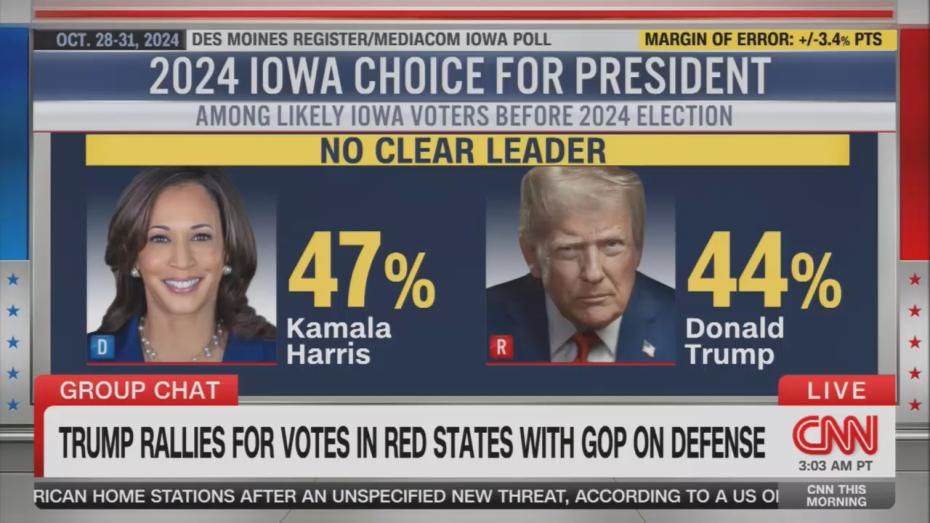
Cornish's answer was the Des Moines Register poll. "Maybe the White House is thinking that that poll that was done in 2024 by the Des Moines Register in Iowa, that did have Kamala Harris up by a few points. It didn't turn out to be the case. And the White House even sued, but are they saying to themselves, well, that one was bad, so all the ones we've ever seen again are going to be bad?"
"Up by a few points. It didn't turn out to be the case," was putting it mildly.
The poll, Ann Selzer's final Iowa survey, released three days before the election, had Harris leading Trump 47 to 44. Trump won Iowa by 13 points, 55.7 to 42.5. From Harris plus 3 to Trump plus 13 was a 16-point miss. Cornish had the example in her hand, the very poll the White House would cite, and she reduced it to a few points that did not turn out.
Instead of Selzer's huge miss, CNN senior media analyst Sara Fischer focused on the lawsuit Trump brought against the Register and Selzer. A judge tossed the suit, she said, because "you can't just sue because you don't like polls."
Fair enough as a legal point. It does not change the result. The poll was wrong by 16 points whether or not suing over it was a mistake.
Cornish Shrinks a 16-Point Iowa Miss, Pads GOP's Trouble With Dem Seats pic.twitter.com/03vkktPti6
— Mark Finkelstein (@markfinkelstein) October 5, 2026
For her second trick, Cornish displayed a chart to bolster her case that Republicans are in trouble. It showed 10 Senate seats most likely to flip.
Problem: three of the seats—in Michigan, New Hampshire, and Georgia— were potential flips from Democrat to Republican! Cornish even suggested that Trump's tariffs were "coming home to roost" in various states, including Georgia.
Roosting on Jon Ossoff, Audie?
Here's the transcript.
CNN This Morning
10/5/26
6:01 am EDT(...)
AUDIE CORNISH: New polling from the New York Times over the weekend is showing that Republicans are on the defensive for five Senate seats.
The polls show a lead for Democrats in states including Alaska, where they're up by seven points. In Texas, Democrat James Talarico is up by six, and it's a toss-up for Republican-held seats in Ohio, Kansas, and Iowa, and a leading issue is the economy.
When likely voters in several battleground states were asked how Donald Trump is handling the economy, 61 percent say they disapprove. The White House isn't so sure.
[Cuts to video]
KEVIN HASSETT: Ahead of an election cycle, the fact that there's, you know, possibly partisan pollsters telling us that the people are really, really depressed, it's a classic Democrat move, and I just don't buy it.
[Cuts back to live]
CORNISH: Joining me now in the group chat, Sara Fischer, CNN senior media analyst and senior media reporter at Axios, Tiana Lowe Doescher, political commentator at the Washington Examiner, and Maria Cardona, CNN political commentator and Democratic strategist. Good morning, guys. Thank you so much for being here.
Sara, I want to start with you because what he said was very specific, that there are pollsters out there, that they're biased, that we shouldn't pay attention to these numbers.
And I realize, maybe the White House is thinking that that poll that was done in 2024 by the Des Moines Register in Iowa, that did have Kamala Harris up by a few points. It didn't turn out to be the case, and the, the White House even sued. But are they saying to themselves, well, that one was bad, so all the ones we've ever seen again are going to be bad?
SARA FISCHER: Yeah, but it's a strange thing to say to yourself, because at this point, whether or not you believe the polls is irrelevant. You have to figure out how you're going to win the state. And so just trying to dismiss the data as it is is not really practical.
I'm glad that you brought up the Des Moines case, because the pollster there, Ann Selzer, she was part of a lawsuit that the president waged against the Des Moines Register at the time, the pollster, Ann, and then the parent company to the Des Moines Register, USA Today, Inc. A judge actually tossed that suit and said, you can't just sue because you don't like polls.
And I kind of feel the same way, just looking at this as an outside analyst. You can't just look at polls and wag your finger and say, well, because the polls are biased, this is not the right data. Regardless of whether or not you think the data is biased or not, this is what people are making decisions on in terms of election spend.
CORNISH: And we hear him using the phrase "worried." We're worried about, we're worried about, which he rarely does.
I want to point to the ten Senate states that people are talking as toss-ups or potential to flip. And over the weekend, when I was doing my prep for, ahead of midterms, what did I notice? Lot of agriculture areas, lot of rural areas.
So, when we say that he was up by double digits the last time we won them, we mean it. And so I'm wondering if there is a reality check, that the diesel prices someone has to drive on in Iowa. Or the gas prices, or the tariffs someone has to deal with in Kansas and Georgia and Maine, that those, that's coming home to roost.