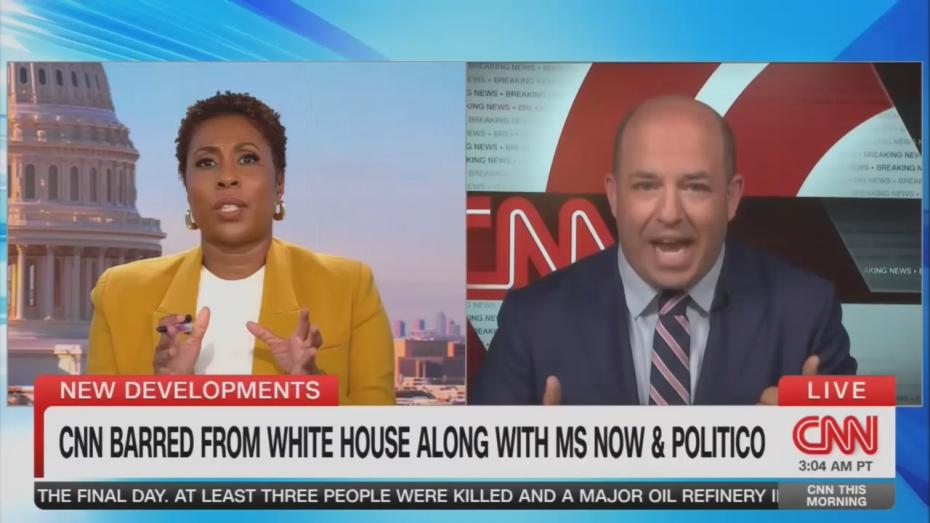
If ever there were a propagandist of the left, it's Brian Stelter, as NewsBusters has amply documented over the years. And yet Stelter had the chutzpah, on today's CNN This Morning, to lecture the country about who counts as a real reporter.
This is a routine CNN complaint -- that the Briefing Room is "ruined" by "MAGA Media" correspondents who don't hate Trump with a passionate intensity making it harder for people to ask their "accountability questions."
You know, in the past 18 months or so, the Trump White House has welcomed in figures from relatively small, relatively obscure streaming sites, blogs, online networks. These are figures oftentimes not coming from journalism backgrounds, but from political advocacy backgrounds.
And I, I tend to have a view, you know, the more voices, the merrier. The more points of view, the merrier. The problem, though, in these Q&A settings, is that you get a few figures who are propagandists right next to real veteran reporters who want to get answers for the American people.
So you might have a reporter saying, something derogatory about Democrats to make the president laugh, when you have reporters from CNN and the New York Times who actually want to ask accountability questions.
So: the more the merrier — unless they sit next to CNN. Then they are "propagandists." The "real veteran reporters" are, conveniently, the ones from CNN, MS NOW, the New York Times, and their ilk.
In addition to Stelter himself, the CNN and MS NOW White House benches have included Jim Acosta, John Harwood, Abby Phillip, and others who were open Trump antagonists — anything but dispassionate "reporters" trying to get answers for the American people.
It would be fun to ask Stelter if that would have been his take when Kaitlin Collins was the White House reporter for the Daily Caller. She wasn't a real reporter then, apparently, but when CNN hired her, she apparently transformed like Pinocchio -- from wooden puppet to real human reporter.
Brian Stelter Bleats About 'Propagandists' At WH Beside 'Real Veteran Reporters' pic.twitter.com/V0InxeULYu
— Mark Finkelstein (@markfinkelstein) September 21, 2026
Stelter approvingly cited former White House Correspondents’ Association president Weijia Jiang: "America does not have state TV. There shouldn't be state TV in America." Host Audie Cornish agreed: "Yeah."
The irony sailed past both of them. Cornish spent years as a face of National Public Radio — the network that lived for decades on the federal public-broadcasting dime, until Congress finally cut it off. The "public" radio that routinely aired anchor Steve Inskeep polishing President Obama's apple. CNN hired Jeff Zeleny after he asked Obama what "enchanted" him about his first 100 days in office.
The three banned outlets — CNN, MS NOW, and Politico — announced a joint lawsuit this morning. That's their right. But they shouldn't be trying to pass off their anti-Trump antagonists as neutral public servants.
Here's the transcript.
CNN This Morning
9/21/26
6:04 am EDT
BRIAN STELTER: We should be clear, there will be other reporters traveling with Trump to New York today. There will be other reporters that can ask him questions.
In some cases, it's very pro-Trump, MAGA media figures who have been welcomed in by the White House. Those are the ones that shout, shout, softballs to the president, that tend to make him real, feel really good, but don't actually get us any information as a country. So there will be some of those reporters.
But locking out the TV pool has serious implications because, you know, I thought Weijia Jiang said it well over the weekend, former Correspondents Association president. She said, America does not have state TV. There shouldn't be state TV in America, right?
AUDIE CORNISH: Yeah. But just so people understand what you're saying, you essentially have, there's some alternatives here, which is they start putting out their own video, edited any way that they want.
But this is different from the first term, right? Where basically they had the typical, and maybe atypically more adversarial relationship with the press, to actually filling the room with organizations they deem more fair to them. How has that looked? Has that meant other networks? Has that meant blogs? What do we mean when we say they've sort of altered the sort of pool of people that they're talking to?
STELTER: And it has made a big difference in the past 18 months or so. You know, in the past 18 months or so, the Trump White House has welcomed in figures from relatively small, relatively obscure streaming sites, blogs, online networks. These are figures oftentimes not coming from journalism backgrounds, but from political advocacy backgrounds.
And I, I tend to have a view, you know, the more voices, the merrier. The more points of view, the merrier. The problem, though, in these Q&A settings, is that you get a few figures who are propagandists right next to real veteran reporters who want to get answers for the American people.
So you might have a reporter saying, something derogatory about Democrats to make the president laugh, when you have reporters from CNN and the New York Times who actually want to ask accountability questions. So that has made a big difference in the past 18 months.
And one of my concerns today, Audie, is that as Trump tries to ban news outlets, he's going to reshape the reporters around him so that they're mostly just propagandists, and there aren't real reporters at all. That's the real danger, I think, that's broader than CNN today as this goes on.