Thursday’s PBS NewsHour showcased the erroneous assumption that President Trump’s recent changes to the naturalization process were purposefully keeping immigrants from entering the United States and becoming citizens. While they suggested it was because of a general hatred of immigrants, PBS omitted how literal war criminals were allowed to pass through.
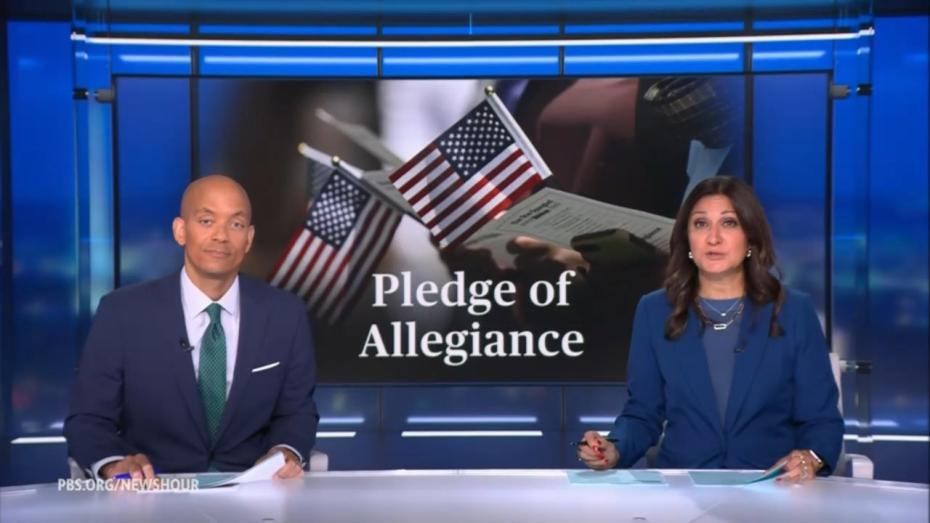
Co-anchor Amna Nawaz set up Justice Correspondent’s, Ali Rogin, story on the matter with this tone:
But for immigrants, the path to naturalization has grown more difficult as the Trump administration has added new requirements and tightened vetting standards. Our justice correspondent Ali Rogin has this look.
Rogin dove into her story by explaining how the naturalization process worked:
For most, the journey involves applying for and holding a green card for years, lengthy applications, hundreds of dollars in fees, interviews with immigration officers, an English language test, and finally a civics test for which applicants spend months studying.
She spoke with Lucio Arevalo, a current green card holder who is preparing for the civic exam, who explained, “The nerves are there. The stress is there,” and assured that it will, “be such a big relief,” when asked what it will mean to him once he takes that oath of citizenship.
Yet, Rogin met this confirmation of relief with the assumption that he’s living in fear of Trump’s recent deportation- even though he has a green card. “Relief, because he hopes to stop living in fear of President Trump's efforts to deport noncitizens,” she said, conflating illegal immigrants with “noncitizens.”
Shedding light on citizenship acquisition was Nazanin Ash, CEO and co-founder of Welcome.US., a national initiative designed to aid new arrivals in the naturalization journey. “It’s a process that’s rigorous and has always been rigorous, and it’s appropriately rigorous,” she said. “Taking on the responsibilities of citizenship is a commitment that no one takes lightly, least of all the aspiring Americans who are pursuing their dreams.”
As Rogin continued her narrative of Trump’s policing of the naturalization process, she never explicitly explained why the vetting process was that much more difficult. This was what she said instead (Click “expand”):
That dream of becoming American has become more allusive since President Trump returned to office. In the last year, the administration has introduced a harder civics test with more questions and a higher number of correct answers required to pass, implemented stricter social media vetting, proposed raising the application fee by 75 percent to nearly $1300, and revived a defunct practice of neighborhood investigations into applicants' moral character.
And, the government is processing far fewer naturalization applications today than during the Biden administration. A 75 percent drop off compared to two years ago, and the rejection rate for naturalization has more than doubled since September 2024 from 9.2 percent to more than 18 percent.
Rogin criticizes U.S. Citizenship and Immigration Services who, “say the changes are necessary to tighten the system that has become too lax,” undermining the fact that multiple war criminals entered the country prior to this remodel.
According to the U.S. Immigration and Customs Enforcement, Miriam Kostic of Boise, Idaho was a, “high-level official in the so-called Autonomous Province of Western Bosnia,” who, “pistol-whipped prisoners; beat them with wooden clubs, stakes and his fists; and kicked them, causing them to lose consciousness. He forced prisoners to beat each other, according to the documents, and he also ordered other members of the Autonomous Province of Western Bosnia to beat prisoners.”
Another case of war criminals entering under falsehoods is Nada Radovan Tomanić who, according to Fox61:
...served in the 1990s with the Zulfikar Special Unit of the Army of Bosnia and Herzegovina… participated in the severe physical and psychological abuse of Bosnian Serb civilian prisoners. This included torture and inhuman treatment… Tomanić denied having ever served in a detention facility or having ever been involved in the detention of others… She also said she didn’t commit any war crimes for which she was not arrested, specifically the crime of inflicting serious bodily harm under the Criminal Law of the Socialist Republic of Yugoslavia.
Talk about a previously lax system, which Rogin attempted to make seem desirable.
The transcript is below. Click "expand" to read:
PBS NewsHour
September 17, 2026
7:25:27 p.m. EasternGEOFF BENNETT: Well, today is citizenship day which recognizes everyone who has attained U.S. citizenship and commemorates the signing of the U.S. Constitution on this day in 1787.
AMNA NAWAZ: But for immigrants, the path to naturalization has grown more difficult as the Trump administration has added new requirements and tightened vetting standards. Our justice correspondent Ali Rogin has this look.
[Cuts to video]
ALI ROGIN: In a federal courthouse in Alexandria, Virginia, 60 of the nation's newest Americans take their final steps toward citizenship, sharing where their journeys began–(New citizens state what country they came from)ROGIN: Before they all arrived at this moment.(New citizens take oath)
UNIDENTIFIED NEW CITIZEN 1: We are super excited. Me and my husband, we both became citizens.
UNIDENTIFIED NEW CITIZEN 2: I don't think people realize how daunting this journey is, but I'm so happy to be here.
ROGIN: For most, the journey involves applying for and holding a green card for years, lengthy applications, hundreds of dollars in fees, interviews with immigration officers, an English language test, and finally a civics test for which applicants spend months studying.
LUCIO AREVALO: Definitely am nervous. The nerves are there. The stress is there.
ROGIN: New Mexico resident, Lucio Arevalo, is nearing the finish line of his naturalization. A green card holder since 1998, he arrived in the U.S. with his parents from Mexico as a baby. He is awaiting his interview date.
AREVALO: I am, of course, a permanent resident, but I just feel like there’s still that thin line between me actually being, I guess, fully part of the country. So, I decided to take that step.
ROGIN: What will it mean to you to take that oath of citizenship?AREVALO: To be honest, it would be such a big relief.
ROGIN: Relief, because he hopes to stop living in fear of President Trump's efforts to deport noncitizens.
AREVALO: It is definitely scary to know that there could be that possibility for, you know, for me to like get stopped I guess by immigration.
ROGIN: To help prepare for the civics test, Lucio turns to Welcome.US, a national initiative that emerged after the U.S. withdrawal from Afghanistan to help new arrivals through the complicated immigration system. That’s how he met volunteer Dana van Ostrand, who lives in Iowa, and has been helping Arevalo study in virtual sessions.
VAN OSTRAND: It’s been a really fun process to not only go through the test, but also just hear of Lucio’s life and what he’s been about.
NAZANIN ASH: There are a lot of changes happening in our immigration system, and in whether and how we welcome newcomers.
ROGIN: Nazanin Ash is the CEO and co-founder of Welcome.US.
ASH: It’s a process that’s rigorous and has always been rigorous, and it’s appropriately rigorous. Taking on the responsibilities of citizenship is a commitment that no one takes lightly, least of all the aspiring Americans who are pursuing their dreams.
ROGIN: That dream of becoming American has become more allusive since President Trump returned to office. In the last year, the administration has introduced a harder civics test with more questions and a higher number of correct answers required to pass, implemented stricter social media vetting, proposed raising the application fee by 75 percent to nearly $1300, and revived a defunct practice of neighborhood investigations into applicants' moral character.
And, the government is processing far fewer naturalization applications today than during the Biden administration. A 75 percent drop off compared to two years ago, and the rejection rate for naturalization has more than doubled since September 2024 from 9.2 percent to more than 18 percent.Sometimes, the roadblocks continue all the way to the courthouse.
[Goes from voiceover to on camera] Since President Trump returned to office, U.S. citizenship and immigration services has been abruptly canceling naturalization ceremonies, many of them at the last minute. In fact, today, here, at this courthouse, there were supposed to be two ceremonies, but the afternoon session was abruptly canceled just last night. Immigration officials say the changes are necessary to tighten the system that has become too lax.
In a statement to PBS News, U.S. Citizenship and Immigration Services said the agency, “has implemented reforms to ensure U.S. citizenship is reserved for those who qualify,” adding that, “USCIS will not take shortcuts in the naturalization process. Naturalization is a privilege, not a right.”
Van Ostrand says his volunteerism is a way to respond to what he sees as this administration's hostility towards immigrants.
VAN OSTRAND: The Trump administration's rhetoric and actions have been quite dehumanizing in my view and I wanted to be a part of welcoming to people who have already been here.
ROGIN: Back at the Alexandria courthouse, the new citizens receive a parting message from Judge William Fitzpatrick.
JUDGE WILLIAM FITZPATRICK: What I ask of you is to keep working hard, to give life, to give meaning to the oath that you took today by making your voice heard, by making sure that government, your government, reflects your values and your vision for what America can be. I have signed the final order. It is official. Congratulations to you all. Best of luck. We’re adjourned.
ROGIN: As the gavel falls in the courthouse, the ceremony ends.
ROGIN: Tell me what emotion you’re feeling right now.
UNIDENTIFIED NEW CITIZEN 3: Yeah, I’m really happy!
ROGIN: And, outside, 60 new American lives begin.
UNIDENTIFIED NEWS CITIZEN 4: Thank you, and God bless America!
ROGIN: For the PBS News Hour, I'm Ali Rogin.