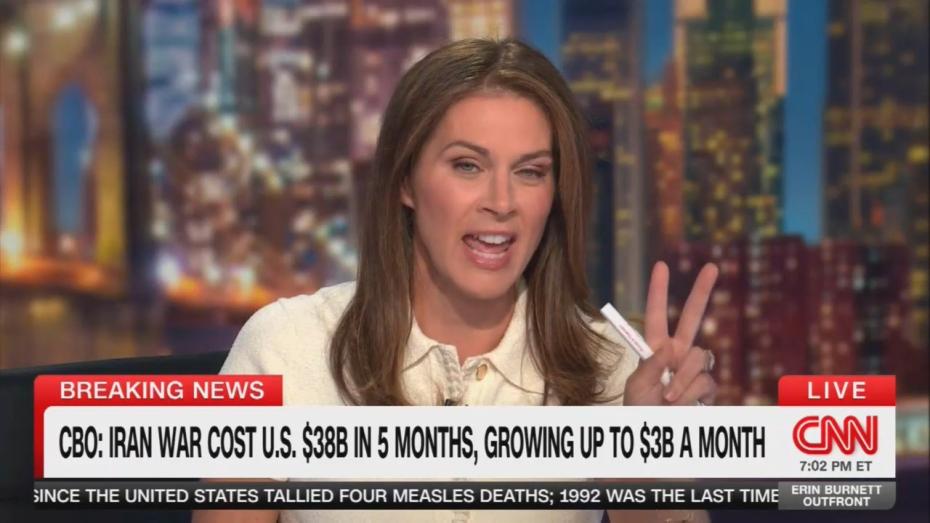
On Tuesday, CNN’s Erin Burnett OutFront latest take was how the war in Iran was burning a hole in the average American’s pocket. This, of course, was in reference to the hike in gas and diesel prices over the last several months, and how tires in Syria and Guatemala are being set on fire as a protest to the dwindling resource. Of course, she was shouting about how all of it was president Trump’s fault, with no blame on Iran for being a menace to the world.
Burnett reported that the Philippines was experiencing blackouts due to the lack of oil, even going so far as to say, “Some pumps have run dry- a sign of what could happen as this spreads around the world because the situation is getting worse.”
Yet the question still stands: how was the new, Iranian backed militants control over the Bab al-Mandab Strait in the Red Sea, along with the recently shut down Saudi oil plant, going to financially affect the average American, and who is to blame? Burnett thinks she had the answer.
Adamant to get a reasoning on why “The [Iran] war has already cost consumers over $100 billion in higher gas and diesel prices,” Burnett turns to Representative Ayanna Pressley (D-MA) and Treasury Secretary Scott Bessent’s conversation during the September 15th House Financial Services Committee hearing to showcase Bessent’s lackluster of an answer:
PRESSLEY: “Since the war started, gas prices are up 52 percent. Yes or no; are you aware of that?”
BESSENT: “Gas prices are up–
PRESSLEY: “Gas prices are up 52 percent since the war started. Are you aware of this issue? Yes or no?”
BESSENT: “From what to what? I think that's not a good number.”
Not only did Burnett attribute the rising costs of gas, diesel, motor oil, and possibly heat in the U.S. to the war in Iran, she harped on the current effects it’s having on Americans:
“The Iran War has cost nearly $40 billion in just the first months of the war. That number is according to the Congressional Budget Office, and it only accounts for the cost to the end of July, right. So, March, April, May, June, July. Just the first five months, not the past two even. And it does not include the damage to U.S. bases and hundreds of U.S. buildings across the region…,”
Therefore prompting concerns on what inflation might look like in the coming months if the GOP 'refuses' to “use the ‘W’ word”:
TODD BLANCHE (U.S. Attorney General): “You called it a war. I disagree with that characterization.”
PRESIDENT DONALD TRUMP: “We're in a- I call it a skirmish because that's what it is.”
VP J.D. VANCE: “I don't- I wouldn't call it a war.”
After continuing to slam the loss of billions of dollars in energy, Burnett brings the segment to a close with Republican Thomas Massie’s Articles of Impeachment against Secretary of Defense Pete Hegseth over the Iran War:
“Secretary of Defense, Peter Hegseth, by such conduct has demonstrated that he will remain a threat to civilians, the lawful conduct of the United State's military operations, the integrity and credibility of the United State’s armed forces and the Constitution.”
While Burnett’s argument seems somewhat sound, she surmises on issues within the GOP, suggesting that Hegseth was engrossed by issues that lack importance such as aesthetics of military brand, rather than one that brings a close to the oil crisis and the spending of American taxpayers dollars.
The transcript is below. Click "expand" to read:
CNN’s Erin Burnett OutFront
September 15, 2026
7:01:07 p.m. Eastern(...)
ERIN BURNETT: …the breaking news, global outrage, mass protests now breaking out around the world over skyrocketing oil prices and food prices caused by Trump's war with Iran. Protesters burning tires from Syria all the way to Guatemala. In Portugal, roads at a standstill as drivers lay on their horns. In the Philippines and in Sudan, people are dealing with blackouts, long lines at gas stations.
Some pumps have run dry- a sign of what could happen as this spreads around the world because the situation is getting worse. The United States still does not have control of the Strait of Hormuz, and Iranian backed militants now control the vital Bab al-Mandab Strait- the gateway to the Red Sea. The Saudis have closed down the most significant oil pipeline across the country after it was repeatedly attacked.
And in the United States, it's added up. The war has already cost consumers over $100 billion in higher gas and diesel prices, something the treasury secretary, Scott Bessent did not want to discuss today.
[CUT TO VIDEO]
REP. AYANNA PRESSLEY (D-MA): Since the war started, gas prices are up 52 percent. Yes or no; are you aware of that?
SCOTT BESSENT (Treasury secretary): Gas prices are up–
PRESSLEY: Gas prices are up 52 percent since the war started. Are you aware of this issue? Yes or no?
BESSENT: From what to what? I think that's not a good number.
[END OF VIDEO]
BURNETT: Well, the pain of rising prices for gas, oil, diesel, motor oil and soon heat is a daily hit to Americans. It's a daily part of conversation and it comes in addition to the cost to taxpayers of borrowing money, because that's what it is now- for a massive war.
The Iran War has cost nearly $40 billion in just the first months of the war. That number is according to the Congressional Budget Office, and it only accounts for the cost to the end of July, right. So, March, April, May, June, July. Just the first five months, not the past two even. And it does not include the damage to U.S. bases and hundreds of U.S. buildings across the region.
It also does not include the slow and incredibly costly process of replacing Americans' expensive munitions that includes almost all of the missile defenses in the region. Munitions that, according to the CBO, will take at least five years to replace. And, despite this being the 200th day of the war with Iran, the Trump Administration does not want to use the ‘W’ word.
[CUT TO VIDEO]
TODD BLANCHE (U.S. attorney general): You called it a war. I disagree with that characterization.
[END OF VIDEO]
BURNETT: Well, that was Todd Blanche, the United States Attorney General, acting as Trump's personal spokesperson. But you know what? Hearing that may feel jarring, right, after what I just laid out. But it is far from the first time that we have heard Trump and his team say, this isn't a war.
[CUT TO VIDEO]
PRESIDENT DONALD TRUMP: We're in a- I call it a skirmish because that's what it is.
[TRANSITION]
VP J.D. VANCE: I don't- I wouldn't call it a war.
[END OF VIDEO]
BURNETT: Well, let's see- what? $40 billion in direct costs for a skirmish? $100 billion in energy costs at the pump? American bases, which dominated the Middle East, inoperable according to the former CIA director? Inoperable? If that isn't a war- and a war not going the way you want it to, then what is?
And tonight, Republican Thomas Massie is introducing Articles of Impeachment against Secretary of Defense Pete Hegseth over the Iran War.
[CUT TO VIDEO]
REP. THOMAS MASSIE (R-KY): Secretary of Defense, Peter Hegseth, by such conduct has demonstrated that he will remain a threat to civilians, the lawful conduct of the United State's military operations, the integrity and credibility of the United State’s armed forces and the Constitution.
[END OF VIDEO]
BURNETT: So, what is the Secretary of Defense doing when faced with an impeachment threat? Formal articles of impeachment from a member of his own party. Well, according to the Wall Street journal tonight, Hegseth’s Pentagon is focused on finding troops who embody the Secretary's specific brand of masculinity to serve as the backdrop for his next speech.
(...)