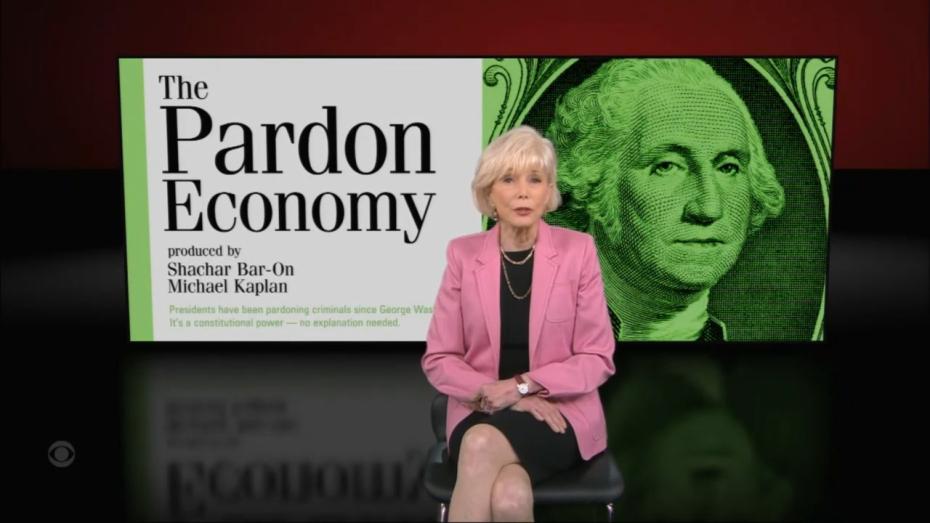
On Sunday, after changes to 60 Minutes by new CBS News editor-in-chief Bari Weiss, which was paired with liberal fears over the show becoming pro-Trump, the first stories of the newest season of the supposed new-look show still continued to showcase the program’s liberal bias. The opening story of the season focused on the rescue mission of U.S. fighter pilots during the Iran War, but editorialized when describing the Iran War. Meanwhile, the second story, by Lesley Stahl, focused on bashing the Trump Administration and its handling of presidential pardons.
Prior to the premiere, a NewsBusters study revealed the magazine show had a nearly five-to-one bias of liberal stories compared to conservative ones over the past six seasons. In reality, the season premiere did not feel that much different compared to the previous seasons, as the show led with two familiar faces in correspondents Norah O’Donnell and Lesley Stahl, and the pair, especially Stahl, still showed their anti-Trump bias.
O’Donnell led the show with her highly anticipated story with an interview with a rescued U.S. fighter pilot who was shot down over Iran. She began, “When an American fighter jet was shot down over Iran this past April 2nd, not one, but two U.S. Air Force officers were left stranded, alone in a rugged mountain range, being pursued by Iranian forces.”
In the first story of the "revamped" '60 Minutes,’ correspondent Norah O’Donnell led off the season with the U.S. rescue mission of downed Air Force pilots in Iran and made sure to editorialize in her introduction, as she called the Iran War “costly and unpopular”: pic.twitter.com/ly3NzyEMaZ
— Nick (@nspin310) September 14, 2026
But O’Donnell then added some editorialized language when describing the Iran War:
To prevent their capture, five weeks into a costly and unpopular war that has taken the lives of 18 U.S. Service members, the U.S. Military launched one of the largest search and rescue operations in its history.
WAY+TCH: "Bravo" describes being shot down over Iran and the terror he felt when his parachute failed to deploy
"My parachute was damaged in the initial attack. At one point, when I looked up and saw no parachute, that was the most -- was the most terrifying thing I've ever… pic.twitter.com/nF55mZvnPU— Jorge Bonilla (@BonillaJL) September 14, 2026
The rest of her story, however, remained more neutral as she interviewed Secretary Pete Hegseth, General Dan ‘Raizin’ Caine, and Admiral Brad Cooper on details of the rescue operation, along with the big get for the interview: Bravo, one of the fighter pilots rescued after being shot down. Here is a portion of their exchange: (Click “expand”)
O'DONNELL: After they ejected, Alpha and Bravo found themselves 5 miles apart, separated and alone on the ground in the rugged Iranian desert. Alpha landed safely. Bravo was lucky to be alive.
BRAVO: My parachute was damaged in the initial attack. At one point when I looked up and saw no parachute, that was the most -- it was the most terrifying thing I've ever seen. So, I paused right then. And I prayed, "Lord, your will be done. But if I'm getting through this, I need help."
O'DONNELL: While you're in the air?
BRAVO: Yeah.
O'DONNELL: Is that almost like free-falling or how would you describe that?
BRAVO: Free-falling is a good way to put it. I wasn't focused on the speed at which I was falling. I was instead focused on trying to correct the problems that were in front of me and doing anything I could to unfurl or pull pieces of the parachute loose.
For the second story of the night, Stahl focused on presidential pardons, with an explicit focus on the Trump Administration:
The fears of ‘60 Minutes’ magically shifting to become pro-Trump were also proven false with the second story of the night, as correspondent Lesley Stahl went after Trump's issuance of presidential pardons during his second term. https://t.co/RHE64rSAIS pic.twitter.com/bWHcGTkd1D
— Nick (@nspin310) September 14, 2026
The Department of Justice does screen applicants and typically only recommends those who remorsefully seek mercy. But that's not always been the process: President Ford pardoned Richard Nixon. President Clinton: Marc Rich after donations. President Biden: his son Hunter and Anthony Fauci.
President Trump? He's developed his own vetting system: pardoning political allies -- including all of the Jan. 6 rioters -- as well as a string of unrepentant financial conmen who argued -- just like him -- that they were wrongly prosecuted.
How do these people get their grievances in the president's ear? Donations appear to help, and those who can pay hire pardon brokers: lawyers and lobbyists who sell their ties to the president for exorbitant fees. It's a marketplace of money and mercy.
In her piece, Stahl interviewed former DOJ Pardon Attorney Ed Martin in what could be described as anything but a softball. After tough questioning, Martin called those who claimed to be able to broker pardons “snake oil salesmen.”
The two figures who claimed to be able to broker pardons and were the focus of the CBS story, Jack Burkman and Jacob Wohl, are known scammers and were described in a 2024 Politico story as “convicted fraudsters.”
Once again, the panic over changes to 60 Minutes and CBS News proved to be overblown, as the network and its premier magazine show do not all of a sudden act as MAGA TV or CBS Newsmax.
Even CNN media analyst Brian Stelter proclaimed that 60 Minutes was still 60 Minutes.
The transcript is below. Click "expand":
CBS’s 60 Minutes
September 13, 2026
7:53:29 PM Eastern
NORAH O’DONNELL: When an American fighter jet was shot down over Iran this past April 2nd, not one, but two U.S. Air Force officers were left stranded, alone in a rugged mountain range, being pursued by Iranian forces.
To prevent their capture, five weeks into a costly and unpopular war that has taken the lives of 18 U.S. Service members, the U.S. Military launched one of the largest search and rescue operations in its history. Tonight, we begin our 59th season with how the mission unfolded. We'll show you newly declassified footage, and you'll meet the colonel who lived through it all to tell us the story.
(Cut to prepared story)
O’DONNELL: When an American fighter jet was shot down over Iran this past April 2nd, not one, but two U.S. Air Force officers were left stranded, alone in a rugged mountain range, being pursued by Iranian forces.
When the U.S. went to war with Iran this past February, it was by sea, by land, but mostly from the air.
ADM. BRAD COOPER: Broadly, we had flown about 13,000 missions up to this point. So, we had air superiority, but clearly, we weren't flying over Kansas.
O'DONNELL: Adm. Brad Cooper is the American commander in charge of the war. We asked him what brought the fighter jet to a mountainous area south of the city of Isfahan, close to where Iran had been keeping much of its highly enriched nuclear material.
(To Cooper) What were they doing in that area?
ADM. BRAD COOPER: Their mission that evening was to conduct a strike on industrial facilities related to the -- both the drone and the missile program, not related to the Isfahan nuclear facility.
O’DONNELL: The plane`s mission call sign was DUDE 44. It was an F-15E, a type of two-seat fighter that's been a workhorse of U.S. air combat operations for decades. The $30 million jet was brought down by a shoulder-fired missile that can cost around $100,000.Evidence of the wreckage was shared online by Iranian media. Defense Secretary Pete Hegseth was woken up Thursday night with the news.
(To Hegseth) When you heard that an American fighter jet was down behind enemy lines in Iran, what went through your mind?
SECRETARY PETE HEGSETH: Probably, "[Expletive], you know, you always knew that was possible." And so, immediately it`s to the next steps, you know, "Are they okay? Does Iran know that?" And, you know, whether they're alive or not, we're going to go get them.
BRAVO: That day was just another day in the war for us, until the moment where we got hit by an Iranian weapon.
O'DONNELL: This is Bravo, one of the two officers shot down over Iran. Neither has spoken publicly until now.
BRAVO: I think the best way I've been able to describe that moment was getting hit by a freight train.
O'DONNELL: We've agreed to call the weapon systems officer by his mission call sign, Bravo, due to security threats from Iran.
BRAVO: We do all we can to try to save the aircraft. It was evident that that wasn't possible. And soon thereafter, we ejected and found ourselves floating over the heart of Iran.
O'DONNELL: So within seconds, you're ejecting? That`s how quick the decision is?
BRAVO: It is. I will be thankful, to my dying day, for my pilot and crewmate, Alpha, for saving our lives and ejecting us.
O'DONNELL: After they ejected, Alpha and Bravo found themselves 5 miles apart, separated and alone on the ground in the rugged Iranian desert. Alpha landed safely. Bravo was lucky to be alive.
BRAVO: My parachute was damaged in the -- the initial attack. At one point when I looked up and saw no parachute, that was the most -- it was the most terrifying thing I've ever seen. So, I paused right then. And I prayed, "Lord, your will be done. But if I'm getting through this, I need help."
O'DONNELL: While you're in the air?
BRAVO: Yeah.
O'DONNELL: Is that almost like free-falling or how would you describe that?
BRAVO: Free-falling is a good way to put it. I wasn't focused on the speed at which I was falling. I was instead focused on trying to correct the problems that were in front of me and doing anything I could to unfurl or pull pieces of the parachute loose.
O'DONNELL: We'll never know just how fast Bravo was falling, but we do know the military trains to survive hard landings.
(To Bravo) So, how fast do you think you were going, when you hit the ground?BRAVO: Professionals based on my description and the injuries that I had, the professionals think I hit the ground, going somewhere between 70 and a hundred miles an hour.
O'DONNELL: How did you survive that?
BRAVO: A modern-day miracle. I believe that it's a testament to God's provision in my life to bring me through that moment in a way that didn't prevent injuries, but prevented any catastrophic injuries that would have affected my ability to survive.
O'DONNELL (voiceover): The fall broke Bravo's back. He also sustained a broken arm, broken shoulder, sprained ankle and was bleeding from cuts and scrapes to his head and face.
BRAVO: I had injuries, but we all train to adapt and overcome the things that are -- that we`re faced with. I moved as quickly as I could, despite the injuries, away from the place that I landed.
O'DONNELL: It's dark, right? And can you tell me what you -- what you see around you?
BRAVO: It is dark. But much like early morning hunting trips, you know, the sun starts to come up, and you can start to perceive elements of the environment around you. Iran is the size of Alaska. And in the heart of Iran, where we were, there are high desert valleys, but also amazing craggly cliffs. And so, I find myself in one of those valleys with cliffs on either side.
O'DONNELL: Bravo told us the safest place for him to go was up. So he quickly made the decision, despite his broken bones, to hike and climb up a 7,000-foot ridgeline.
(To Bravo) Given your injuries, how did you find the strength to make it up the mountain?
BRAVO: Never let a lack of motivation put you on Iranian TV.
O'DONNELL: You were thinking that?
BRAVO: Absolutely.
(...)
8:10:25 PM Eastern
LESLEY STAHL: Presidents have been pardoning criminals since George Washington. It's a constitutional power. No explanation needed.
The Department of Justice does screen applicants and typically only recommends those who remorsefully seek mercy. But that's not always been the process: President Ford pardoned Richard Nixon. President Clinton: Marc Rich after donations. President Biden: his son Hunter and Anthony Fauci.
President Trump? He's developed his own vetting system: pardoning political allies -- including all of the Jan. 6 rioters -- as well as a string of unrepentant financial conmen who argued -- just like him -- that they were wrongly prosecuted.
How do these people get their grievances in the president's ear? Donations appear to help, and those who can pay hire pardon brokers: lawyers and lobbyists who sell their ties to the president for exorbitant fees. It's a marketplace of money and mercy.
(...)
8:18:31 PM Eastern
STAHL: Until nine days ago, Ed Martin, a Trump appointee, ran the pardon office at DOJ, where 16,000 applications are awaiting a decision.
(To Martin) People pay $300,000, a million dollars, $3 million to these brokers to get the application before the president. Meanwhile, all these other people that you look at, at the Department of Justice, they are not getting their pardons.
ED MARTIN: I'm not –
LESLEY STAHL: And is that a fair system?
MARTIN: I'm not seeing -- I reject your characterization of the system. I've not seen it. I`ve not heard it. And I sat with a thousand people over – in the last year in my office, and I listened to them tell -- some of them ended up with clemency. Some of them were pardoned.
STAHL (voiceover): We checked: About 70 percent of President Trump`s clemencies in his second term have not gone through DOJ. If you include the January 6 rioters, that goes up to 92 percent. And we noticed that some pardons came after well-timed donations or a business deal.
Take, for example, this businessman who was sent to prison for fraud. He conned investors with this video of the first zero-emission truck driving along. It was actually a fake, rolling down a hill. After he and his wife donated almost $2 million to support Trump`s re-election, he was pardoned.
This CEO failed to prevent money laundering on his crypto exchange. He was pardoned after his company, Binance, boosted a Trump family crypto venture, though both sides deny any connection to the pardon. And this health care executive, convicted of tax crimes, was pardoned after his mother paid a million dollars to attend a Mar-a-Lago fundraiser.
(To Martin) A pardon seeker going to Mar-a-Lago and joining in a fundraising event where you had to pay money and then getting a pardon, why isn't that a quid pro quo? Why isn`t that pay to play?
MARTIN: I don't know about those examples, but I would just say the prerogative -- again, the presidential prerogative, that-- it's in the Constitution. It's complete. It`s plenary. When people say, "There`s brokers, there`s quid pro quo," I`ve never seen it. I haven`t seen it, I haven`t heard it.
STAHL: Ed.
MARTIN: Yup?
STAHL: The point is, they're going around you.
MARTIN: Well, I –
STAHL: And the whole point, they're bragging about going around you.
MARTIN: I just don't see any evidence of some magical brokers. I think people are trying to make money.
STAHL: So, are you saying that these brokers, they're con men?
MARTIN: They're snake oil salesmen; they're swamp salesmen. What do you want? What word do you want?
JACK BURKMAN: We want to do this. I think we can help you.
STAHL (voiceover): After we notified Jack Burkman and Jacob Wohl of our hidden-camera operation –
JACOB WOHL: A sting operation client, a fake client.
BURKMAN: A sting run by you, right?
STAHL (voiceover): They agreed to sit down with us to discuss the new pardon economy.
WOHL: There's nothing corrupt about it. There's nothing improper about it.
STAHL: It seems that you have to have money to get a pardon these days.
BURKMAN: We don't work for free any more than you do, right? You're well-paid for what you do. We're well-paid for what I do. Navigating Washington, as you well know, is not an easy thing.The average person, the average rich person, they need help doing that. How would the President become aware of these cases unless some –
STAHL: Through the normal way that presidents have done it for a hundred years or more.
BURKMAN: Well, lobbyists have been hired for two centuries to do just that.
STAHL: People have gone through a system that has been set up.
WOHL: You think there weren't lobbyists working on pardons in the Obama administration?
STAHL: There were, but –
WOHL: The Biden administration?
OSLER: There've always been lawyers who are willing to prepare a clemency petition, you know, often for a couple of thousands of dollars. You know, what's changed is the amount of money that -- that people are charging.
(...)