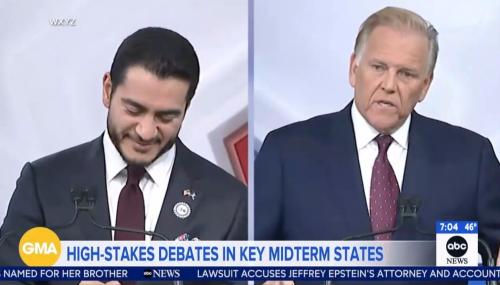
With radical candidate Abdul El-Sayed narrowly seizing victory in the Democratic Senate primary in Michigan, the media has quickly rallied to defend their new buddy. Amid concerns of El-Sayed’s socialist policies and unsavory campaign allies, CNN opened this Thursday’s This Morning with a segment on the divisive candidate.
Prompted by host Audie Cornish, the president of Demand Justice, Josh Orton, had his own stance on the post-primary debate regarding El-Sayed’s campaign:
And I think, frankly, people are making a mistake if they see this in too partisan terms. He's talking about how people are being hurt by the current economy, by the tariffs that Trump has initiated.
On CNN, Josh Orton says that it's a "mistake" to see El-Sayed's race in "too partisan terms."
People wouldn't be seeing it that way if El-Sayed wasn't pushing such extremist policies! pic.twitter.com/jF79UHJdsg— James Waterman (@jwatermaniv) August 6, 2026
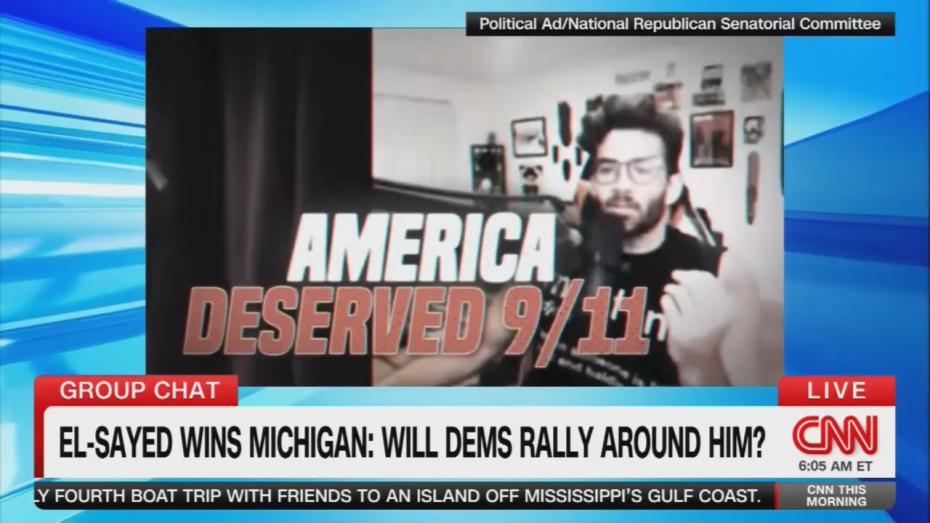
Why would anyone see El-Sayed in partisan terms? Maybe it’s because he supports socialist energy policies, hypocritically accuses doctors of racism for refusing Medicaid, backs defunding the police and even compares the U.S. response to 9/11 to 9/11 itself! It’s not shocking that people are using partisan terms when an extremist candidate is in the running!
Staying on the topic of extremism, Cornish later prompted NOTUS congressional reporter Stephen Neukam on El-Sayed’s close relationship to extremist podcaster Hasan Piker, who openly promotes violence on his show and elsewhere. The discussion didn’t go where one would expect, though:
CORNISH: It's interesting that part about disavowing people's views because of the far left podcaster, Hasan Piker, has been campaigning, you know, shoulder to shoulder with this guy. And so it's a little bit different than saying, oh, there's some people who have supported you in the distance.
(...)
NEUKAM: The establishment put all their weight behind trying to crush Abdul in Michigan. And, you know, the election shows that it didn't work.
Then, when asked about El-Sayed's relationship with violent extremist Hasan Piker, Stephen Neukam dodges the question.
Instead of dealing with El-Sayed's terrorist-sympathizing buddy, Neukam talks about El-Sayed's underdog story in the primaries. Talk about deflection! pic.twitter.com/0In3XvQVfC— James Waterman (@jwatermaniv) August 6, 2026
Neukam dodged the Piker issue almost entirely. Instead, he pivoted to a much more pro-El-Sayed topic: his dramatic underdog story. It’s a tactic the leftist media is very familiar with, reminiscent of their coverage of Obama in the 2008 campaign, using his underdog credentials to dodge actual substantial questions.
Finally, Cornish turned to the sole Republican on the panel, Doug Heye. Incidentally, Heye was the only guest to properly criticize El-Sayed and his buddy Piker for their radical beliefs:
But I will say in sort of Pikers defense… AIPAC has been a code word, it has been a dog whistle, and that word is 'Jewish'… Piker is being blatantly obvious here and blatantly honest. And that is, you know, going to be a big part of this campaign.
Heye sarcastically praises Piker for at least being open about his antisemitic stances, implying the hidden antisemitism within El-Sayed attacks against AIPAC during his campaign. Not surprising that the honest and critical coverage only shows when a conservative is on air.
The transcript is below. Click "expand" to view.
CNN This Morning
August 6, 2026
06:03:24 a.m. Eastern
AUDIE CORNISH: Joining me now in the group chat, some new faces: Stephen Neukam, congressional reporter for NOTUS, Doug Heye, Republican strategist and former RNC communications director, and Josh Orton, president for Demand Justice.
So I want to start with my Demand Justice friend. Are people feeling like this is their moment? Did this feel like a turning point for this network of folks that has been outside of the Democratic Party and finding themselves winning in primaries?
JOSH ORTON: I mean, I think this is one of the biggest upsets in modern American political history. He was outspent, you know, almost ten to one. There were $60 million of outside money. He came—Abdul came with a really strong argument against, you know, this power dynamic that's sort of crushing working people, you know, data centers being built in people's backyards. You know, the rising prices.
And I feel like he had a theory of that power and how he was going to fight it, and I think that is resonating. And I think, frankly, people are making a mistake if they see this in too partisan terms. He's talking about how people are being hurt by the current economy, by the tariffs that Trump has initiated.
And I think that is actually resonating with Michigan, and this notion that somehow he's going to be a much harder sell in the general election, I don't think is necessarily true. He's an excellent political athlete. He lights up a room. He's optimistic and-
CORNISH: I like the term political athlete, right? Retail politics is real, I get that. I want to be clear, Haley Stevens did perform well. Like if you actually look at the state, it's not like he ran away with it. What was it like 15,000 votes?
[Graphic on screen]
Oh, we got a little map. Okay. The dark blue is El-Sayed, so I understand population centers, but just to be clear, those are a lot of rural areas, some black-leaning districts where he is going to have some work to do. And here is how the first attack ad is going to look. I want you guys to take a listen:
[Cuts to video]
ATTACK AD: Abdulrahman Muhammed El-Sayed, the most radical Senate candidate in America.
ABDUL EL-SAYED: I’m pretty [bleep] dangerous!
ATTACK AD: El-Sayed pledged support for the leader of the Muslim Brotherhood, a designated foreign terrorist group. When his ally claimed America deserved 9/11:
HASAN PIKER: America deserved 9/11, dude.
ATTACK AD: El-Sayed refused to disavow him.
EL-SAYED: I'm not here to disavow people's views.
[Cuts back to live]
CORNISH: It's interesting that part about disavowing people's views because of the far-left podcaster, Hasan Piker, has been campaigning, you know, shoulder-to-shoulder with this guy. And so it's a little bit different than saying, oh, there's some people who have supported you in the distance. This is somebody who he is attached to, for better or worse, at this point.
STEPHEN NEUKAM: Yeah, absolutely. I also think that, look, there's going to be a lot that needs to be done to repair the party in Michigan after this primary. I mean, it was pretty nasty. I mean if you go back six years ago, seven years ago, Abdul lost to- I'm sorry, to now-Governor Whitmer by a landslide in that state.
And this is a comeback story, seven years later, that has splintered the Democratic Party. Gary Peters, who you saw on the television just now, who used to be the Democrat who ran campaigns for Senate Democrats, came out and endorsed Haley Stevens after saying he would not endorse in that race.
The establishment put all their weight behind trying to crush Abdul in Michigan. And, you know, the election shows that it didn't work. And there's going to have to be a lot of repairing of feelings that happens on the back end here.
CORNISH: Here's what Hasan Piker thinks of this idea of the repairing and the mending and all the language that you're supposed to use after a primary to bring everybody together. It sounded like this:
[Cuts to video]
PIKER: Everyone being like, Abdul has a [bleep]ton of work to do, mending bridges… Here's a [bleep] take nuke for you, okay? You are all unbelievably Islamophobic pieces of [bleep], Okay? You literally called the dude a [bleep]terrorist for months on end and, like, called him a sexist, misogynist terrorist, bad candidate, doesn’t— fake doctor, when he has like two [bleep] degrees. And now you're going to sit there and be like, “Well, you know, you've really got to come to me now.” Like, what are you talking about? Do you want to [bleep] win or not? Lock the [bleep] in, okay?
[Cuts back to live]
CORNISH: Doug, what have Republicans learned from bear hugging the independent podcast universe?
DOUG HEYE: Look, I think-
CORNISH: It has implications towards the end of the show when we talk about Tucker Carlson and Megyn Kelly.
HEYE: Thanks for that.
CORNISH: I just wanted to let you know, so it's no spoiler.
HEYE: Look, I think those people that you embrace and you campaign with can help define your campaign. They can do it in good ways, they can do it in bad ways. CORNISH: Yeah. HEYE: When you come out of a victory, you know, I watched the interview with El-Sayed last night with Kaitlan Collins, he said and did all the right things.
The problem is his own people aren't helping him. That is as unhelpful as possible. But I will say in sort of Piker’s defense-
CORNISH: Yeah, please.
HEYE: You know, so often when we talk about race and religion, we hear the term, especially about Republicans, “dog whistles” and “code words.” AIPAC has been a code word, it has been a dog whistle, and that word is “Jewish.” It has attacked the Jews in so many candidates and campaigns have run with code words attacking Jews. When um, when- now I'm blanking on his name. Graham Platner from Maine. When he stepped out of his race, what did he do? He blamed AIPAC, meaning he blamed the Jews. So-
CORNISH: And Thomas Massie in Kentucky, in his loss also.
HEYE: So, Piker is being- Yeah. And Piker is being blatantly obvious here and blatantly honest. And that is, you know, going to be a big part of this campaign, especially as there are repairs that have to be done. I think we tend to oversell how divisive primaries are. CORNISH: Yeah. HEYE: Parties always come together.