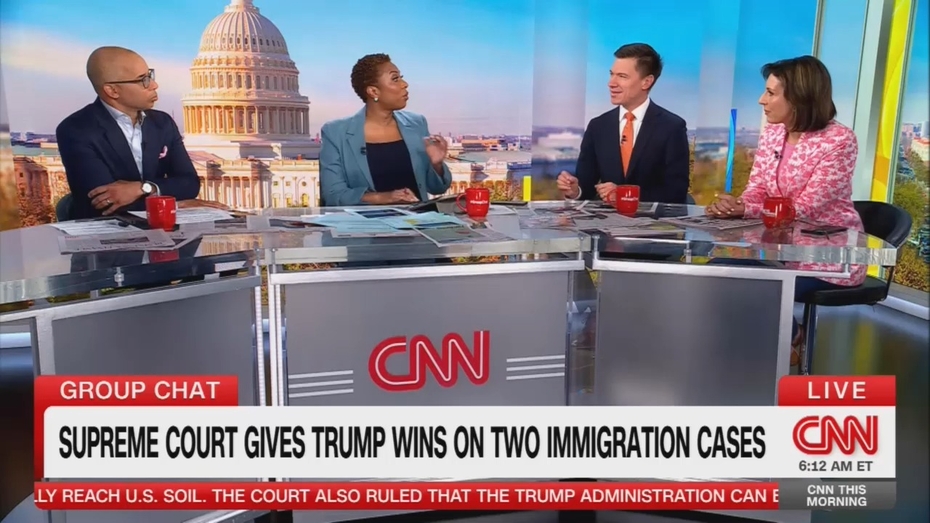
After a lead story on the Venezuelan earthquakes and the destruction in the country, Cornish immediately turned to the TPS ruling. She bemoaned, “Now, while the people in Venezuela are desperate for help, we here in the U.S. have seen two rulings from the Supreme Court indicating that the U.S. is not quite the place of refuge it might have been. “
After the Supreme Court's Temporary Legal Status ruling, CNN This Morning's Audie Cornish connected the decision to the Venezuelan Earthquake disaster:
— Nick (@nspin310) June 26, 2026
"Now, while the people in Venezuela are desperate for help, we here in the U.S. have seen two rulings from the Supreme Court… pic.twitter.com/P1iXMylWNy
The show played a soundbite from a Border Czar Tom Homan press conference where he said, “temporary means temporary.” CNN legal analyst Elliot Williams said Homan “does have a point,” but said “there wasn’t a ton of process” and it was “simply a stroke of a pen.”
After Cornish read part of liberal Justice Elena Kagan’s ruling that read, “race entered into the president's resolve to remove Haitians from this country,” Bluey turned to say the ruling is good for the President as it will help fulfill a campaign promise of mass deportations.
When asked if he was happy with the ruling, he said, “Absolutely. I think that these rogue judges were out of step. Absolutely, I do.”
As @RobertBluey said he was pleased with SCOTUS's TPS ruling, the NYT’s Lulu Garcia-Navarro was not and said conservatives “conflate everything" and asked, “What is this about, if not about racial animus?” https://t.co/ZjYynYbvKl pic.twitter.com/PKTrmjY6ss
— Nick (@nspin310) June 26, 2026
Immediately after Bluey’s thought, New York Times podcaster Lulu Garcia-Navarro responded in a soft voice and said, “these were not illegal immigrants,” before she complained that conservatives “conflate everything”:
“Exactly. And so the idea that the problem that I have always with this argument is made by conservatives is that they conflate everything, right? It's like illegal immigrants, TPS holders. It's basically anyone who's brown, who has been allowed in this country.”
She then remarked, “What is this about, if not about racial animus?”
Cornish then teamed up with Garcia-Navarro and went to Bluey in continuation of her conservatives' “conflate everything” comment:
“But I hear your point that, again, conflating mass deportation of illegal immigrants. Is that the same as haphazard deportation of illegal migrants that you have approved and vetted? And why lump those two together?”
Bluey kind of chuckled and argued "I do think that we have a massive problem. What, upwards of 20 million people who entered the country illegally under Joe Biden's watch?" Cornish continued to go after Bluey and wanted him to answer the “legal migrants” point: “I just want to make sure you get a chance to answer that point.”
He responded and said Congress gave the authority to the secretary to revoke legal status and “rogue judges were interfering." Cornish responded, “Because -- that's not what they have in their decision here,” before she returned to Garcia-Navarro’s racial animus argument.
As Garcia-Navarro made the case about race and Cornish connected the ruling to Venezuelan earthquakes, the decision could also simply be realized as the court ruling the word “temporary” can actually mean “temporary.”
The transcript is below. Click "expand"
CNN This Morning
June 26, 2026
6:05:41 AM Eastern
(...)
AUDIE CORNISH: Now, while the people in Venezuela are desperate for help, we here in the U.S. have seen two rulings from the Supreme Court indicating that the U.S. Is not quite the place of refuge it might have been.
The Supreme Court ruled immigration officials at the U.S. Mexico border can turn away asylum seekers before they enter the country. Now, in her dissent, Justice Sonia Sotomayor wrote that “the consequences of today's decision are predictable. More people will die.”
Now, the justices also allowed the Trump Administration to strip temporary protected status for hundreds of thousands of Haitians and Syrians living in the US.
[Cuts to clip]
TOM HOMAN: The whole statute exists temporarily to give people protection while the countries in turmoil or after they suffer a hurricane. But the problem is, no administration has had the guts to actually follow that statute. President Trump has the guts to follow the law, so temporary means temporary. When the condition in that country gets better, they need to go home. [Jumpcut] So, temporary means temporary. And I'm grateful for that decision.
(...)
6:07:32 AM Eastern
CORNISH: Elliot, I got to start with you. The legal of this. Basically, this law from the 1990s gives people a kind of quasi-legal status. You can work a bit, you can stay a bit, but it is by definition limited unless it gets continual extensions. So, does Homan have a point? And is that what the court underscored, or did they point to something else?
ELLIOT WILLIAMS: They pointed to something else. He does have a point in that - so the point of temporary protected status is when conditions in a country are such that people cannot return there. Haiti was an excellent example after the earthquake. Certainly it was not feasible for the United States to send people back there.
CORNISH: Or Syria, with the war.
WILLIAMS: Or Syria with the war and the deteriorating conditions there. Now, what countless administrations of both parties have done is extend those designations each time and sometimes multiple times up to a period of years. Now, on the flip side, what Kristi Noem, the former secretary of Homeland Security did, was simply just suspend TPS for Haitians and Syrians -
CORNISH: Yeah. And I'm going to put up a map showing all the countries the administration has tried to terminate TPS.
WILLIAMS: Yes.
CORNISH: Just so people have a sense of where folks are coming from and where we're trying to stop them.
WILLIAMS: Right. And but here, there wasn't a ton of process. It was just simply with the stroke of a pen we're going to suspend this right here. That was part of what animated the lawsuit. But certainly, you know, again, Tom Homan, frankly, who I worked with for years at ICE and whom I know, he's got a little bit of a point in that the sort of temporary nature of all of this.
That said, the manner in which they did it and the potential consequences in light of the Venezuelan earthquake could be profound for the entire hemisphere. And it's just something to think about what comes next after this Supreme Court decision like any other.
CORNISH: There was a twist in this conversation, which is that the Haitian plaintiffs said, look, this administration has said such heinous things about Haitians in particular, that there's obviously racial animus in the way they made this decision about TPS for their status.
And it was interesting. You had Elena Kagan writing “the statements fairly shout in their racial undertones and overtones alike. That race entered into the president's resolve to remove Haitians from this country.”
I'm not sure if we have some clips of that. We might, but needless to say, we have been hearing over the years, especially during campaign time, when Vance accused Haitians of all manner of thing, and that the court rejected that.
ROB BLUEY: Well, Audie, I'm glad you brought up the campaign, because I think going back to this conversation, just more broadly on immigration, Donald Trump promised to carry out the largest mass deportation in our country's history. The fact of the matter is, if you look at the first year of the Trump administration, they did not hit the mark on the president's own promise. And now the mass deportation coalition is saying that they need to deport up to a million illegal immigrants this year.
CORNISH: Are you bringing this up because you're saying this was a win they needed?
BLUEY: Yes. I'm saying that Donald Trump if that's the promise that he was going to deliver on. And that was a central theme of his 2024 campaign. These victories at the Supreme Court certainly put him on the pathway to getting back on track when it comes to carrying out that. Now, we may disagree on whether or not that's the policy the United States should carry out. I just happen to say, as a conservative and as somebody who was animated
CORNISH: You're happy about this ruling?
BLUEY: Absolutely. I think that these rogue judges were out of step. Absolutely, I do.
LULU GARCIA-NAVARRO: Um, well, the first thing is these were not illegal immigrants. These were people who were here and were given legal status. They did all the things that they needed to do. Specifically, they got vetted. They have jobs. They are nurses. They are doctors. They are journalists.
CORNISH: I’m going to put up, while you're talking, an example of the kinds of jobs Haitian TPS holders were doing in this country, 200,000 of them in the U.S. Workforce.
GARCIA-NAVARRO: Exactly. And so the idea that the problem that I have always with this argument is made by conservatives is that they conflate everything, right? It's like illegal immigrants, TPS holders. It's basically anyone who's brown, who has been allowed in this country. Um, we have seen under this administration, basically refugees - the entire refugee program being suspended and being now handed over to white South Africans. What is this about, if not about racial animus?
And I think what Elena Kagan was pointing to was the president's very own statements. They're eating the dogs. They're eating the cats, talking about Haitians who were working. And that was completely fabricated. And so I think at the end of the day, when you look specifically at a place like Haiti, how can you argue that that is safe for people to go back to?
CORNISH: But I hear your point that, again, conflating mass deportation of illegal immigrants, is that the same as haphazard deportation of illegal migrants that you have approved and vetted? And why lump those two together?
BLUEY: Well [laughs] I do think that we have a massive problem. What, upwards of 20 million people who entered the country illegally under Joe Biden's watch? So there's that issue
CORNISH: No, I want to repeat. Legal migrants. Why put those together? I just want to make sure you get a chance to answer that point.
BLUEY: Well, if we're going to go back to the Supreme Court decision, ultimately, it comes down to the fact that it's up to the Secretary of Homeland Security to make this decision and it's not a matter for the courts to review that’s ultimately what the court -
CORNISH: Well, I think they said it was Congress. But let me just add one more thing.
BLUEY: Congress gave the authority to the Secretary of Homeland Security -
CORNISH: Yes. Let me follow Lulu’s point.
BLUEY: And these rogue judges were interfering.
CORNISH: Because - that's not what they have in their decision here. But, Lulu, I do want to answer something you said about the racial animus. Alito spoke to this directly, and he said, look, “political discourse by prominent public figures is increasingly couched in terms that would have scandalized the public just a short time ago.” And he talks about Haitian the commentary around Haitians in particular. But he says, whatever one may think of the kinds of statements that the state's lawyers couldn't even repeat in court, he says they're insufficient to show that the termination of Haiti's TPS designation was based on the race of the Haitian people.