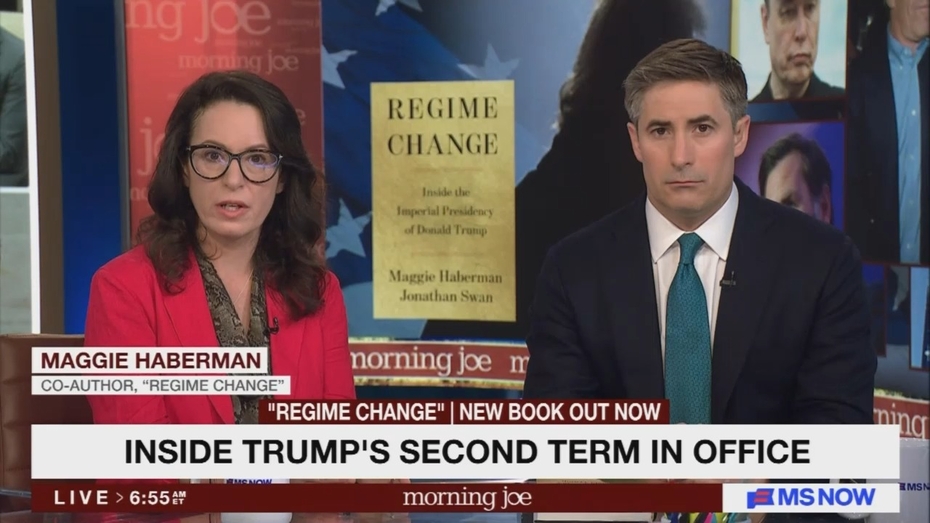
On a Morning Joe segment on Friday, Haberman misleadingly framed it as Trump and his allies “wanted to leave their imprint on what art Americans can see."
Haberman highlighted one flashpoint: an Amy Sherald exhibition slated for the National Portrait Gallery that included “Trans Forming Liberty,” a painting depicting the Statue of Liberty as a trans woman.
According to Haberman, internal discussions and pressure from figures like Vice President JD Vance and Rep. Carlos Gimenez led to concerns, prompting Sherald to pull the show over fears of “artistic control.”
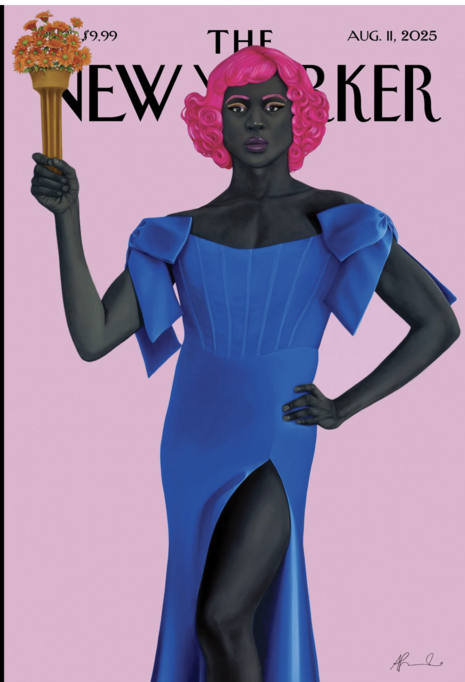
Private museums and galleries can (and likely will) compete to display the painting—perhaps with the marketing hook of “The Painting Donald Trump Banned!” But neither Sherald nor any artist has an entitlement to the Smithsonian’s taxpayer-funded imprimatur and national platform.
The segment’s narrative conveniently overlooked how the Smithsonian, under leaders they tout, like Lonnie Bunch, founding director of the National Museum of African American History and Culture [NMAAHC], and later overall Smithsonian Secretary, long advanced left-leaning perspectives on history, race, and culture, including during the Obama and Biden presidencies. No media elitist objected.
Morning Joe Denounces Trump’s Smithsonian 'Takeover'—Ignores Years of Left-Leaning Displays Under Obama and Biden pic.twitter.com/ThGD7C9ZHx
— Mark Finkelstein (@markfinkelstein) June 26, 2026
Consider just a few examples from the Obama and Biden eras:
- The NMAAHC’s “Talking About Race” portal featured a chart titled “Aspects and Assumptions of Whiteness and White Culture in the United States.” It listed traits such as “objective, rational, linear thinking,” “hard work,” “delayed gratification,” and the “nuclear family” as hallmarks of “white dominant culture.” The museum quietly removed it after widespread backlash.
- Upon the NMAAHC’s 2016 opening under Obama (with Bunch at the helm), Justice Clarence Thomas—the second Black Supreme Court Justice—was conspicuously absent from exhibits celebrating black historical figures. His only initial mention linked him to Anita Hill’s accusations. Conservatives, including Sen. Tim Scott, decried the omission; a more balanced display with Thurgood Marshall came later.
- The Smithsonian actively supported the New York Times’ 1619 Project, including a 2019 NMAAHC symposium featuring Nikole Hannah-Jones. Elements of its reframing—placing slavery and systemic oppression at the center of the American story—were reflected across exhibits.
These were not neutral presentations. They reflected deliberate choices about “what art Americans can see” and how U.S. history is framed, backed by federal funding and institutional prestige. Bunch’s dual role amplified that influence across the entire Smithsonian complex.
Trump has been seeking to counter what his administration views as divisive, ideologically driven content in favor of more unifying, exceptionalism-celebrating portrayals. Whether one agrees with every decision, the idea that only one side was previously “leaving their imprint” is the real fiction.
Morning Joe’s selective outrage highlights a classic liberal-media double standard—celebration of left-leaning curation for years, outrage when conservatives push back.
Here's the transcript.
MS NOW
Morning Joe
6/26/26
6:54 am EDTMIKA BRZEZINSKI: You go into deep detail about the takeover of the arts, this dramatic situation with the Smithsonian, and then I wanna get to tech titans.
But why, why the art and culture, the, the incursion into art and culture, why does that play into the themes that you're putting together in this book?
MAGGIE HABERMAN: So one of the things that we were really struck by last year was how early on Trump and his advisors and allies wanted to leave their imprint on what art Americans can see, on what defines US history.
And there was this executive order, I think it was March of last year, that was essentially dictating what could be shown at the Smithsonian, which is this massive, very revered, congressionally funded, network of museums all around Washington. And there, there's a number, of museums and research libraries and so forth.
This was, this was deeply impactful within the Smithsonian central itself. It is led by the first ever black secretary, Lonnie Bunch. He was the co-founder or founder of the African American Museum, several years ago. It was, it was one of his definitive works.
And this was about how slavery is talked about. This was about how US history is talked about. And it really is shaping the culture for, for many, many years forward, with the possible threat of losing funding.
And so, we got very deep inside these Board of Regents meetings, one of which involved the cancellation or the future cancellation of an Amy Sherald exhibit. And Amy Sherald, is a, a renowned artist. She had, done a portrait of Michelle Obama, and she had an exhibit that was supposed to be coming to Washington, and it was, featured several paintings, but one was the Statue of Liberty as a trans woman.
And we got inside this meeting on June 9th, where the Vice President and much more aggressively, Carlos Gimenez, a Congressman from Florida, were demanding the head of the National Portrait Gallery, where this was going to be shown, should be fired.
There, someone at one point, JD Vance leaves the room, and one of his young aides sits next to, or near, John Roberts, the Chief Justice of the Supreme Court, who presides over these meetings. And he holds up an iPad and he flips through it and he says, "This is also going to be a problem." He points to that image and says, "This isn't what Americans want to see."
And this became a huge flashpoint at the Smithsonian. Amy Sherald ultimately pulled her exhibit because she didn't want any sense that there was artistic control over it. It does define how you are seeing Trump and the White House try to put an imprint on all aspects of American life.