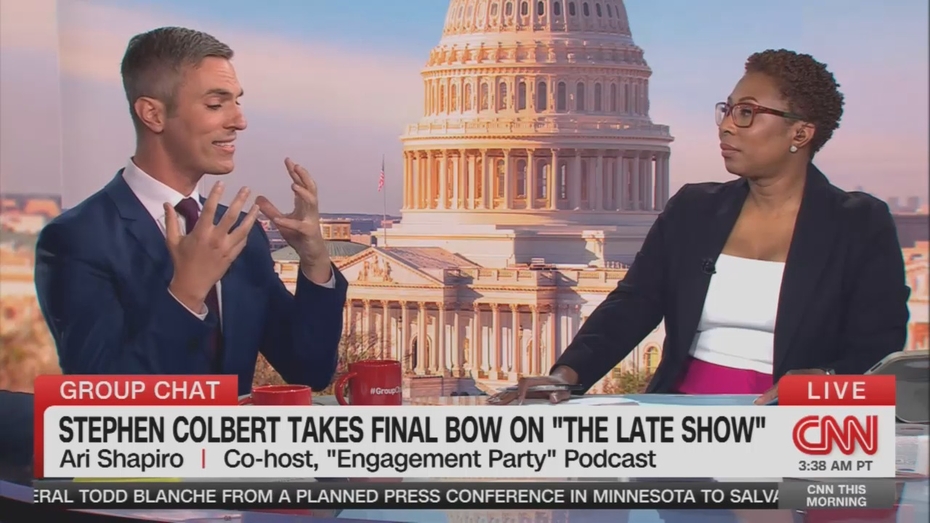
The discussion quickly turned into a nostalgic send-off for Stephen Colbert’s Late Show. The segment perfectly illustrated the insular world of legacy media’s liberal talent pipeline. Cornish and Shapiro, both veteran NPR anchors, were joined by Garcia-Navarro (another longtime NPR host) as they lovingly processed Colbert’s exit.
Shapiro set the tone early, describing the finale as “so moving” with a “snow globe moment” that “brought a lot of people to tears.” He praised Colbert as "this gentleman of a mold that you don't see that much anymore" in an entertainment industry full of “big and toxic personalities,” noting how staff revered him and that he loved his family and fishing trips back to Charleston.
What NPR types like Shapiro don’t seem to grasp is that Colbert’s nightly monologues brought millions of other Americans to tears — of frustration and anger — for very different reasons. Colbert built his brand on relentless, one-sided venom directed at Republicans and especially Donald Trump. That apparently doesn’t count as “toxic” or ungentlemanly in the Shapiro-Cornish worldview.
Cornish added that “we all know” the Trump White House had something to do with the show’s end, while citing a New York Times opinion piece claiming CBS had canceled “core American values, such as the right to speak freely.”
Garcia-Navarro took it further: “I think Stephen Colbert can now actually apply to the Anti-Weaponization Fund... He can say he was politically persecuted for free speech, and maybe get a big payout.”
That reflects a common liberal misconception. In fact, Stephen Colbert retains full freedom of speech. He can stand on any street corner in New York, launch a Substack, start a YouTube channel, or go anywhere on the open internet. The First Amendment protects the right to speak — it does not guarantee a money-losing network television show subsidized by advertisers who no longer want to pay for it.
Later in the segment, Shapiro described where Colbert’s "DNA" lives today. He pointed to figures like Matt Rogers and Bowen Yang (Las Culturistas podcast) and Julian Shapiro-Barnum (launching a new YouTube late-night show Outside Tonight). All three operate firmly in the same progressive cultural lane — heavy on urban, left-coded humor with little interest in ideological diversity.
CNN Turns Colbert Farewell Into NPR Reunion, Mourns Loss of 'Gentleman' Late-Night Liberal pic.twitter.com/wMSbzigoZQ
— Mark Finkelstein (@markfinkelstein) May 22, 2026
The discussion felt less like journalism and more like Old Home Week for NPR alums. Cornish, Shapiro, and Garcia-Navarro all share deep roots in public radio’s famously left-skewing culture. Their emotional send-off for Colbert — and their inability to grasp why so many viewers tuned him out — says far more about the bubble they inhabit than about the “end of an era.”
This kind of navel-gazing bubble is precisely why millions of Americans have abandoned legacy media for good.
MRC alum and Daily Signal president Rob Bluey pointed out that whereas Colbert's show was a money loser, in a recent month, Gutfield! was the fourth-highest rated show in cable news, precisely because it speaks to an audience shunned by the legacy media. Garcia-Navarro shot back: "But Greg Gutfeld is literally that on the other side. So that argument, with respect doesn't, I think, hold."
Here's the transcript.
CNN This Morning
5/22/26
6:30 am EDTAUDIE CORNISH: Okay, joining us in the Group Chat, my friend Ari Shapiro, co-host on the new show Engagement Party, our podcast which debuts today.
ARI SHAPIRO: Hi, audience. So nice to be here.
CORNISH: Welcome to the Chat.
SHAPIRO: It's great to be with you.
CORNISH: This feels like the perfect topic 'cause, like, on Engagement Party, we're talking about what everyone is talking about, and late night shows are sort of last water cooler adjacent moments. Was this one?
SHAPIRO: Oh, the show itself was so moving. There was this little snow globe moment at the end that I think actually brought a lot of people to tears.
Obviously, there are a lot of tributes right now to Stephen Colbert as a media force, as a comedian. I think in this moment, it's also nice to remember who he is as a person. Because in this Hollywood world, in this late night world, where there are a lot of big and toxic personalities, the people who work with him, who I talked to when I interviewed Colbert a couple years ago, revere him.
CORNISH: Yeah.
SHAPIRO: He has this reputation as somebody who loves his family, fishing, going back to his hometown of Charleston whenever he can. Like this gentleman of a mold that you don't see that much anymore.
CORNISH: Yeah, he did not talk about how and why his show was ending. We all know that, certainly, the Trump White House had something to do with it, and the New York Times, in their opinion pages, saying, "CBS cancels itself, not just Colbert, the biggest losses to core American values, such as the right to speak freely, even in brutally mocking terms about those in power."
LULU GARCIA-NAVARRO: I think Stephen Colbert can now actually apply to the Anti-Weaponization Fund. I mean, isn't this now where we're at, with this fund?
CORNISH: The FCC spoke, so line him up.
GARCIA-NAVARRO: Line him up. He can say he was politically persecuted for free speech, and, you know, and he can maybe get a big payout.. . .
ROB BLUEY: I think as somebody who grew up watching Jay Leno and David Letterman, certainly it is the end of an era. It's the changing viewer consumption habits, I think, as well.
It's not that late night can't be successful. Greg Gutfeld, I think in April, had the fourth most popular show on cable news. So, there is a market for that audience, but I just don't think Stephen Colbert resonated, when it was so cutting against President Trump night after night, and that just alienated a huge segment of the American people. And so --
GARCIA-NAVARRO: But Greg Gutfeld is literally that on the other side. So that argument, with respect doesn't, I think, hold.
CORNISH: Well, this is the kind of topic I often wanna do on the show, but it's like not quite news. A lot of pop culture. It intersects with so many things, which is, I think, why we wanted to do a show together.
SHAPIRO: Right. So our show, Engagement Party, is gonna dig into these kinds of things that everybody is talking about. And where we go from the conversation about politics and Colbert might be to, where does the DNA of this show exist today?
And I'm thinking about, there was a Vanity Fair article that was like the New Late Night, and the people featured in that article were, like, Matt Rogers and Bowen Yang, hosts of Las Culturistas, or Julian Shapiro-Barnum, no relation, who is now launching a YouTube Late Night show.
So even though the network TV model of The Late Show and programs like it may be shriveling, we see those seeds spreading to a lot of interesting places.
CORNISH: And you guys can check out Engagement Party. We actually launched today, the first episode is dropping on the CNN app.