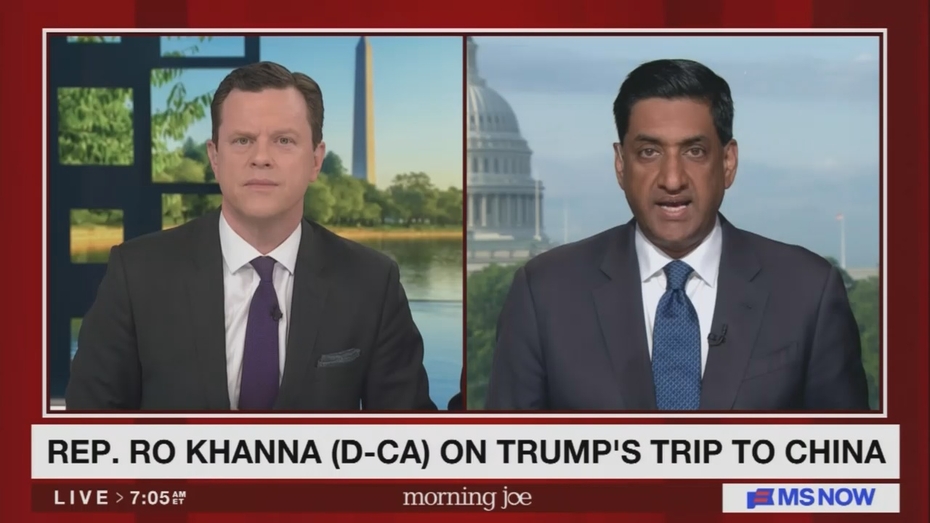
Willie Geist asked Rep. Ro Khanna (D-CA): “In what ways is China ripping off the United States or practicing unfair economic policy?”
Khanna eagerly listed Beijing’s tactics: heavy subsidies for every strategic industry, dumping products on American shores, and Chinese companies in the U.S. hiring undocumented workers, abusing labor, and operating non-unionized while still receiving subsidies. “Americans simply can’t compete,” he kvetched.
Khanna even gave a nod to Donald Trump, noting that Trump had run on the issue and warned America was getting its “lunch eaten” by China — only to accuse the current administration of "betraying" American workers by courting Wall Street, tech billionaires, and more Chinese investment.
Richard Haass then gently pushed back, observing that these criticisms have been made “for over twenty years” since China entered the World Trade Organization. He asked Khanna: What would you actually do differently?
Watch:
— Mark Finkelstein (@markfinkelstein) May 14, 2026
Ro Khanna's plan for the American economy: copy China's central planning! pic.twitter.com/fYdB5SgAIg
Khanna had a pre-packaged answer ready. Not tougher enforcement, reciprocity, or market reforms. Instead, he unveiled a four-point domestic central-planning scheme he called a “Marshall Plan not for Europe, but for the United States of America” — and branded the whole thing “economic patriotism.”
His plan:
• Create an “industrial investment bank” to fund government-selected factories in “the industries of the future” — batteries, new steel, new cars, new ships — specifically targeted at “places that were deindustrialized,” paired with investment and production tax credits.
• Open a thousand new trade schools.
• Open new tech institutes to prepare workers for AI and future technology jobs — again directing investment to “places that were hollowed out.”
• Pour government money into the “care economy” while redistributing venture capital away from wealth centers like his own Silicon Valley district.
In other words, after condemning China for state subsidies and directed industrial policy, Khanna’s solution is for America to do the same thing — only this time with Washington politicians picking both the winning industries and the favored regions of the country.
Solyndra ring a bell, Ro? The Obama administration tried exactly this approach — picking “industries of the future” and showering them with taxpayer billions. The most notorious result was Solyndra, the solar panel maker that received a $535 million federal loan guarantee--only to file for bankruptcy two years later, laying off 1,100 workers and sticking taxpayers with the bill.
Adding to the irony, Khanna — whose own Silicon Valley congressional district holds, according to him, roughly one-third of the nation’s wealth — slammed that concentration as select places and people “hoarding the nation’s wealth.”
When's the last time you heard a congressman complaining that his district was too well off? Most lawmakers brag about “bringing home the bacon.” Khanna wants to ship Silicon Valley’s bacon to Warren, Ohio.
Left unmentioned: the new trade schools and tech institutes would almost certainly be staffed by government unions. Also unaddressed: the long track record of government “industrial policy” funneling billions to politically connected companies that return the favor with campaign contributions.

Morning Joe offered no pushback on Khanna's pivot to central planning. Once again, the liberal answer to China’s state-directed economy is simple: become more like China.
Here's the transcript.
MS NOW
Morning Joe
5/14/26
7:05 am EDTWILLIE GEIST: In what ways is China ripping off the United States or practicing unfair economic policy?
RO KHANNA: First of all, they subsidize, heavily, every one of their industries. So if you're an American steel manufacturer, you don't get the United States government giving you money. China gives all of their manufacturers basically unlimited subsidies if they think the industry matters.
Second, they dump into American shores. Third, some of the companies that they have in the United States have hired people who are undocumented or abusing those workers, they're non-unionized, and they're still getting subsidies. So Americans simply can't compete.
And as you pointed out, Trump ran on all of this. He said that we were getting our clock eaten by — our lunch eaten by China — and now he finally has a chance to do something to rebalance. And he's taking the very Wall Street and tech billionaires offshored our jobs, and he's begging China to put more money into the United States, and violate labor? It's really a betrayal of the American worker.
. . .
RICHARD HAASS: Congressman, yeah, a lot of these criticisms have been made really for over twenty years, since China entered the World Trade Organization. So what would you actually do differently?
And, you know, what policies would you adopt that would make a difference — particularly since a lot of people would say, while China's part of the problem, the bigger problem is not so much China as the emergence of new technologies which are replacing workers on the assembly line.
KHANNA: Richard, I would have a Marshall Plan not for Europe, but for the United States of America. Let me give you four concrete ideas.
I'd have an industrial investment bank that would actually fund factories in this country in the industries of the future — batteries, new steel, new cars, new ships — in places that were deindustrialized, combined with an investment and production tax credit.
Second, I'd open up a thousand new trade schools.
Third, I'd open up new tech institutes to get folks prepared for the jobs in AI and technology of the future, and make sure you're investing in places that were hollowed out.
Fourth, I'd invest in our care economy, and I'd make sure all the venture capital wasn't just in my district. We've got a country — my Silicon Valley district has one third of the nation's wealth, twenty trillion dollars. You can't have a few places and a few people in America basically hoard the nation's wealth.
We need to make sure that the investment is across this country, and I call it "economic patriotism."
If we did that, we could actually compete with China, instead of watching our industry and our jobs just hollowed out.