She especially hated using religion to "justify essentially attacking the press and saying that the press is doing a bad job for doing its job and raising questions about this war." The press isn't just "raising questions." It's relentlessly negative, from multiple directions, like switching from hating Trump's threats of mass destruction and then mocking him for "chickening out" with a ceasefire.
Haberman added that war should not be viewed “from a religious standpoint, as a mission.” That would come as news to Dwight D. Eisenhower.
In his D-Day “Order of the Day,” Supreme Allied Commander Eisenhower explicitly cast the Allied invasion of Normandy as a “Great Crusade”—capitalized in the original—and urged troops to “beseech the blessing of Almighty God upon this great and noble undertaking.”
Nor was Eisenhower alone.
Haberman: Religious War Rhetoric ‘Unseen in 80 Years’—Really? pic.twitter.com/k1jM7BuMh9
— Mark Finkelstein (@markfinkelstein) April 17, 2026
That same day, President Franklin D. Roosevelt addressed the nation in a radio broadcast framed entirely as a prayer, repeatedly asking for divine support for the invasion and describing the mission as “a struggle to preserve our Republic, our religion, and our civilization.”
In other words, two of the central figures of World War II—hardly ancient history—openly and repeatedly invoked religion to justify and frame the war effort.
So much for “unlike anything.”
Here's the transcript.
CNN This Morning
4/17/26
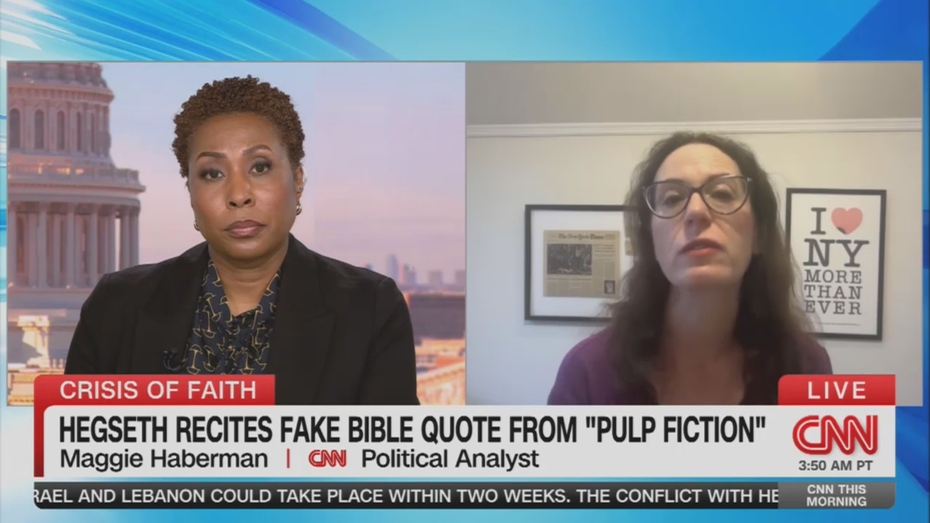
6:48 am EDTAUDIE CORNISH: Joining me now, Maggie Haberman, CNN political analyst and White House correspondent for The New York Times. She's also the author of Regime Change: Inside the Imperial Presidency of Donald Trump.
I wanted to talk to you about this, Maggie, because the internet has been very quick to seize on the Trump-White House-Pope feud into a broader conversation about religion, and how the Trump administration uses religion in its dialogue with the public about the war. What do you see in the way they've tried to defend themselves?
MAGGIE HABERMAN: Well, it's interesting, Audie. Aside from the Quentin Tarantino Pulp Fiction of it all in terms of that one quote, what I have seen the Secretary of Defense do, now renamed Secretary of War do, is use religion not just to justify the war.
We've seen that many, many times, but also to justify essentially attacking the press and saying that the press is doing a bad job for doing its job and raising questions about this war.
This is unlike anything really that we have seen in ever, in the last, at least in the last 80 years, and possibly, you know, ever in decades upon decades. And so before that.
It is not, look, there are people, I don't want to sound as if I am saying that somebody is not sincere in their religious beliefs. There certainly is no reason to say that. However, that doesn't mean that everybody has to then view the war in this country or anywhere else in the world, from a religious standpoint, as a religious mission.
CORNISH: Yeah.
HABERMAN: And I think that is where it starts to go off the rails.