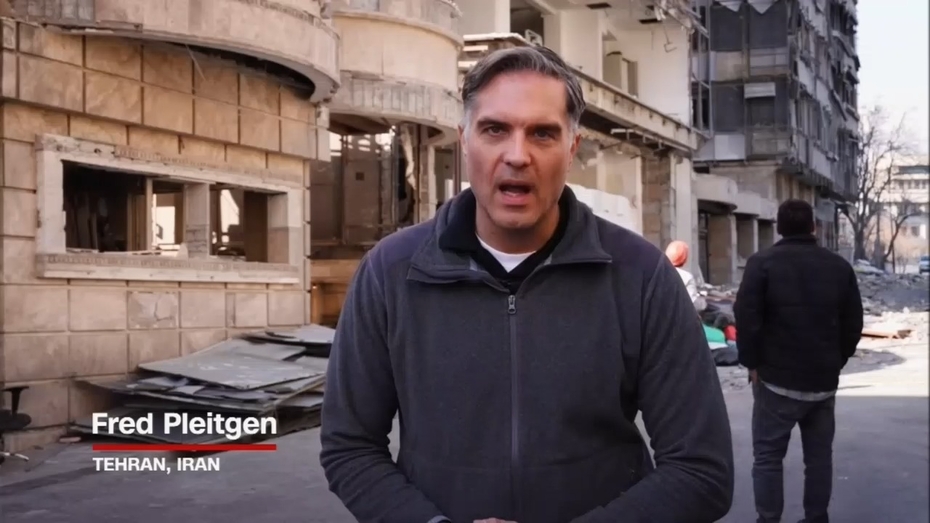
“Did you have a minder? Were you taken around by someone?” asked Guardian’s media and power reporter Jeremey Barr. A minder in this case being someone who worked with/for the regime who would shadow or guide a foreign journalist, who would only show them what the regime wanted, or to be a constant reminder the regime was in control over their stay and life.
Pleitgen initially suggested they didn’t have a minder, but they did have “a guy” who showed them around and translated. He began to say the guy “obviously” had some sort of duty before cutting himself off and noting that the regime had asked the guy not to show them certain places:
No, we didn’t. So, we don’t have a minder. We have a translator who’s a guy that we hire and we pay, but he obviously – the culture ministry asks him to not take us to places that are sensitive.
Sorry Fred, that’s what a minder is.
Pleitgen went on to make excuses for why they needed regime permission, particularly IRGC permission to go certain places and attend “larger events.” Essentially, so he wouldn’t get arrested:
And they also told us that when we go around this time, we needed to inform them before we went anywhere because if you go to strike sites, the aftermath of strike sites, there’s a lot of Revolutionary Guard Corps security officials there. And if they don’t know that you’re coming or if you don’t have someone who will mitigate the fact that you’re there or mediate between you and them, then that can be a big problem pretty quickly. And then also for larger events and stuff like that, you had to sign up before going there. It was more restrictive this time than it had been in the past, but still, by and large, we could do everything that we wanted to do.
When asked about if he felt his coverage was “truly independent, considering the limitations,” Pleitgen said he wished he was able to speak with more average Iranian so he could judge how much support the regime actually had:
I felt good about the coverage. I think that as far as the ongoing war was concerned, we definitely did what we’d set out to do and what we wanted to do. One of the things I would like to delve into more, which we didn’t get to do to that extent, was to what extent the government still has the support of the people. Because there were very few people who were still out on the streets, and a lot of people are afraid to speak to you.
Fred. That meant the people knew the regime was following and listening to you. They wouldn’t be able to give you their true feelings because it wasn’t safe and the regime would target them for execution.
When asked, “Why do you think Iran granted you a visa?” Pleitgen suggested he just applied and asked nicely:
I’ve been going there for a long period of time, so I have known these people for years, and the moment it started, I put in a visa request and I contacted the culture ministry, which is responsible for foreign media and I told them that we really want to come in, and I told them that it’d be important to have international media there. And then they granted the visa.
Meanwhile, CNN had been cultivating a working relationship with the murderous regime by going to parties hosted by the Iranian Embassy in London to celebrate the regime.
In a statement to NewsBusters, a CNN spokesperson defended their attendance at the party for the regime, saying: “Journalists attend different functions as part of normal work as an opportunity to speak with government officials whom they cover. The individuals photographed were there briefly for that reason and joined journalists from several different news outlets at this event.”
CNN declined to answer our question asking if the Embassy party played a role in Pleitgen getting permission to operate in Iran.
Humorously, Pleitgen also told The Guardian “I can take the criticism. I think it’s fine.” Meanwhile, he blocked this author on X because of the criticism.
Pleitgen: “I can take the criticism.”
— Nicholas Fondacaro (@NickFondacaro) March 17, 2026
Narrator: He couldn’t take the criticism. https://t.co/BqZ2WjIHdU pic.twitter.com/lJSH199eA0