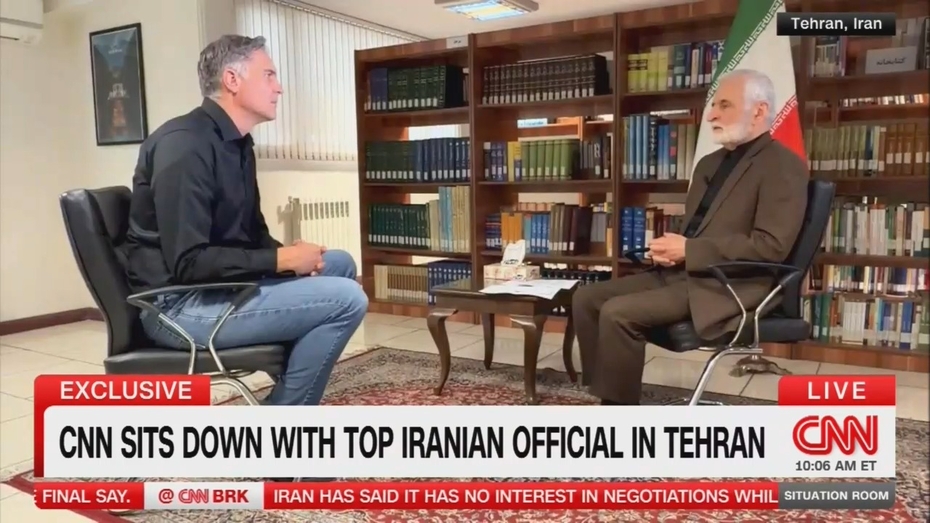
Ahead of the interview, co-host Pamela Brown (who recently put out a series of anti-Christian content for the pro-Islamic Republic outlet) reiterated that “CNN operates in Iran with the permission of the government.” This time they added to their disclaimer, noting they were adhering to everything “required under local regulations, but maintains full editorial control over what it reports.”
While the part about maintaining full editorial control sounded good, one should realize it meant that CNN could and would self-censor in order to stay on the regime’s good side to remain in the country, or prevent something worse.
Possible evidence of this self-censorship appeared in the aired segments of Pleitgen’s interview with Kharazi.
The first couple of questions Pleitgen raised essentially teed up Kharazi to boast about how Iran’s military was supposedly still as strong as ever (Click “expand”):
PLEITGEN: Iran has a new supreme leader. What does that mean for your military effort and the confrontation with the United States and Israel?
KHARAZI: That means the system is quite functioning
PLEITGEN: So the United States says it's drastically degraded the Iranian military, the capabilities as far as missiles is concerned, drones is concerned. How much longer can you do this?
KHARAZI: That is one of the false narratives that the United States government is producing. Iranian military is quite strong, as you see, because they have the motivation. They have the arms that they need, which are produced in Iran. As a matter of fact, we are not dependent on any other country for weapons and arms.
Pleitgen didn’t appear to press Kharazi on the numbers showing that Iran had been firing fewer and fewer missiles each day since the conflict began and that their navy was basically nonexistent anymore.
IRGCNN now claims that while CNN has the "permission" of the regime to operate in Iran, the network "maintains full editorial control over what it reports."
— Nicholas Fondacaro (@NickFondacaro) March 9, 2026
They then proceed to allowing an Iranian official to push their propaganda unchallenged and claims that America is the… pic.twitter.com/9zJNSxv5Yd
The next series of questions were essentially to allow Kharazi to blame everything on the United States and President Trump, frame America as the bad guys, and wash Iran’s hands of their role in hostilities (Click “expand”):
PLEITGEN: So, your side is ready for a long war, if the United States and Israel choose that. Do you consider this an existential threat to the Islamic Republic?
KHARAZI: It is an existential threat to the Islamic Republic, and therefore we have to stay with full might, as we are doing now.
PLEITGEN: Is your side seeking or will you seek a ceasefire with the United States at this point in time, and with Israel?
KHARAZI: I don't see any room for diplomacy anymore because Donald Trump had been deceiving others and not keeping his promises. And we experienced it in two times of negotiations that while we were engaged in negotiations they strike us.
PLEITGEN: How does all of this end then? If you say right now there's no room for negotiation, President Trump says he wants complete surrender. What does that lead to?
KHARAZI: There is no room unless the economic pressure would be built up to the extent that other countries would intervene to guarantee this termination of aggression of Americans and Israelis against Iran.
Pleitgen didn’t appear to ask Kharazi why Iran was targeting civilians in all their gulf neighbors (bombing hotels, resorts, apartment buildings, infrastructure, etc.) and beyond. No questions about their escalations. No questions about targeting civilian oil tankers. No question about giving up their ambition to obtain nuclear weapons.
His final questions teed up Kharazi to send a message to Trump (Click “expand’):
PLEITGEN: Finally, what is your message to President Trump as we sit here as the war is going on?
KHARAZI: That means that - what is important for us is the end of this game, and we are ready to continue that game.
PLEITGEN: The end of this game? You mean how this war will end? Is - is -
KHARAZI: At the end of the game would be the time that American and Israelis would come to this understanding that this strategy is not working, and they have to stop their aggressions against Iranians.
At no point was it apparent that Pleitgen asked Kharazi about the 30,000 civilians the regime killed, which spurred Trump to act. And while he asked about the election of a new supreme leader, there was no question about how Khamenei didn’t want his son elected and that it went against the Islamic revolution’s objection to hereditary monarchies like the Shah.
CNN might have full editorial control, but they knew what not to say and what buttons not to press so they can keep their precious access. Much like they looked the other way with Saddam Hussein’s atrocities in Iraq (including when their cameraman was abducted and tortured).
NewsBusters reached out to CNN to inquire about the editorial decisions that had been made regarding their Iran coverage. “What editorial decisions have been made to quell or avoid any objections from the regime?” our e-mail asked.
In a statement to NewsBusters, a CNN spokesperson said: “CNN is operating in Iran with the permission of the Iranian government, as required under local regulations. CNN maintains full editorial control over what it reports. The Iranian government does not review, approve, or preview CNN’s reporting prior to publication or broadcast.”
The transcript is below. Click "expand" to read:
CNN This Morning
March 9, 2026
10:06:35 AM EasternPAMELA BROWN: CNN is the first network inside Iran since the start of the war with the U.S. and Israel, with the government's permission there in Iran. And this morning, CNN's Fred Pleitgen sat down for an exclusive interview with a top Iranian official, the foreign policy adviser to the office of the supreme leader.
Fred Pleitgen is in Tehran. And just a note, as I mentioned, Tehran - or CNN operates in Iran with the permission of the government there, as required under local regulations, but maintains full editorial control over what it reports. Here are some key moments of Fred's interview.
[Cuts to video]
FRED PLEITGEN: Iran has a new supreme leader. What does that mean for your military effort and the confrontation with the United States and Israel?
KAMAL KHARAZI (Foreign Policy Adviser to the Supreme Leader): That means the system is quite functioning
PLEITGEN: So the United States says it's drastically degraded the Iranian military, the capabilities as far as missiles is concerned, drones is concerned. How much longer can you do this?
KHARAZI: That is one of the false narratives that the United States government is producing. Iranian military is quite strong, as you see, because they have the motivation. They have the arms that they need, which are produced in Iran. As a matter of fact, we are not dependent on any other country for weapons and arms.
PLEITGEN: So, your side is ready for a long war, if the United States and Israel choose that. Do you consider this an existential threat to the Islamic Republic?
KHARAZI: It is an existential threat to the Islamic Republic, and therefore we have to stay with full might, as we are doing now.
PLEITGEN: Is your side seeking or will you seek a ceasefire with the United States at this point in time, and with Israel?
KHARAZI: I don't see any room for diplomacy anymore because Donald Trump had been deceiving others and not keeping his promises. And we experienced it in two times of negotiations that while we were engaged in negotiations they strike us.
PLEITGEN: How does all of this end then? If you say right now there's no room for negotiation, President Trump says he wants complete surrender. What does that lead to?
KHARAZI: There is no room unless the economic pressure would be built up to the extent that other countries would intervene to guarantee this termination of aggression of Americans and Israelis against Iran.
PLEITGEN: Finally, what is your message to President Trump as we sit here as the war is going on?
KHARAZI: That means that - what is important for us is the end of this game, and we are ready to continue that game.
PLEITGEN: The end of this game? You mean how this war will end? Is - is -
KHARAZI: At the end of the game would be the time that American and Israelis would come to this understanding that this strategy is not working, and they have to stop their aggressions against Iranians.
[Cuts back to live]
BROWN: Our Fred Pleitgen there in Tehran. Thank you so much.