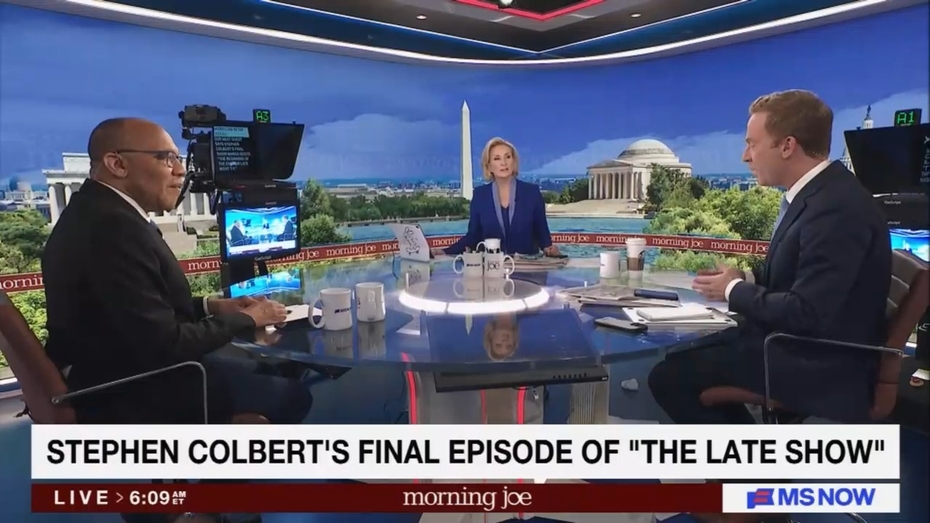
After playing a cringe-worthy portion of the final Late Show episode, Morning Joe hosts Mika Brzezinski, Jonathan Lemire, and Willie Geist, who were filling in for Joe Scarborough, welcomed author and historian Jon Meacham, columnist and former Washington Post associate editor Eugene Robinson, and Puck News journalist and podcaster Matthew Belloni on air to simp over Stephen Colbert.
“Stephen is an architect of the culture,” Meacham began the Colbert worship service that Morning Joe and many other mainstream outlets had devolved into after The Late Show officially ended. He compared Colbert to musician Paul McCartney, the special guest on the series finale, suggesting the show was “a hinge in the cultural life of the country and of the West,” because Colbert happened to tape from the same Ed Sullivan Theater that The Beatles played at in 1964.
Moreover, Meacham claimed that Colbert had an "enormous audience,” despite the fact that The Late Show was losing tens of millions of dollars every year and not getting enough views to justify the massive cost, which he ignored.
Despite the utter failure of Stephen Colbert and his show, Meacham still lamented his loss from the airwaves:
And here Colbert was as the capstone and one of the few things that could bring a lot of people together in this media climate, and I think we're going to miss him, miss his insight. And for those who say, 'Oh, he was too political, too partisan,' you know, always worry when they come for the comedians.
The liberal elitist media loves to harp on Colbert’s cancellation as an issue of politics and free speech. Immediately following Meacham’s remarks, Brzezinski suggested exactly that:
I mean, there is - this is amidst a backdrop that is a little bit depressing for members of the media and people who believe in free speech.
Robinson then touted Colbert as “such an amazing” and “talented man,” and The Late Show as “a touchstone in our cultural life,” before Lemire brought it back to politics:
Yeah, pretty - pretty ideal closer last night. And, yeah, Colbert didn't mention Trump by name, but of course, the Trump and the pressure on CBS and Paramount, you know, was noted throughout the week.
Of course, President Trump, though he criticized Colbert and other media figures, held no real power over CBS’s hosts, and the decision to terminate The Late Show was much more financial than political. Belloni acknowledged this point, but then continued to speculate about Trump’s involvement:
And yet, there is this kind of stink of politics that has been around this cancellation … Trump has gone after late night and Colbert in general. So the speculation is that, well, maybe there was some, the financial motivations were real. The politics of the situation had to at least play into the minds of the decision makers.
According to the panelists of Morning Joe, everything must be Trump’s fault, no matter the external circumstances.
The transcript is below. Click "expand" to read.
MS NOW's Morning Joe
May 22, 2026
6:06:20(...)
JONATHAN LEMIRE: You know, Jon Meacham, I know you know Stephen Colbert very well over the years. And there had been speculation, of course, that the Pope might be there, Colbert having fun with that. But the real hope, I think, from a lot of people was that maybe, just maybe, Paul McCartney would show up and bookend the Beatles 1964 Ed Sullivan Theater performances by closing things out for Stephen last night. And there he was, just extraordinary.
JON MEACHAM: Yeah, you know, it's - Stephen is an architect of the culture.
And it - and on reflection, of course, the theater itself is that. The '64 arrival at Ed Sullivan changed global culture in 1964. In some ways, it's a hinge in the cultural life of the country and of the West.
And what Colbert has done, beginning with his character, Stephen Colbert, and his attack on truthiness, and really kind of the prescient ability he had to see where so much of our public life was going back in his Comedy Central days. And then he brought that to this enormous audience - what passes, certainly, for an enormous audience in this atomized world. That's another thing to think about, is think of how many people had to tune in to Ed Sullivan in 1964, because there weren't that many other options.
And here Colbert was as the capstone and one of the few things that could bring a lot of people together in this media climate, and I think we're going to miss him, miss his insight. And for those who say, 'Oh, he was too political, too partisan,' you know, always worry when they come for the comedians.
MIKA BRZEZINSKI: Yeah, yeah, that's for sure. Eugene Robinson -
EUGENE ROBINSON: Yeah -
BRZEZINSKI: Your thoughts? I mean, there is - this is amidst a backdrop that is -
ROBINSON: Yeah -
BRZEZINSKI: - a little bit depressing for members of the media and people who believe in free speech.
ROBINSON: You know, yeah. It's, you know, I mean, nothing lasts forever. But Stephen Colbert was such an amazing, and such - he is such a talented man. I was on his Comedy Central show once, and we had a lovely conversation in the green room before. And at the end he said, 'Now when we go out there, I'm not me. I'm that character.' And we got on the show and he was just perfect as the -
BRZEZINSKI: Yeah.
ROBINSON: - you know, with all his truthiness.
And - now what a bookend, though, to have McCartney, anyone my age or older remembers that night in 1964 on that very stage when indeed the Beatles and, you know, Paul McCartney right there did change the culture. And it's a - it's a very different world, now. There's something comforting about that to me, actually. It's a touchstone in our cultural life and -
LEMIRE: Yeah, pretty - pretty ideal closer last night. And, yeah, Colbert didn't mention Trump by name, but of course, the Trump and the pressure on CBS and Paramount, you know, was noted throughout the week. Springsteen explicitly so a few days prior.
But as Colbert, it's not - he's extraordinarily talented, extraordinarily smart, a very decent man with a big heart. And that - that heart really filled last night, but the entire run of The Late Show, and I also think it is a safe bet; though this chapter closed, this is not the last we have seen of Stephen Colbert.
BRZEZINSKI: Yes, it'll be interesting -
LEMIRE: He will do many brilliant things going forward, mhm.
BRZEZINSKI: - It'll be interesting to see what he does with this. Our next guest says Stephen Colbert's final show marks 'The beginning of the end for late night TV.'
Let's bring in founding partner of Puck, Matthew Belloni. He's the author of Puck's flagship newsletter, 'What I'm Hearing,' and the host of the podcast The Town. He's also the former editor of The Hollywood Reporter.
So, let's exercise our free speech and talk about what really is going on here: why he's leaving, what this is the backdrop of, what's coming in its place, and what this does mean for late night television? Matthew.
MATTHEW BELLONI: Well, that's a lot there. And the fact of the matter is - is that The Late Show was losing money. I mean, according to my reporting, it was tens of millions of dollars that the show was losing each year. And yet, there is this kind of stink of politics that has been around this cancellation.
The move was made by the former owner of CBS. However, it was right as the sale to the Ellison family was going on, and obviously the Trump administration was very involved in that. They had been saying that they don't like the content on CBS, particularly, Trump has gone after late night and Colbert in general. So the speculation is that, well, maybe there was some, the financial motivations were real. The politics of the situation had to at least play into the minds of the decision makers.
And yet they gave him a year, they gave him an entire season of the show to go out on this run, and to have people like Springsteen on the show, to essentially bash the ownership on their own network. And I think that says something about the owners that they, yes, maybe they were doing this to appease Trump, but at least they kind of let him go out saying what he wanted to say.
WILLIE GEIST: And we're - remind people of the timeline. They announced in July that Stephen's show had been canceled, and one week later to the day, that deal was approved for Paramount Skydance.
So, Matthew, your piece, you say this is the beginning of the end of late night TV. Obviously, Jimmy Kimmel has come under withering fire almost weekly, it seems, from President Trump. He's been suspended and come back to his job, there were calls a couple of weeks ago after the Correspondents' Dinner for him to be fired. He has not been.
So where do you see late night comedy going from here? It's been an institution going back to, you know, Jack Paar in this country.
BELLONI: Yeah, I think that these current hosts, both Kimmel and Fallon and Meyers at CBS or at NBC, I think they will be the last to host these shows.
The economics of late night TV are just not there. The audience is not tuning in. They are on streaming platforms. They are on their phones. The habit of watching these late night shows after the local news is not there.
And, at least at CBS, they had not figured out the model to make money on the clips and the YouTube shows. They were making some, and Kimmel and Fallon make a lot more money on the digital application of those shows than CBS did. So I think that saves them for a little bit longer, especially now with Kimmel, that Trump has gone after him explicitly. Disney, which owns ABC, has now decided to fight the FCC on this.
And this is a big deal, because they could have just bowed to Trump and said, 'okay, we'll take Kimmel off the air.' And they're not doing that. They suspended him in the fall for a couple nights around that Charlie Kirk joke that he made. But ultimately, the backlash was so swift, they brought him back and they figured out a way to deal with the station groups that air the show. But I do think that given the economics of late night, these hosts will be the last late night hosts.
BRZEZINSKI: Founding partner of Puck, Matthew Belloni, thank you. We know it is an extremely early morning for you out on the West Coast, thank you so much for waking up for us.