Research analyst Bill D’Agostino compiled the following package using video from the MRC’s archive, showing the evolution of the scandal and the liberal media’s reaction to each new revelation:

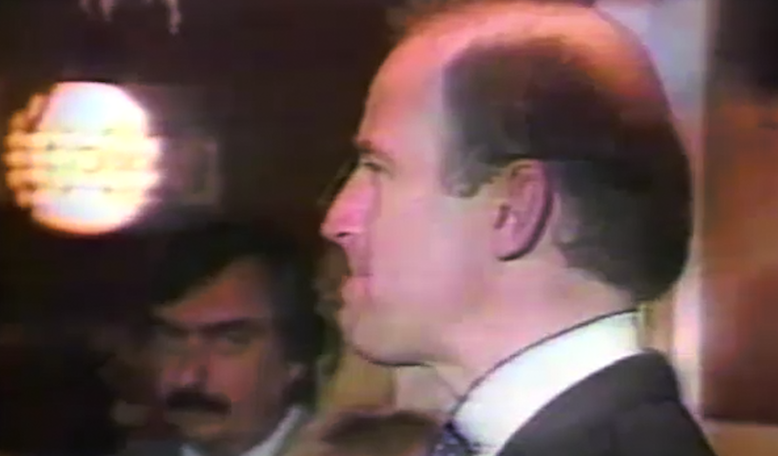
As NBC political reporter Ken Bode pointed out in his initial report on September 12, 1987, “the problem here is that Senator Biden told his audience he’d just been thinking about these things” on the car ride to the Iowa state fair, “and failed to give any credit at all to his famous British speechwriter.”
Within days, reporters had found examples of Biden using the words of other famous orators without credit, including a word-for-word lifting of a 1968 speech by Robert F. Kennedy about how the Gross National Product doesn’t “measure the health of our children, the quality of their education, or the joy of their play.”
Then reporters found out Biden had committed plagiarism in law school, “for lifting without citation five pages from a published law review,” as the Washington Post’s Paul Taylor explained in a September 18, 1987 article. At a press conference, Biden admitted to having “done some dumb things,” adding, “I’ll do dumb things again.”
But none of it was true. As ABC’s Jed Duvall reported on the September 22 edition of Good Morning America, “Biden now concedes he did not graduate in the top half of his law school class, that he does not have three degrees from college, and that he was not named outstanding political science student in college.”
That same morning on CBS, anchor Forrest Sawyer relayed that the then-44-year-old Biden “says his memory had failed him.”
The next day, Biden’s 1988 campaign was over. While his staffers complained about the unnamed rival who had first sent the Kinnock material to the media (it turned out to be Michael Dukakis’s campaign manager, John Sasso, who was subsequently fired), Iowa political reporter David Yepsen told the CBS Evening News: “Look, this is politics, these are campaigns. And when you say sabotage, Joe Biden was victimized by the truth.”
During the 12 days in which this scandal news unfolded, the liberal media’s take on Biden was devastating. On The McLaughlin Group, liberal Washington Post columnist Richard Cohen said Biden’s reputation was of someone “who doesn’t think on the run, is too glib, doesn’t think before he talks, and that’s exactly how this makes him look.”

The American Enterprise Institute’s resident political pundit William Schneider declared Biden’s use of Kinnock’s life story a “stupid thing” on ABC’s Nightline on September 17, while the next morning’s New York Times quoted Schneider dismissing Biden’s intellectual habits as “lazy, undisciplined and sloppy.”
On the September 18 Good Morning America, ABC correspondent Jeff Greenfield (a former Robert Kennedy speechwriter) said Biden’s plagiarism of other politicians “suggests there is a kind of emptiness that you will fill with whatever sounds good.” On the same show, PBS commentator David Gergen suggested “voters are going to have to decide whether he was dishonest or dumb.”
Two days later on ABC’s This Week, Boston Globe columnist Ellen Goodman whimsically observed Biden has “always been somebody who fell in love with the sound of what we thought were his own words.”
Writing in the October 5 edition of Newsweek magazine after Biden had ended his campaign, Jonathan Alter and Howard Fineman assessed that “what made these cumulative disclosures reverberate so loudly inside the campaign wind cave is that they seemed to confirm an existing echo — Biden as a superficial lightweight.”
In a soundbite for the September 23 CBS Evening News, Time magazine’s William Henry opined that candidates who “are going to do things that are stupid as well as immoral...then they’re probably too dumb to have the job of President.”
+++++
So far, Biden’s 1987 scandals have been a non-factor in media coverage of his current race for the White House. Neither ABC nor NBC has even mentioned the plagiarism story on their evening newscasts, while CBS correspondent Ed O’Keefe gave it a mere four seconds on the March 7 Evening News. Yet other elements of Biden’s distant history, such as his handling of the 1991 Clarence Thomas hearings, received significant airtime (nearly nine minutes) on the evening news this year.
But our review shows that when the multiple plagiarism accusations first appeared 32 years ago, liberal journalists treated them as Joe Biden’s first big test of character on the national stage — and, in their eyes, he flunked.