Right at the top of the incoming Democrats' agenda is the abolishment of the Electoral College. Of course, to abolish it via constitutional amendment is pretty much impossible so the Democrats are planning to bypass it by basically rendering it moot, via the National Popular Vote Interstate Compact scheme. However, according to CNN's senior legal analyst, Elie Honig, that compact would also have a near impossible chance of succeeding.
Honig, almost certain to soon endure Democrat wrath for laying out the hard legal facts, revealed in Tuesday's New York magazine why such a compact of states plan probably will go nowhere as you can see in "Democrats’ Real But Risky Path Around the Electoral College."
The Electoral College was embedded in the Constitution from the start, of course, and there’s always been a straightforward method to change it: the amendment process. But barring a new constitutional convention, an amendment would require approval by two-thirds of the House, two-thirds of the Senate, and three-fourths of the states (38 of 50). That hasn’t happened since 1992 (even then it was on the piddling issue of congressional pay raises), it’s not happening now, and it feels like it might never happen again.
Okay, so according to Honig (and almost everybody else) the chance of abolishing the Electoral College via constitutional amendment ranges somewhere between nil and none. Now on to Plan B which Honig also tosses very cold water upon.
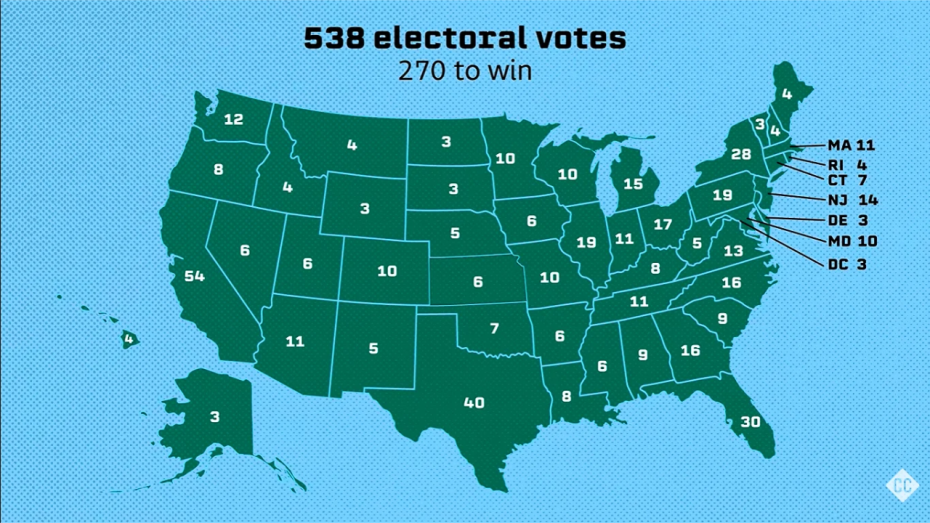
...a group of left-leaning states developed a creative workaround: the National Popular Vote Interstate Compact. The idea is that states will pledge to allocate all of their electoral votes to whichever candidate wins the national popular vote, regardless of the vote within each individual state. The compact becomes effective only when enough states join to reach the 270 electoral-vote threshold necessary to win the presidency. Ultimately, if enough states sign on, the winner of the national popular vote will be guaranteed to win the Electoral College and the presidency.
...Despite growth over the past two decades, the coalition has never quite reached the 270-vote threshold. But suddenly, after the midterms, the target number is within range. Democrats soon will take control of the governorship and both legislative chambers in five new states: Arizona, Michigan, Nevada, Pennsylvania, and Wisconsin. If all five were to join, the compact would reach 283 total electoral votes. The compact would still exceed 270 electoral votes even if one of Arizona, Nevada, or Wisconsin did not join.
But the ultimate success of the compact will be trickier than the raw math. First, it’s far from certain that the newly all-blue states will sign on. Shapiro has voiced enthusiastic support in Pennsylvania, but other Democratic governors, governors-elect, and legislative leaders in Arizona, Nevada, and Wisconsin have conspicuously dodged when asked for their positions on the compact.
...Further complicating matters, states that have already entered the agreement might try to leave. The Maine House of Representatives voted to leave the compact in 2025, though the withdrawal effort ultimately failed. And in 2022, grassroots activists unsuccessfully tried to advance a ballot initiative that would have pulled Washington out of the compact. Questions also remain about how long a state’s initial agreement can last. For example, Illinois joined the compact in 2008 with the final signature affixed by then-governor Rod Blagojevich — who, in the generation since, has been impeached, indicted, convicted, imprisoned, and pardoned. How long does a state’s agreement to join the compact last? Eighteen years (and counting)? Forever?
Honig then proceeded to list a whole host of additional legal issues for the Democrats to overcome. Finally comes the sad summary of the nightmare involved in attempting to bypass the Constitution on this issue:
All told, the odds are stacked against the compact. Its proponents ultimately will succeed only if they overcome every obstacle. Four of the five newly all-Democratic states must join the compact; no other states can drop out; the original agreements of all signatory states must be deemed continuous and ongoing even if they were made decades ago; and the compact must prevail over every legal objection, including compact-, equal-protection-, and electors-clause challenges.
This will not make Democrats and liberals happy but they now have a ready scapegoat to blame for the crime of just analyzing this issue. Sorry, Elie.