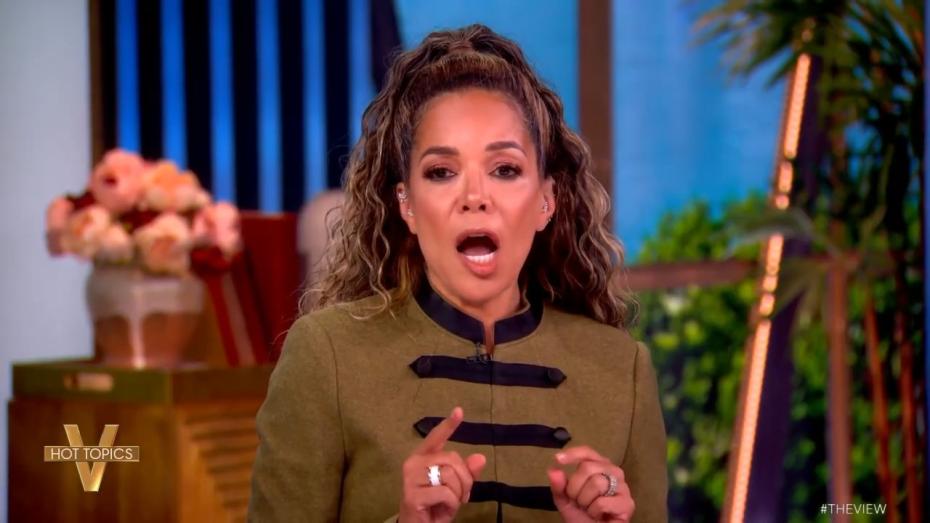
Over their hiatus, it was announced that The View co-host Sunny Hostin has sold her likeness and the rights to smut books to be produced into a series of movies by a film company that utilizes A.I. On Friday’s episode, the ABC News co-host defended her actions by claiming Hollywood was “gatekeeping” her because they were racist, and suggested that black and brown people were not being hired for projects. However, her co-hosts pointed out the hypocrisy that by using fake people in her adaptations, she was keeping those same black and brown people from getting work.
“I've written a trilogy, and for six years, I've tried to get my films or my stories made into series and films. And the gatekeeping in Hollywood around black and brown, creative content is insane,” she whined. “I cannot get New York Times best-selling books onto the screen to tell diverse stories to diverse communities.”
That’s right Sunny, Hollywood is not adapting your books because they’re discriminating against you, the multimillionaire TV personality. It couldn’t possibly be because your smut books are bad and your sales are buoyed by your TV stardom.
“With A.I. that cuts out the gatekeeping. You get to make your film,” Hostin boasted. “It's a way, I think, to get black and brown stories told. There are a lot of hidden figures out there.”
Sunny Hostin claims she had to partner with an AI company to turn her smut books in movies and not a real studio because of racism and "gatekeeping," not because her books are bad. She also claims black and brown actors are "not getting the jobs" in Hollywood:
"I recently… pic.twitter.com/OyjE4CXcEk— Nicholas Fondacaro (@NickFondacaro) September 14, 2026
Hostin referencing herself as one of the “hidden figures out there” seemed to be her lumping herself in with Katherine Johnson, Dorothy Vaughan, and Mary Jackson, the black female NASA scientists featured in the movie Hidden Figures, which suggested whites didn’t want them known to history.
Hostin’s race baiting got worse amid push back from her fellow co-hosts. Her argument shifted to asserting that black and brown people where just not being hired for jobs in Hollywood:
HOSTIN: And those stories are not being told.
BEHAR: But if those people are, in fact, robots, how does that help the real -
HOSTIN: They're not robots. They're A.I. images.
BEHAR: - black community? The real people are not working!
HOSTIN: Because the stories are not being told, Joy. Because the real people are not getting jobs in Hollywood. Black and brown actors are not getting the jobs.
BEHAR: Well, this makes sure they never will.
HOSITN: They’re not getting the jobs.
Token Republican co-host Alyssa Farah Griffin was okay with Hostin selling her likeness, but was concerned she was “closing the doors to those roles being played by black and brown actors.” “That would be great if the studios would not gatekeep and allow the stories to be told,” Hostin shot back.
Alyssa Farah Griffin points out that by using AI, Hostin herself is keeping black and brown actors from having those rolls. Hostin still blames the racism of the studios:
FARAH GRIFFIN: But I worry that you're closing the - two things. I worry you're closing the doors to those… pic.twitter.com/nuXT8WIAHO— Nicholas Fondacaro (@NickFondacaro) September 14, 2026
Co-host Joy Behar was the most fervent in her opposition to Hostin’s A.I. gambit. A longtime member of the Screen Actors Guild, Behar was deeply concerned about Hostin contributing to actors losing their jobs. Hostin insisted all of Hollywood was against her and black people:
HOSTIN: Well, I don't need the project, I think that diverse stories need to be told, like the story-
BEHAR: I get that Sunny, but we've said that already, but I'm saying that those same people that you're worried about are now out of work.
HOSTIN: Yes, but I'm not the person putting them out of work, because the studios just won't make these projects, Joy.
BEHAR: Well, force them to do it rather than have a robot replace black people in movies.
As The View cast continued to push back against Hostin for not giving acting jobs to real black and brown people, Hostin claims Hollywood is refusing to back movies about black and brown people:
ANA NAVARRO: Did you feel any ethical issues in signing that?
HOSTIN: I thought… pic.twitter.com/EcI0D9xLcx— Nicholas Fondacaro (@NickFondacaro) September 14, 2026
Of course, Hostin’s argument wasn’t factual. The movie she seemed to referenced was proof of that. The View had promoted the movie, as well as the Black Panther Marvel movies. Black actor Michael B. Jordan is beloved and has had leading roles in the Creed series and Sinners. Comedian Jordan Peele had also become a critically acclaimed director and writer in his own right with films such as Get Out, Us, and Nope.
Director Taylor Perry had even created his own movie studio for projects by black creators. It’s unclear if Hostin pitched it to them, but if she did and they passed, it blows up her cries of racism.
Hostin likes to be a perpetual victim, it’s virtuous.
The transcript is below. Click "expand" to read:
ABC’s The View
September 11, 2026(…)
SUNNY HOSTIN: I think it can be considered a new art from. I recently partnered with a company called Fountain Zero who had an AI movie released at the Tribeca Film Festival. It's the first time that that was done.
And one of the reasons I partnered with this company is because I've written a trilogy, and for six years, I've tried to get my films or my stories made into series and films. And the gatekeeping in Hollywood around black and brown, creative content is insane!
I cannot get New York Times best-selling books onto the screen to tell diverse stories to diverse communities.
JOY BEHAR: So, what does that have to do with A.I.?
HOSTIN: With A.I. that cuts out the gatekeeping. You get to make your film. You get to have a director -
ALYSSA FARAH GRIFFIN: Do they have actors in it though?
HOSTIN: No, they're generated. I’ve licensed - I've licensed my image. And so I may appear ‘Where’s Waldo’ somewhere in it.
BEHAR: Wait, wait, you're a robot now?
[Laughter]
HOSTIN: I may - my - my - I may appear. But in all seriousness, it's a way to go then to a streamer and say, ‘here's the product. Will you license it? Will you show it?’ It's a way, I think, to get black and brown stories told. There are a lot of hidden figures out there.
[Crosstalk]
HOSTIN: And those stories are not being told.
BEHAR: But if those people are, in fact, robots, how does that help the real -
HOSTIN: They're not robots. They're A.I. images.
BEHAR: - black community?
FARA GRIFFIN: I would say I would--
BEHAR: The real people are not working!
HOSTIN: Because the stories are not being told, Joy. Because the real people are not getting jobs in Hollywood. Black and brown actors are not getting the jobs.
BEHAR: Well, this makes sure they never will.
HOSITN: They’re not getting the jobs.
FARAH GRIFFIN: Yea. See, I half agree with you, and then I half strongly disagree. I think - Well, I wouldn't do it. I support where you did with licensing your likeness. Because you have the right to do that -
HOSTIN: And my IP.
FARAH GRIFFIN: - it’s your IP. And that's your--
HOSITN: And also my IP.
FARAH GRIFFIN: But I worry that you're closing the - two things. I worry you're closing the doors to those roles being played by black and brown actors.
[Crosstalk]
HOSITN: That would be great if the studios would not gatekeep and allow the stories to be told!
FARAH GRIFFIN: And it's a fair point, but also consider this. An A.I. actor is pulling from intellectual property of all the existing actors out there.
Do a comedy part. I'm pulling a little bit of Whoopi Goldberg, a little bit of Joy Behar, a little bit of Gwyneth Paltrow, whoever. That's how they build A.I. It's from existing knowledge and intellectual property.
BEHAR: But we're still here, and why can't we just do it?
FARAH GRIFFIN: And we don't get any-- you don't get any residuals for it.
HOSTIN: And Hollywood doesn't gate keep you out of it. That’s the issue.
BEHAR: So, wait. When I leave this show, can we have an A.I. version of me?
HOSITN: Yes.
FARAH GRIFFIN: An avatar of you.
BRIAN TETA: Been working on it for years, Joy.
BEHAR: What?
TETA: I've been working out of for years. Don't worry, I'm ready.
FARAH GRIFFIN: Be careful what you wish for it's cheaper than we are.
(…)
ANA NAVARRO: Did you feel any ethical issues in signing that?
HOSTIN: I thought about it a lot, and I--
JOY BEHAR: But she needs the project.
HOSTIN: Well, I don't need the project, I think that diverse stories need to be told, like the story-
BEHAR: I get that Sunny, but we've said that already, but I'm saying that those same people that you're worried about are now out of work.
HOSTIN: Yes, but I'm not the person putting them out of work, because the studios just won't make these projects, Joy.
BEHAR: Well, force them to do it rather than have a robot replace black people in movies.
(…)
HOSTIN: I don't think it's ever going to take away the arts. I think it's a different art form.
BEHAR: Okay. This is me, this is not an A.I. version of me, and this person is saying, "We'll be right back."